Foreshadowing the City [a photo sermon]


philly-traffic-skyline-sunset

For those new to  the blog: occasionally, I try and write a “photo sermon” based on the themes of WordPress’ Weekly Photo Challenge. This week’s theme is “Foreshadow“.

* * * * *

Foreshadowing is a huge part of the Christian faith. The opening words of the Bible offer us the problem that the rest of the book will explore a solution to. It says, “In the beginning, God created the heavens and the earth.” From the beginning, “heaven” and “earth” are two different things, in two different “places”. God intends to bring them together and make them one. How will he do it? The book invites us to read on.
Continue reading

Millennials, Media, & Meta-Churching


coffee-client-mugFor those of you out there that keep track of the “Christian blogosphere” (and if you don’t, you’re probably better for it), there’s a very weird discussion happening amongst many different writers and thinkers about “millennials” (those born from the early 80s to early 2000s), and how they relate to the church.

A couple of weeks ago Rachel Held Evans wrote a post for CNN’s religion blog in which she said that millennials are leaving the church because they don’t find substance there; but rather, all they seem to find are hypocritical, judgmental, and bigoted people that want to fight over silly things. She said that this desire for substance is why the millennials that do stay in the church are leaning towards more liturgical traditions. She encouraged church leaders to look at millennials and consider whether their departure might be speaking to systemic issues that are plaguing the American evangelical church.

Continue reading

“Simplistic Atheism: a final response” by Daniel Bastian [GUEST POST]


de Goya-fight with cudgels"

(Note: These exchanges are now complete. There is a Table of Contents to the discussion now available.)

Well, it seems that we were not in fact done with this little series. After my final post, Daniel chose to take me up on my offer to have the final word (as I normally try to do in exchanges like this). He has chosen to respond, point-by-point, to my list of what things would lead me to embrace Atheism. If you feel like any of the points still demand a reply from me, or if you have any questions about what Daniel says, feel free to to comment here, on Facebook, or get in touch with me privately. For my part, though, I consider this particular set of exchanges finished. Once again, I thank Daniel for this exchange. I hope you enjoyed it as well.

Paul,

When I initially decided to compile a list of criteria that would convince me my conclusion on the question of theism was wrong, I had sincere hope that a Christian, Muslim or other person of faith would tally up a corresponding register. I am glad to see you rose to the challenge and enrolled in this dialogue. It has been a wonderfully enlightening experience for me, and I do hope that sentiment is mutual.

I read your piece the day it was posted and while at first I found much of it persuasive, the more I reflected the more I realized it was probably the list I would have drafted two years ago, before I renounced my faith. Much of your criteria seems to rest firmly on the aesthetic appeal of the Christian narrative. And this would seem to slot right in line with your epistemological moorings-a concern for the communal connection, compelling force and overall mesmerism of a worldview over against its underlying facticity.

Yet it seems this only holds true up to a certain threshold, given a few of the items on your list. You seem to be OK with affirming the faith given its impact on your life, the power of influence you’ve seen it have on history, and the way it has shaped others with which you’ve crossed paths. But if you were to discover beyond reasonable doubt that this narrative was based on so much myth, that this loosely corroborated Yeshua the gospels are based on was a mere mortal (item #1), you would relinquish the faith forthwith.

Thus it seems to me that our epistemic divergence is one of degree, not of type. With that in mind, I’ll attach some brief notes beside the items in your list. Continue reading

Humbled into Pride (thanks & sorry) {a confession}


paul-pipe-bwLast week was an odd week on the blog. It was one that humbled me in such profound ways. The readers of this blog shocked and amazed me with their kindness, encouragement, and continued support of what I try to do here.

My series of discussions with my Atheist friend concluded on (what I felt was) a high note. The number of readers of that series numbered into the thousands, even though the writings were so long. (I copied and pasted all the posts into a single Word document just for the heck of it, and it was over 100 pages long–single-spaced! So if you read most of those, then congratulations, you finished a book in a week-and-a-half.)

People in all parts of my life were reading (at least some of) these pieces. People at work, church, Facebook, and Twitter all sought me out to encourage me in these conversations. The diversity of people who were keeping track of this stunned me and humbled me. I couldn’t believe how many people would spend their time reading stuff I wrote and listening to my own thoughts and opinions about things.
Continue reading

The Historical, Political & Theological Roots of Urban Pain


26359563536I’m trying to get an early start on reading my seminary books (which I’m still trying to purchase–thank you so much to all who have helped out!). I’m currently enjoying Mark Gornik’s To Live in Peace: Biblical Faith & the Changing Inner City. I’ve read similar books before, and expected more of the same, but this really is a much higher level-analysis of urban policy than I thought it would be. He is writing from the context of the inner city community of Sandtown, in West Baltimore. I’m really liking it and encourage you to check it out yourself.

I wanted to devote my entire post today to a series of excerpts from his section going through the historical and theological roots of urban and racial difficulties. In light of recent comments–especially by conservatives–demonizing those who live at this level and at these places in the world (or demonizing the government policies that serve them), I found this appropriate in offering us some perspective.

On a side note, for newer readers: I do not ascribe to a particular party and I actively speak out against both of the main ones wherever I see injustice, hypocrisy, and absurdity. This just happens to be an area of policy where Republicans are far more guilty. Here are the excerpts (the bold-faced lines are my emphases). Continue reading

Abstinence is Not Chaste (Exercise Your Celibacy!)


Sandorfi-AngeYeah, I’ll admit it. I belong to that ever-decreasing group that thinks that our human sexuality is a big enough deal that how we exercise it has profound implications for human, societal, and spiritual flourishing. Further, I believe God has woven in the design of the world particular rhythms and ways in which sexuality lends itself to that flourishing. I see it as something so integral to our souls and bodies that there is a type of care and stewardship that we are lovingly called to exercise with it. And sometimes “stewardship” means placing limits on oneself.

I’ve talked about what this stewardship looks like in various other contexts, but for the purpose of this post, I’m focusing on one in particular. My focus today–to put it plainly–is on the idea that people who aren’t married aren’t “supposed” to have sex.

This isn’t a systematic defense of that idea. I know there are lots of differences of opinions and nuances (even among Christians) on this. I know that we talk about this in the abstract in one way, and when we get to particular people and situations, these “clear” ideas break-down quickly. I get that. But just walk with me for a little bit.
Continue reading

A Christian & An Atheist: A Discussion [a table of contents]


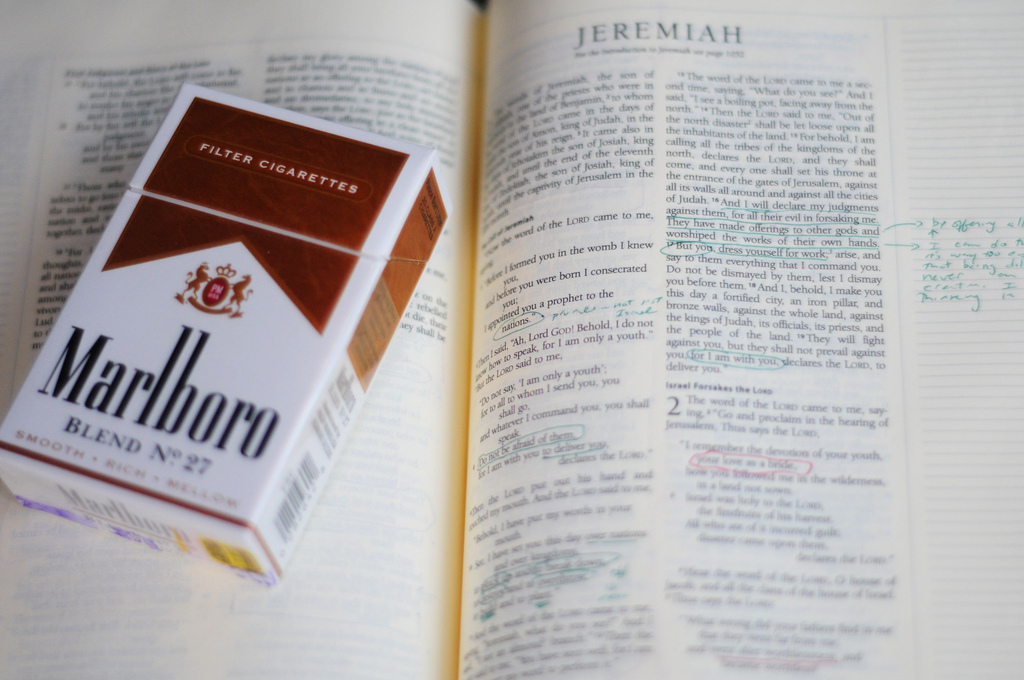
Schrott-Cigarettes-Bible-Jeremiah

I had the privilege over the past couple of weeks of engaging in a spirited back-and-forth with a good friend of mine, Daniel Bastian. Unfortunately, in the speed with which this exchange occurred, I know it was hard for people to keep track of the writings, the arguments, and the comments. And so, I’m writing this post in hopes of making it easier for people to follow. Here you will find a “Table of Contents” of sorts for the entire exchange, as it appeared on this blog.

Sadly, much was said over Facebook comments (and even blog comments) that cannot be sorted out and highlighted in their proper place. Comments on each post were scattered among different places and sites and posts, and so to try and consolidate them and make any sense of them for the reader would be nearly impossible. These long-form pieces will have to do, though I’ve provided the link to the Facebook comments when able, in case the interested reader wants to wade in.

____________________
Continue reading

Simplistic Atheism {4}: What could make me an Atheist?


paul-schrott-painting-11-11

(Note: These exchanges are now complete. There is a Table of Contents to the discussion now available.)

In this series of exchanges with my friend Daniel, I’ve tried to argue that his Facebook post on why he is an Atheist expressed an overall view of the world that is too small and too simplistic. I think this is because of his empiricist method and materialist conclusion about reality–that all there is is what we can see, touch, feel, etc.

Some concluding remarks

My whole point has not simply been that Daniel’s facts or even his method is wrong. But rather, it finds its proper place, meaning, fullness, and possibility within the Christian view of reality. I have argued in each of my posts that Christianity does not “refute” reason, science, history, skepticism, textual messiness, historical difficulty, or even doubt. Instead, the Gospel encompasses it all, and each of those things find a greater fulfillment in their use, cohesion in the whole of the world, and reality within that place.

Continue reading

New Testament & History: Christians can be confident [a retort]


bible-schrott-coffee-paul

(Note: These exchanges are now complete. There is a Table of Contents to the discussion now available.)

Update: Daniel has posted a reply below.

When I have these kinds of exchanges on the blog, I really try to let the other person have the last word. After all, I have home field advantage here. I was absolutely ready to move on to my last part of this ongoing exchange with my friend Daniel Bastian in response to his Facebook post about his Atheism.

Last week, I wrote a post trying to give a cursory response to some of his claims about the Bible and miracles. Daniel wrote a response, posted a couple of days ago. I offered a brief response to his critique of my view of miracles. I was really eager to get back to writing about other things.

But it seems I can’t. Not yet.

I’m starting seminary back up this Fall, not simply because I’m interested in all the “knowledge” about the Bible, but because I feel I actually have a (pastoral?) concern for the spiritual well-being of people. I care a lot about what people might see on this blog, and I care that they are able to receive these things in ways that will be ultimately helpful to them.

And I fear that his post, at least for Christians not well-read in these issues, will cloud the waters more than clear them. Don’t get me wrong. Christians should wrestle with what Daniel has written in earlier posts, especially when it comes to the more abstract philosophical concerns of God’s existence and work in this world. These are things that don’t have easy or even clear responses by Christians. I’m not worried about Christians having restless nights or days as they wrestle with legitimate difficulties in the seeming difference between what they believe about God and the way the world seems to be.

But, when it comes to the Bible and the Resurrection, I don’t think we are on as shaky ground as Daniel makes it seem. Let’s discuss.

Continue reading

“The Cocoon of Unfalsifiability” by Daniel Bastian [GUEST POST]


stone-light-hallway-cave(Note: These exchanges are now complete. There is a Table of Contents to the discussion now available.)

Paul,

I thoroughly enjoyed reading your most recent piece. It’s the best one yet in the series. You actually (finally) lay down some things we can really sink our teeth into. Something tells me you should have started with this one…

However, after the opening paragraphs my hopes were dashed as I found that much of the rhetoric here is beset by the same pitfalls that have been addressed time and again. Most importantly, (and what I will focus on in my response), is that the above piece suffers from what I will call the doctrine of unfalsifiability.

Continue reading

Simplistic Atheism {2}: Science “versus” Theology


darwin-buddy-jesus-humor

(Note: These exchanges are now complete. There is a Table of Contents to the discussion now available.)

I’m doing a little series this week responding to a Facebook post by a friend of mine named Daniel Bastian. He outlined twenty things that would make him change his mind about Atheism. The piece is well-organized and thought out, I encourage everyone to read it and wrestle through it themselves.

In line with my belief that these sorts of discussions always seem to end up at differences in hermeneutics (interpretive filters) rather than facts, I wrote a post talking about what appeared to be Daniel’s bigger commitments and understandings of the world, human reason, and assumptions about spirituality (also read the Facebook comments).

I was, of course, accused of still not engaging with his specific points, even as I sought to talk about principles behind the points. And so, I’m excited to say that with today and tomorrow, we will be hitting many of Daniel’s specific points
Continue reading

Simplistic Christianity; Simplistic Atheist: a response [GUEST POST]


(Note: These exchanges are now complete. There is a Table of Contents to the discussion now available.)

Earlier today, I posted an introductory post in response to a Facebook note by my friend Daniel. Before I posted it, I had a few friends read the post to see if they thought it would be taken especially personally and shut down, rather than promote, further conversation. They said that it was on the line, but they didn’t think it was too personal. Unfortunately, it seems I (we) were wrong.

Daniel responded in a comment, but I thought it deserved a more prominent place on the blog. I’ve included his response below, and included some brief words of clarification to his points.

__________________________________

Paul,

While I do appreciate your taking the time to respond, I don’t appreciate the flagrant misrepresentation. The religious opinion and intellectual caliber you ascribe to me in this piece in no way reflect my actual disposition and are so off-piste that I quickly lost track of whether you were talking about me or some nondescript internet denizen with which you have passing familiarity.

To set the record straight, you do not know me personally, and you clearly know even less about my views of religion and the serious, contemplative academic respect for and to detail to which I approach the topic. If you have a question about my views on an issue, ask me. Ask me. Don’t implant your own thoughts onto my character and radiate them in a public post. It’s unprofessional and ventures headlong into character intrusion.

To avoid further blatantly misinformed opinion from surfacing, I have tremendous respect for people of any and all religious persuasion, though I may depart from them on the metaphysics of their beliefs. I am under no delusion that theism, and Christian theism, can be dismissively fit into a box rather than a broad spectrum of nuance and theological nicety. Fundamentalism is *not* the truest articulation of Christianity and in fact is the most injurious strain of Christianity in its long history. There *are* legitimate theistic views to be voiced and I can entertain and respect those voices without affirming them for myself. I do so regularly and incorporate many of these voices in both my reading list and my book reviews on various websites.
Continue reading

Simplistic Christianity leads to Simplistic Atheism: it’s our fault


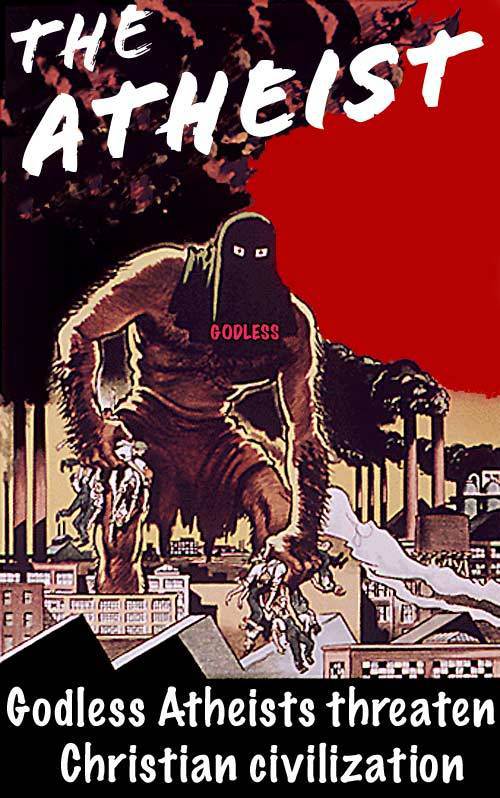
Atheist-monster-poster(Note: These exchanges are now complete. There is a Table of Contents to the discussion now available.)

“I walk outside my house, I look around, and it doesn’t seem apparent to me that there is a God. I just don’t feel it. It doesn’t seem to be the natural conclusion of reality when I live life and look around. I see the world, and the existence of God doesn’t feel like a natural conclusion one could draw.”

I stare down into my coffee, catching the corner of my pastor’s glasses in the dark reflection.

“Well”, he says, “I know it doesn’t fix how you feel, but in the grand scope of human history, and even the global humanity living today, that opinion you just expressed is in the extreme, extreme minority. Most people living in the past and now have found looked at the world and have not been able to come to any conclusion other than their being a God.”

Crap. He was right. What I thought was such an objective engagement with the world around me, was (of course) still the product of the cultural forces from which I drink deeply. History and developmental psychology have shown us that religiousness is the default mode of the human heart.

We are by nature religious. It takes other, external forces to push back against that and move us away from it. And this fact is no apologetic for religion. It’s neither a point “for” or “against” religion. We are also by nature selfish and willing to do whatever it takes to be the fittest and survive. We try not to give into this natural drive and through education and conditioning try to move away from it.

Continue reading

How the NSA can impact our souls. [QUOTE]


Persons of faith should be deeply concerned about the current surveillance flap not because privacy is an absolute end in itself but rather because it points to and safeguards something else even more basic and fundamental, namely, human dignity. According to Vatican II’s Declaration on Religious Freedom, Dignitatis Humanae, real dignity requires that human beings “should act on their own judgment, enjoying and making use of a responsible freedom, not driven by coercion but motivated by sense of duty.” Such responsible freedom is the basis for both the establishment of friendships and the maintenance of family [and social] life. Without the possibility of non-coercive self-disclosure, which is vitiated by unfettered intrusion, such relationships are fatuous.

— Timothy George, “American Stasi? What’s Wrong with NSA Surveillance?” via First Things’ On the Square blog

Just a friendly reminder that “Americanism” is a heresy. Even today. (Happy 4th!)


paul-young-america-flagI’m really not trying to ruin anyone’s party. I promise. But I just wanted to remind everyone that in 1899 Pope Leo XIII declared “Americanism” a heresy in the Catholic Church.

(I have provided this picture of this post’s author in order to help soothe any anger over this reminder.)

Basically, in the middle of the 19th-century, there was a huge influx of Catholics into America from Europe. Being so far away from the “home base” of European Catholicism, these Catholic leaders started “softening” Catholicism in order to make it more palatable to the new context they found themselves in.

Continue reading