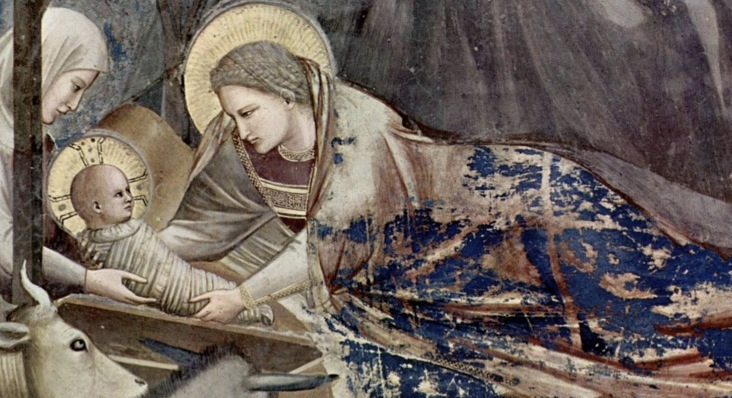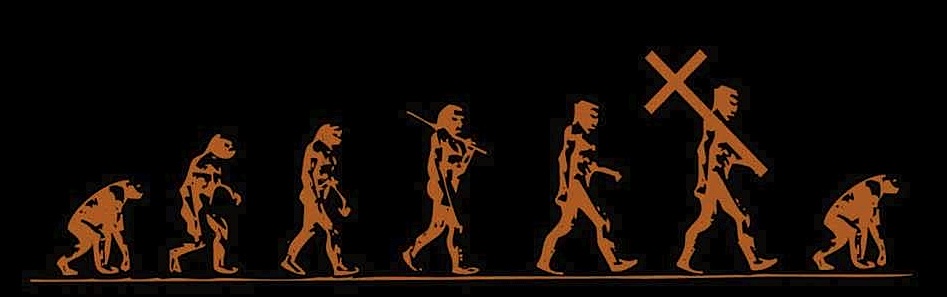
Advent, Evolution, & Absolution [RE-POST]


Today, I’m re-posting a piece I wrote exactly a year ago for last year‘s Advent series. During this year‘s, we’re seeing how the Advent event affects parts of our lives that we usually don’t associate with it. Today, it’s Advent and Evolution. You can follow the series here.

It’s Advent. A time where we especially orient ourselves towards rejoicing and celebrating the fact that God did not remain far off and merely create a “legal” or “dogmatic” satisfaction for the plight of his creation and creatures. Rather, he broke into it and came into his creation and among his creatures. In this year’s Advent series, we’re exploring how, in this Coming, Jesus took on our creaturely formcare-taking functioncomprehensive fallenness, and communal formation.

First, God took physical, human, creaturely form. In the study I did–and subsequent lecture I gave–on Beauty a couple of years ago, I defined “Beauty” as the attribute of something that expressed complexity simply. Is not this God-in-human-flesh (theologically referred to as the Incarnation) the most beautiful of all miracles to take place? The Infinitely Complex God inhabits the simplest of human forms: a child.
Continue Reading –>

Advent & Mary: Ordained as Prophetess, Priestess, & Queen


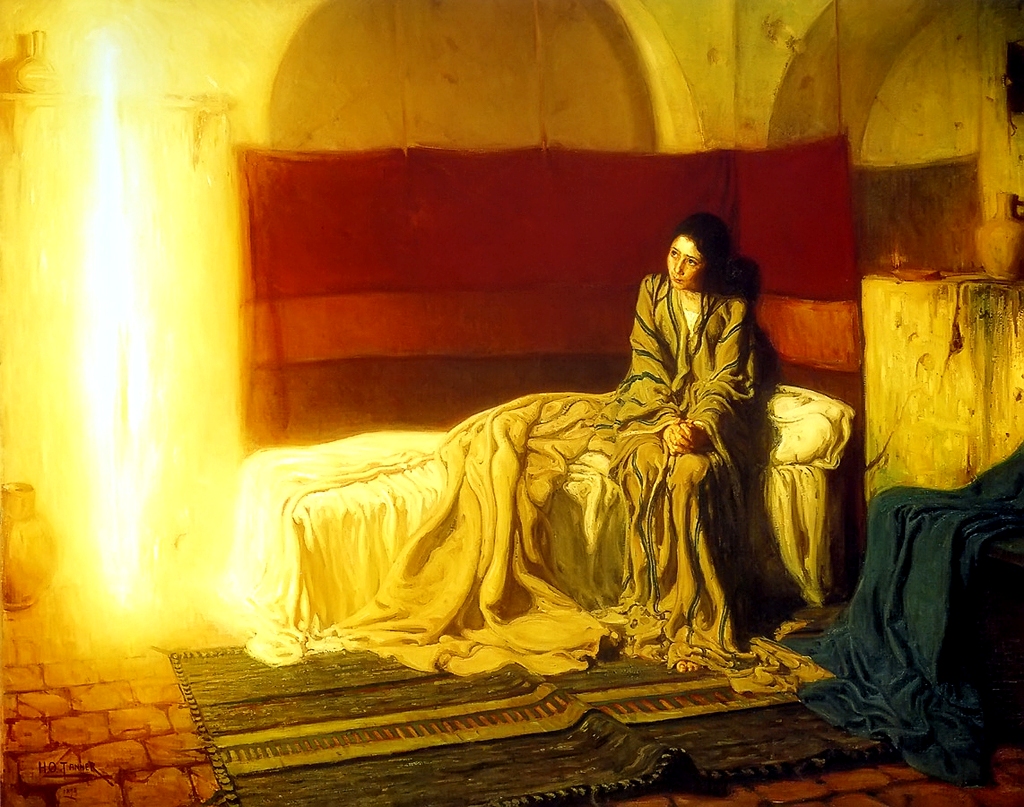
Tanner-the-anunciation-mary

This Advent, we’re seeing how this season affects parts of our lives we usually don’t associate with it. Follow the series here. This post is also filed in the series “Catholics Aren’t Crazy” and “Women Leading Stuff in Churches“.

If a woman is revered by the church for giving the faithful their savior, then surely women are good enough for leadership roles in the church to save it. –Vishwanath Ayengar

I ran across that quote in some letters to the editor of Newsweek a couple of years back in response to a cover story arguing that if women were ordained as priests in the Catholic Church, there wouldn’t have been any sex abuse scandal. I don’t know if that’s true, but the quote is insightful and (hopefully) thought-provoking.

I can hear conservatives now: Well, God used a donkey to speak! He used Caiaphas the high priest to unknowingly prophesy about Jesus before sentencing him to death! He used Judas to bring about Christ’s crucifixion and therefore our salvation! It doesn’t mean that they were fit to be ordained pastors!

Yeah, yeah, I get it. This post isn’t necessarily meant as a “proof” or “defense” of women’s place in ministry (though it’s a part of my on-going series on the topic). I just want to revel a bit in some divine mystery. Can we all just put our swords down and marvel?
Continue reading

Advent & Politics: The Government is on His Shoulders


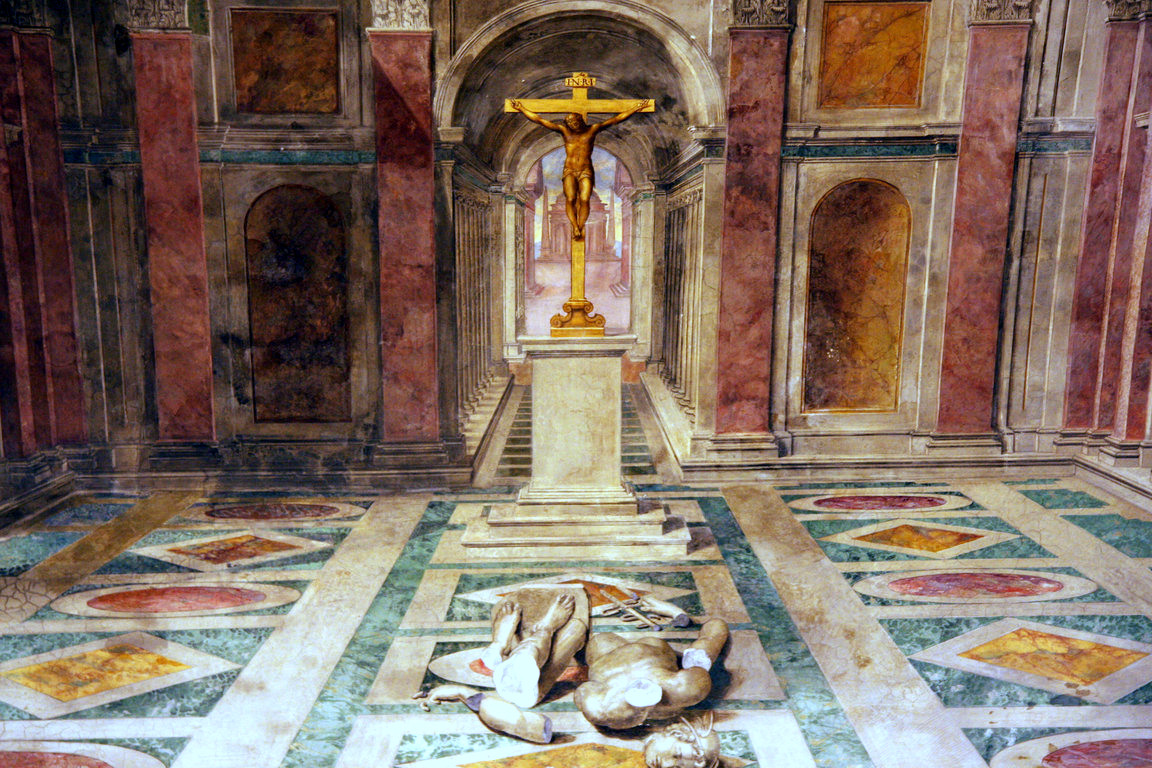
laureti-triumph-christianity-pagan-statue

This Advent season, we’re seeing how the Advent event affects parts of our lives that we usually don’t associate with this time. You can follow the series here.

The book of Isaiah is a minefield for biblical studies, mainly because of the development it seems its contents went through to get to its final form. It appears to be a strange stitching together of many writings, perhaps by many people, for several different purposes. But in all of its complexity and mystery, there is one theme that it consistently holds throughout its contents: politics. The political movements of the nation of Israel and the nations around it–and God’s movement in and through all of it–occupy most every chapter of the book.

Interestingly, this is also where many of the most dramatic and explicit messianic prophecies are found–specifically Advent prophecies. When telling the Christmas story, the gospels quote Isaiah (I believe) more than any other Old Testament book. Images of virgins, Emmanuel, Davidic lineage, “roots of Jesse”, and John’s “voice crying in the wilderness” all find their source here.

There seems to be an intimate connection between politics and Advent.
Continue reading

Free Advent Mixtape Available Now!


Advent-Mixtape-Cover

Update: I got some inspiration and updated the Mixtape, changing the song selection/order a little bit from when this was originally posted. Sorry for the inconvenience.

A new church season, a new mixtape. You can find this year’s Advent Mixtape above, in the appropriately-named tab, or just click here. It’s free, and you can stream, download, or share it.

It’s very similar to last year’s except with some songs removed, added, and re-ordered. I definitely think this one is better. (Let me know what you think!) Be sure to read my post introducing Advent this year, including ways than you can more intentionally participate in this season. I hope this Mixtape can play some role in your time as well.

Here’s some more info, from the “Advent Mixtape” page:
Continue reading

Welcome to Advent, 2012.


This Sunday marks the first Sunday of Advent. This is the New Year’s Day of the Christian Church Calendar. It’s the season in which we celebrate and meditate upon the “Advent” (latin for “Coming”) of Jesus into the world in the Incarnation. This season begins this Sunday and lasts until Christmas.

In this time, we stare deeply into the reality that the Creator God of the universe came into human form by way of human birth.

The season is marked (as with every Church season) with a profound tension. We meditate on the darkness into which Christ entered the world, as well as the light he brought in his Coming. Advent is a time that we sit in the tension of past, present, and future, and see how this most-differentiating belief of Christianity has profound implications on these places in time, and indeed, the whole of human life and experience.

This is why, for this year’s Advent, I’ll be doing a series meditating on how Advent affects seemingly unrelated parts of human life: art, politics, sexuality, singlenesswomen’s ordination, social justice, Evolution, suffering, humor, the city, and more.

There are several other ways you can engage in this season:
Continue reading

a beautiful quote on our security in the Incarnation (by T.F. Torrance)


The stark actuality of Christ’s humanity, his flesh and blood and bone, guarantees to us that we have God among us. If that humanity were in any sense unreal, God would be unreal for us in him. The full measure of Christ’s humanity is the full measure of God’s reality for us, God’s actuality to us, in fact the measure of God’s love for us. If Christ is not man, then God has not reached us, but has stopped short of our humanity – then God does not love us to the uttermost, for his love has stopped short of coming all the way to where we are, and becoming one of us in order to save us. But Christ’s humanity means that God’s love is now flesh of our flesh and bone of our bone, really one of us and with us.

— T.F. Torrance, Incarnation, 185

A good friend posted this on Facebook, and I just had to post it. It connects very well to a few of the Advent posts I did recently (namely the ones on Evolution, our Fallenness, doubting God’s “liking” of us, and how he makes us most human).

I’ve never actually read Torrance before, but I’ve heard a lot about him from people that were, at the time, reading his work. From what I understand, though, he is a theologian whose mind is brilliant and pen is beautiful–a combination sorely lacking in the Christian world today. I also hear that he is a theologian to which I would feel a certain affinity, so I look forward to reading more of him.

HAPPY ADVENT!! {10}


Well, it’s here. The day we’ve been building up to and meditating upon. This is the day we joyfully celebrate the King who broke into our reality and ushered in His Kingdom and our salvation by coming in the form of a little child.

Even though this time can be tough for some (my grandfather died a year ago tomorrow), I do hope and pray that we are all able to have at least one good laugh this year and see the smile of at least one person we love and that we know loves us. And eat good food. And drink good drink. And listen to bad, cheesy music. (On a side-note: the picture above is a picture of the wall-hanging that went up in my house every year as I grew up. And now I have it. I love it.)

Don’t worry, this isn’t really a whole other post. This Advent season has been an especially fruitful time for my writing (as my Facebook Wall obviously shows). I want to thank everyone that has been telling me how helpful these posts were–or even those that just told me they were reading them in the first place!. I can’t tell you how much it affects me, sticks with me, and encourages me. But anyway, I just wanted to write this post so I could put up all these posts in one place for you easy reading pleasure, should you so desire. Happy Advent!
Continue reading

What is the True Gospel of Advent? {9} (hint: it’s not your salvation)


As I mentioned in my previous post, my church has been doing an Advent series called “The Other Christmas Stories” where we’ve been looking at various texts (outside of the traditional Christmas narratives) that comment on the Advent event. Last week, our pastor preached from the book of Revelation, including some of these verses:

Then I heard a loud voice in heaven say: “Now have come the salvation and the power and the kingdom of our God, and the authority of his Messiah. For the accuser of our brothers and sisters, who accuses them before our God day and night, has been hurled down. They triumphed over him by the blood of the Lamb and by the word of their testimony; they did not love their lives so much as to shrink from death. Therefore rejoice, you heavens and you who dwell in them!”
–Revelation 12:11-12

Continue reading

God loves me. But does he like me? (on being “Christ-like”) | Advent {8b}


[This is Part 2. Read Part 1 here.]

My church has been doing a series called “The Other Christmas Stories” where we’ve been going through other texts in the Bible that comment on and meditate upon the event of Advent. The first message was preached on that quintessential Advent text, John 1. The preaching on these verses really struck me:

But as many as received him, to them he gave power to become the sons of God, even to them that believe on his name: Which were born, not of blood, nor of the will of the flesh, nor of the will of man, but of God.
— John 1:12-13

The sermon went on to remind us that in these verses is a promise that the Advent did not happen in order to make us into something we are not, but rather to give us the power to become who we most truly are (children of God). Now, I want to be clear. I grew up in Church hearing that phrase “be who you are” (and hearing it in music), and in certain seasons that thought has been helpful to me, but I’m not quite trying to express the same sentiment.
Continue reading

God loves me. But does he like me? (on being “Christ-like”) | Advent {8a}


UPDATE: Part 2 of this post is now up.

I have a quick confession. I technically ascribe to the “flavor” of Protestantism called “Reformed” that takes the roots of its doctrinal tradition all the way back to the leaders of the Reformation. The first church I really learned much of anything about Christianity and theology is Reformed…ish. The seminary I went to prides itself in being the bastion of orthodoxy for “Reformed” theology. My church is a member of the Reformed Church in America family of churches.

But, I’m not a good Reformed man.
Continue reading

There is No One Like You (Adv, Days 23/24; HelloGoodBye 09/10) by David Schrott [GUEST POST]


[Through college up through about a year and a half ago, I ran a little online magazine called Reform & Revive. It’s dead now. While it was going on, one of my best friends, David Schrott, was one of our contributors. He’s an amazing drywaller, photographer, writerperson, and boyfriend (also here, here, and here). This is a post he wrote for R&R back in 2009 at the end of a particularly trying year for him. It’s one of my favorite Advent meditations I’ve ever read, and so I wanted to share it with all of you. Enjoy.]

_______

“I want men everywhere to lift up holy hands in prayer.”
–I Timothy 2.8, NIV

There are these days, when it is so difficult to find words that wrap around concepts, that, no matter how concrete in one’s mind, find it impossible to find substance in the barrier we use to communicate called language. In those moments, it seems that experience does precede existence and existentialism, for a moment, seems fun (and fun is clearly the wrong word, but for to-day, for this beautiful-day-before-Advent, will have to do).
Continue reading

The Formation of God | Advent {6}


All last week, I offered some meditations on this season of Advent. I actually have several more I’ll be posting more or less every day until Christmas, but today I’ll be offering the last in this little alliterated series in which we’ve been exploring how in the Advent event, Jesus took on our creaturely form, care-taking function, comprehensive fallenness, and now, communal formation.

We spend a lot of time and energy in this season focusing on how Jesus has changed everything and how the implications of Advent change much of our lives and existences. But Jesus did not merely come to change and affect things, but to also be changed and affected by them.
Continue reading

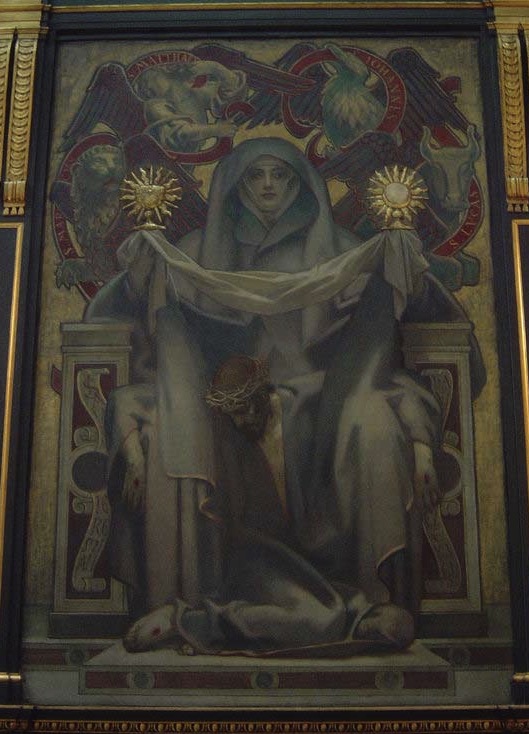
Artist John Singer Sargent on the Advent {5}


image

“Being made man, I am maker of man, and redeemer of what I have made. God in the flesh, I redeem body and soul.”

“On the cross is the figure of the dead Christ, with the figures of Adam and Eve, typifying Humanity, kneeling on either side. They are bound closely to the body of Christ, since all are of one flesh, and each holds a chalice to receive the Sacred Blood. About the feet of Adam is entangled the Serpent of Temptation. Above the arms of the cross there is inscribed in Latin “The sins of the world have been redeemed.” At the foot of the cross the Church is symbolized by the Pelican feeding its young, while around it doves symbolize the Seven Gifts of the Holy Spirit.”

Read a full description of the pieces here. Find the official website for the commission here.

__________

Continue reading

What Christ did not taste, Christ did not redeem. | Advent {4}


This Advent season, we’ve been meditating on how the Advent reminds us how God took on our creaturely form, care-taking function, comprehensive fallenness, and communal formation.

First, a question.

Think back on the Christmas story. After Jesus is born, when he’s about three years old, the wise men go to King Herod and say that they’re looking for this newborn King. Herod is shocked to hear about a child-king having been born right under his nose, whose potential future reign threatens his own, and so he puts out a decree calling for the death of all children ages three and under (in history and art this is referred to as “The Slaughter of the Innocents”. An angel comes to Joseph in a dream and tells him to flee to Egypt to prevent this from happening.

Here’s the question:

Why flee to Egypt? If they stayed and Herod killed the child Jesus, would that not still be Jesus, the Son of God–the Incarnate God–dying unjustly at the hands of a Roman provincial governor attempting to cement the reign of the powers and principalities of the world? Why go to all that effort to wait 30 years later for the same thing to happen on a cross?
Continue reading

Advent, Evolution, & Absolution


It’s Advent. A time where we especially orient ourselves towards rejoicing and celebrating the fact that God did not remain far off and merely create a “legal” or “dogmatic” satisfaction for the plight of his creation and creatures. Rather, he broke into it and came into his creation and among his creatures. In this year’s Advent series, we’re exploring how, in this Coming, Jesus took on our creaturely form, care-taking functioncomprehensive fallenness, and communal formation.

First, God took physical, human, creaturely form. In the study I did–and subsequent lecture I gave–on Beauty a couple of years ago, I defined “Beauty” as the attribute of something that expressed complexity simply. Is not this God-in-human-flesh (theologically referred to as the Incarnation) the most beautiful of all miracles to take place? The Infinitely Complex God inhabits the simplest of human forms: a child.
Continue reading