
The Cross vs. The Resurrection


art-museum-crucifix-death-pmaIn Christian theology, there is a seemingly small thing that really influences so much of one’s theological outlook and even how they think they should live as a Christian.

Are you “Team Cross” or “Team Resurrection”?

Yeah, yeah, I know that the right answer is “both”, but really, most people tend to emphasize one more than the other.

What got me thinking about this was a Facebook post I saw on Easter evening. The poster said that the Resurrection was not when Jesus conquered sin and death. Instead, Jesus did that on the Cross, and the Resurrection was “simply” the “validation” of what Jesus did.

In other words, all that Jesus came to accomplish was done on Good Friday. God the Father saw it, thought it was awesome, so he went ahead and raised Jesus on Sunday.

In other other words, if the Resurrection never happened, nothing “essential” to salvation would be lost, merely the “proof” that it had been accomplished.

It really stuck with me, and no matter how much I tried to re-articulate it in my mind, give him the benefit of the doubt, or pick apart my own presuppositions, I really couldn’t shake how strongly I disagreed with this statement.

Continue reading

The Martyrdom of Perpetua: read the earliest Christian writing by a female


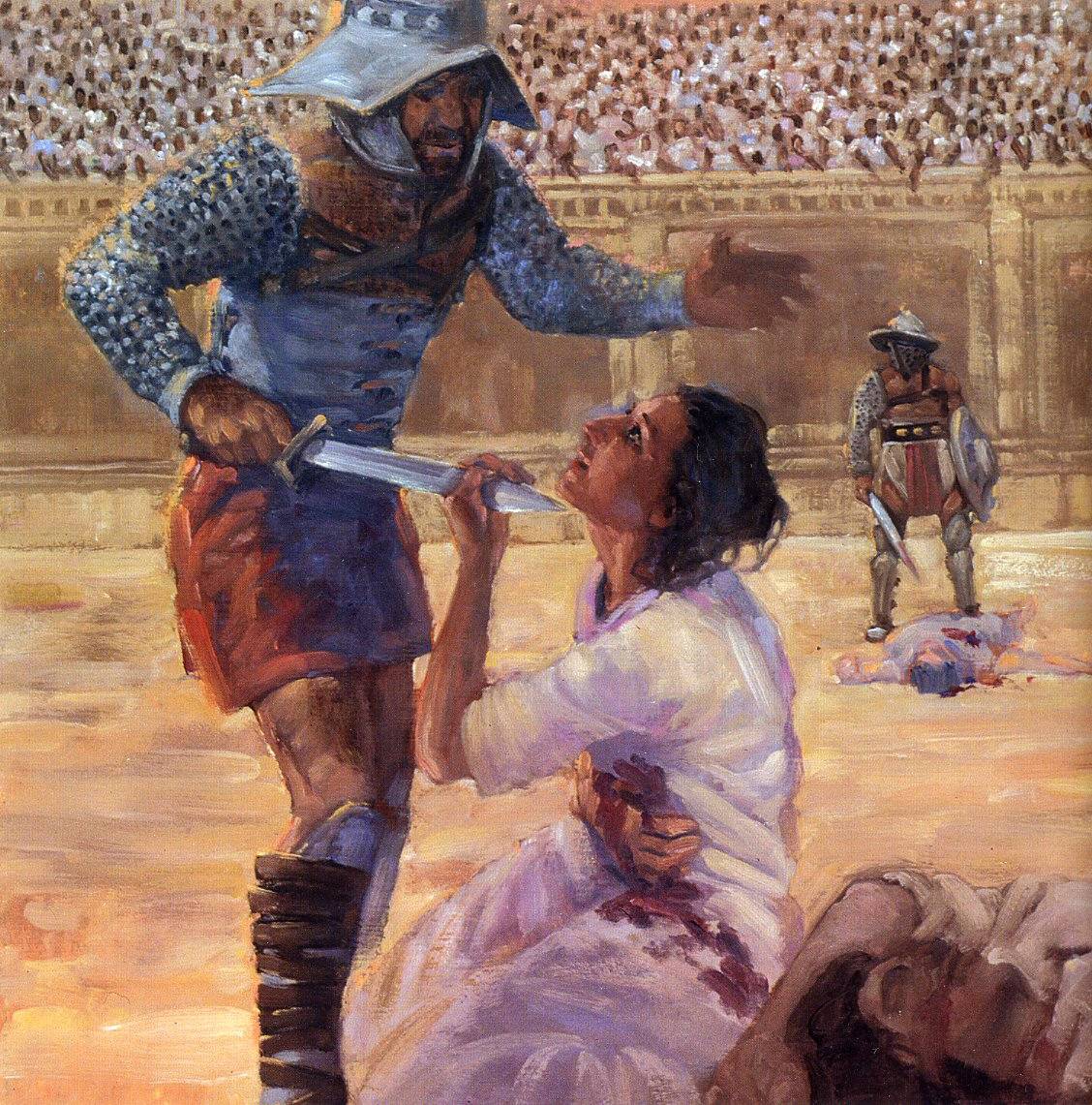
Perpetua-21In my last post in our series on Women and the Church, I mentioned a young girl named Perpetua, who was martyred in Carthage in about 202 or 203 CE. Her prison diary, written in the days leading to her public and violent death, is still the earliest known piece of Christian writing we have by a female. She was 22-years old when she died.

And so, as we head into Palm Sunday weekend, I thought I’d share this work of hers with you. It is a stunning, beautiful, and passionate work.

The bulk of her diary consists of her father trying to convince her to abandon Christianity, as well as her visions and dreams she has to encourage the other prisoners around her. As she is sent off to die, she entrusts the diary to an unnamed individual who picks up the story from there and describes her dramatic death. This individual also added a brief introductory paragraph.

I hope and pray that the example and visions of Perpetua will speak deeply to us, in the midst of our own pain, weakness, and sorrow.

Continue reading

Women & Church History: The Bad Reformation & the Good News {pt.3}


Silencing-Women-duct-tapeThis is a post in an on-going series on Women in the Church.

The past couple of days, we’ve been talking about the historical development of this whole “Women in Church Leadership” idea. in the first post, we talked about why this is so important, and in the second post, we discussed where this change in ideas concerning ordained female leadership happened. Today, let’s talk Reformation and concluding thoughts.

Continue reading

Women & Church History: the century we’re still recovering from {pt.2}


Dubay-lizglass-eyeThis is a post in an on-going series on Women in the Church.

Yesterday, I began talking about the history of Women in the early Church. Up front, I gave my primary source for information, this issue of Christian History Institute Magazine on “Women in the Early Church”, which I will quote from in this post. If you need more information, you can go there.

I also gave a brief sketch of my view: women were quite active in leadership in the first two-centuries of the Church, but come the 200s, some radical things began to change in the Church–things that still effect us today, especially as it pertains to women in ministry.

(Most of this material is comes from the excellent article “The Early Controversies Over Female Leadership” by Dr. Karen J. Torjesen.)
Continue reading

And….We All Have a New Pope! (Catholics Aren’t Crazy)


pope-funny-bigMere minutes ago, a new Pope emerged from the conclave in Rome after Pope Benedict’s surprising resignation several weeks ago. The new Pope is the cardinal formerly-known as Jorge Mario Bergoglio.

But now, he is Pope Francis.

Now, I am fully and securely a Protestant, as most of the readers of this blog are. But for those of us that find ourselves in that Protestant tradition, we often forget a little detail of that name: Protestant.

It means, literally, “the protesting ones”. We are “protest-ant” about many of the practices and teachings of the Catholic Church. But to “protest” something does not necessarily mean you are no longer a part of it.

This is why I describe myself, denominationally, as a “Protesting Catholic”. (Okay, I stole that from Austin Ricketts.)

And you should to.
Continue reading

Love well for Easter: liberti Easter outreach


jlwo-Blood-WaterLent has historically been a time where we look at things that we don’t like to look at, and dwell on things that are broken and painful. And when we do, we see that this darkness is to be found both in our hearts and in the wider world around us.


It’s not hard to see pain and injustice woven into the very fabric of our neighborhoods and the nations around the world.

What is hard, though, is figuring out how to respond to this pain and injustice in ways that are proper and truly loving.

Truly Loving

I believe that the most transformative efforts to address pain and injustice have several things in common: Continue reading

I’ve got some problems with repentance (and how you people talk about it)


belle-isle-bridge-long-walk This post is part of my 2013 Lent series: Reflections on Repentance.

Martin Luther famously kicked off the Reformation by saying the whole of the Christian life is one of repentance. In this, he was implying that it was not a singular moment, but rather a lifelong process. Yet, as I’ve lived life in the Church, I have found that this is not quite the way that most Christians talk about repentance, nor does it seem to be the way the Bible itself does.

If you ask your run-of-the-mill Christian convert, or even pastor or theologian, what repentance is, you will usually get some answer that involves the phrase “180 degrees” or talk about a change of your mind or turning away from a sin you do.

Good sermons and books on repentance will usually involve the Luther formula of using the Holy expectations of a Holy God to expose just how sinful we are, and then hitting us with just how radical God’s grace is in light of that. They will show us our need, trying to woo us to a God that forgives us. They try to expose even those sins hidden to ourselves or those that we hide from others or those that have beset us for years, and then invite us to “turn” from those things and instead trust God.

Sermons and books like this have contributed to beautiful moments in my life, drawing my heart to God and convicting me of my sins.

And yet, I have a problem with this. In these articulations of repentance, there seems to be a disconnect. A major, major disconnect.
Continue reading

Intelligent Repentance: Hearing our Hearts


[This is part of my 2013 Lent series: Reflections on Repentance.]

“Is anyone thirsty? Come and drink— even if you have no money!
Come, take your choice of wine or milk— it’s all free!
Why spend your money on food that does not give you strength? Why pay for food that does you no good?
Listen to me, and you will eat what is good. You will enjoy the finest food.

“Come to me with your ears wide open. Listen, and you will find life.
I will make an everlasting covenant with you.
I will give you all the unfailing love I promised to David.
See how I used him to display my power among the peoples.
I made him a leader among the nations.
You also will command nations you do not know, and peoples unknown to you will come running to obey,
because I, the Lord your God, the Holy One of Israel, have made you glorious.”

Seek the Lord while you can find him. Call on him now while he is near.
Let the wicked change their ways and banish the very thought of doing wrong.
Let them turn to the Lord that he may have mercy on them.
Yes, turn to our God, for he will forgive generously.

“My thoughts are nothing like your thoughts,” says the Lord.
“And my ways are far beyond anything you could imagine.
For just as the heavens are higher than the earth,
so my ways are higher than your ways and my thoughts higher than your thoughts.”

The writings of the Prophet Isaiah, Chappter 55, verses 1-9 Continue reading

Ash Wednesday Egalitarianism, or “Why do female preachers suck?”


paul-schrott-ash-wednesday-bwYes, that’s me in that picture. I love that picture. It’s been used in a few posts since it was taken a couple of years ago. This isn’t (just) because of some weird sense of narcissism that loves to see my face on my blog posts. Rather, this picture is a very meaningful reminder of one of the most formative nights in my Christian life.

I said in the beginning of this series on Women in the Church that for most of my life, I had been one of the staunchest defenders of male-led church leadership. I knew all the arguments, I believed the caricatures of the other side, and importantly, I had experienced that women made terrible preachers of sermons.

Now remember: this was “pre-conversion” Paul that was thinking these things. But still, as I had visited friend’s churches, listened to audio, and seen female televangelists, it was hard not to notice that I had never heard a “good” sermon offered by a woman. It seemed clear to me, then, that this unique “anointing” and “gifting” to preach was reserved for men.

Don’t get me wrong. I had received incredible guidance, teaching, and wisdom from women. But these had been in the contexts of schools, lectures, books, blogs, campus ministers, podcasts, and the wider world–not church sermons.

Continue reading

Join liberti for Ash Wednesday tonight


liberti-churchIf you find yourself in the Philly area, I just wanted to extend an invitation to you to join my church, liberti center city, tonight for our Ash Wednesday service. It will be a time of reflection, singing, prayer, imposition of ashes, and inviting into this year’s Holy Lent.

The service is tonight at 7pm sharp, at 17th and Sansom St. There is also free parking available.

A group of us will probably get dinner afterwards. So if you’re in Philly, and especially if Ash Wednesday is new to you, I encourage you to come on out and join us at the beginning of this Holy Lenten season.

Also, for the rest of the Lent season, liberti has put together a simple prayerbook to guide our times of meditation and reflection. The liberti Lent prayerbook is a highlight of my Lent every year, and so be sure not to miss out.

Women’s Ordination is indeed the end of the world


Delaunay-City-Paris
We’ve spent a few weeks focusing on Genesis—the beginning of our story as Christians—and seeing what cues we can draw from it regarding our continuing discussion of women’s roles in churches. Having done that, I thought it might now be helpful to check out what implications the end of our story might hold for us.

After a few generations of bad (or incomplete) teaching, Western churches are, I think, reconnecting with the accurate Christian doctrine of heaven. The sense I get is that more and more of us are regaining the belief that the final heaven is not some abstract, ethereal, disembodied existence, but rather this material earth and these physical bodies renewed and re-imagined.
Continue reading

Women & the Church: What’s Adam & Eve got to do with it? [1]


durer-bw-adam-eve

As I’ve been looking into these “Women in Ministry” discussions for this on-going series, they usually follow a similar pattern. Conservatives will point to some Bible verses, Egalitarians will point to the context (as I did in our last post), and then, at some point, the conservatives bring up this simple, yet logical and reasoned argument:

Yes, you can point to the cultural context all you want, but at the end of the day, Paul’s reason for what he says, is not the cultural context, but the very structure of pre-sin creation in which God created Adam first. This is something that’s true no matter the context.

Now, I’ve said repeatedly that my egalitarian beliefs come not from desire to move away from the Bible, but my attempts to be all the more obedient to it. And so, I want to take this argument as seriously as possible. I’ll attempt to do that in these posts.

As I started writing up the problems I had with this “creation-order” argument, it became so long, that I had to break it up into two posts. Today, we’ll focus on the particular Timothy passage in question and other related things that Paul writes. Tomorrow we’ll focus on the Genesis story itself to see what it might say to this.

The Timothy Passage

Continue reading

On Women Leaders in the Church: Timothy’s cultural context


artemis-greek-urnFor many of the Christians that believe women are not to be ordained, authoritatively teach in churches, nor hold formal church leadership offices, 1 Timothy 2:8-14 is the first (and oftentimes the only) Bible text they throw out as a conversation-ending, slam dunk against people they feel are “re-writing” the Bible for their own ends.

When last we left our on-going series on women in the church, we talked about the text and translation of this passage. We talked about its history of mistranslation and how the seemingly best and most consistent translation offers us a different picture than the traditional one. Today, we’re going to pull back from the text itself to look at the culture and context behind the letter.

my thesis

I’ll give my view up front, so you can leave it, take it, or read on for why I land there. This post is a long one.
Continue reading

N.T. Wright: Egalitarianism isn’t “progressive”; it’s biblical. Others object.


The Rt Revd N T (Tom) Wright delivering the Ja...Alas, due to my obsessive commitment to not let blogging get in the way of the relationships in my life, my promised post on the historical context of 1 Timothy will not be coming today (and may have to wait until next week). Instead, as part of this ongoing series, today I’d like to offer to all of you an excellent Op-ed that biblical scholar N.T. Wright posted in The Times of London (copublished here).

Last week, the Church of England voted not to allow any female bishops (though they have, for some time, allowed female priests). Prime Minister David Cameron bemoaned this, telling the Church they needed to “get with the programme” and ordain women bishops because that’s just where the world is right now, apparently. (This issue is also causing other political problems for the Church.)

Wright, who supports female bishops wrote the Op-Ed blasting Cameron for encouraging the Church to “get with the times”, saying that that is never a reason why the Church should do anything. He continues, blasting the idea of naive “progressivism” that has dominated monder thought.

Instead, he says, the Church should ordain female bishops because it’s biblical, not because it’s “cool” or “progressive”. He goes on to say that appealing to the culture does damage to the truth that it is biblical, and reinforces the patently false idea that those that oppose female ordination are the ones reading Scripture “literally” and “faithfully” while egalitarians are only listening to “culture”.

The Op-ed is brief, snarky, and powerful. Needless to say, it garned some thoughts from conservatives on this side of the pond. Doug Wilson did not just one, but two posts on it, and Denny Burke also wrote against it. The Internet Monk then brilliantly deconstructed their responses.

And so, I give you these men (why is it always men!) to read and discuss in the space below. Have fun.

On Women Leading Stuff in the Church: 1 Timothy 2:8-12


In this series on women in the church I haven’t taken the usual approach of jumping right to Bible verses. I feel there are far deeper things that affect how we interpret before we even opened the Bible. I thought we should talk about that.

This has also been a really hard post to write. For much of my readership (especially those whose minds I am most interested in changing–male church leaders who disagree with me), I don’t know what I can say that’s different than what they’ve heard before. I don’t like feeling like I’m contributing to the noise.

So here’s what we’re going to do. I’m just going to try and deconstruct the more conservative view of these verses (this post), and then offer a reconstruction of how I view the verses now (the next post). If people need me to cite sources and such, then I can do that in the comments. I won’t bog down this post with that stuff, because the people that care are generally the people that both know where to find the information and/or already know it and have incorporated it into their view. So here we go.

the text

Here’s the text in question. This is the single most “problematic” text for those that see a valid place for women in the ordained leadership offices of the Church. The text is 1 Timothy 2:8-14 (ESV):
Continue reading