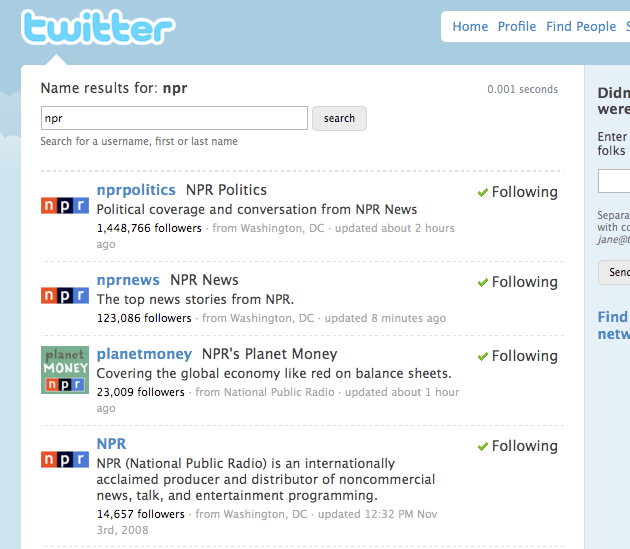
I encountered one of the most fascinating things the other day. In the picture above (click for a larger version), you will see a search I recently did on Twitter for “npr”. I was trying to find their various Twitter accounts so I could follow, get news updates, and the like. I was shocked to see that with 1,448,766 followers, NPR’s Politics account is by far the most popular. NPR News is a distant second with only 123,086 followers.
Why is that?
This has been giving more pause than it should. Why are there more than ten times as many people wanting to follow NPR Politics than NPR anything else? Of course, there are many factors I don’t know that could contribute to these results. The Politics account could be the oldest account, and the News one being a relatively new one. They all could have been started around the time of the election. The Politics account could have been advertised more. I don’t know, but still: would those variables fully account for the inequality?
Are Americans really that much more interested in Political news as opposed to general News? Actually, maybe. I know that prior to this election, I only got obsessed with politics for the five or so months leading up to voting night, and then dropped it like a bad habit the next morning. But not this time. For some reason unbeknownst to me, I have kept up with my political engagement – perhaps increased it, in fact. My personal addiction to NPR, The Economist, the Politics section of the New York Times and Slate magazine, various editorials and opinion columns, and all things Social Justice-y has only increased since November.
Could this be a reflection of the amount of hope and anticipation a completely new guard promised to bring? That Americans freely ascribed to? That all of us knew was needed? Perhaps. Personally, I think that the academy is moving past postmodernity into what I’m currently calling “neo-pragmatism” (some good friends would rather call it “critical realism”, and they have some good points). But either way, I feel like modernity preached to us the mind, postmodernity the heart, and now “neo-pragmatism” the legs. In short, I think people are seeking a “whatever works” approach. The great fulfillment promised by the previous two major philosophical epochs never happened, so now people are willing to do whatever it takes – throw off any convention, question so many presuppositions, and change ideologies – in the hopes that something might actually effect change and lasting growth in our lives.
Perhaps this simple Twitter search is a reflection of this? Maybe there really is a much greater interest in the mechanisms of change in the world because people know we need it, they want it, and want to know how their leaders are trying to help them accomplish it. Need I mention more than Obama’s campaign-winning slogan? It wasn’t Ideology you can believe in or even Truth you can believe in. It was Change. And politics is much more likely to accomplish change than news (for better or worse).
I think we’re right in looking for change. I think we’re right in looking for that which will actually be readily applicable in our everyday lives. I think we’re right in looking for what works.
I just fear we’re looking in the wrong place.


 the long way home