Noah, Prophecy, & the Comfort of the Earth | Genesis 5.28-29


When Lamech had lived one hundred eighty-two years, he became the father of a son; he named him Noah, saying, “Out of the ground that the Lord has cursed this one shall bring us relief from our work and from the toil of our hands.”
Genesis 5.28-29

Noah’s name means “comfort” or “rest”. This is an interesting prophetic statement concerning Noah. Hebrew irony at its best. The same Hebrew word for “earth” is used here as “ground”. Same word as in “God created the heavens and the earth”. So, how Noah will bring “relief” from the toil is by playing a part in the undoing of God’s creation of “the heavens and the ground”. In other words, he comes out of the ground to bring comfort to that ground by undoing the ground. Oh, Hebrew.

See other Marginalia here. Read more about the series here.

Universal Intimacy: The Beautiful Transition | Matthew 11:25-39


At that time Jesus said, “I thank you, Father, Lord of heaven and earth, because you have hidden these things from the wise and the intelligent and have revealed them to infants; yes, Father, for such was your gracious will. All things have been handed over to me by my Father; and no one knows the Son except the Father, and no one knows the Father except the Son and anyone to whom the Son chooses to reveal him.

“Come to me, all you that are weary and are carrying heavy burdens, and I will give you rest. Take my yoke upon you, and learn from me; for I am gentle and humble in heart, and you will find rest for your souls. For my yoke is easy, and my burden is light.”
Matthew 11:25-39

What a beautiful transition; from words of exclusivity to words of rest and invitation. It is precisely into the intensely exclusive intimacy between the Son and the Father into which we are invited to come and find rest. This is true Christian “Universalism”: the whole cosmos is brought into the exclusive, fiery love of the Trinity.

See other Marginalia here. Read more about the series here.

Insecurity Leads to Fasting? | Ezra 8:21-23


Then I proclaimed a fast there, at the river Ahava, that we might deny ourselves before our God, to seek from him a safe journey for ourselves, our children, and all our possessions. For I was ashamed to ask the king for a band of soldiers and cavalry to protect us against the enemy on our way, since we had told the king that the hand of our God is gracious to all who seek him, but his power and his wrath are against all who forsake him. So we fasted and petitioned our God for this, and he listened to our entreaty.
Ezra 8:21-23

What an odd and beautifully honest aside. At first I was put off by the logic here. “I proclaimed a fast…For I was ashamed.” I thought “that’s a terrible reason to have a fast!” But the more I thought about it the more I realized that, of course!, that’s the right time to fast! When you are most unsure, most in need, most insecure. This is when “we might deny ourselves before our God.”

See other Marginalia here. Read more about the series here.

Introducing Marginalia: a new part of this blog


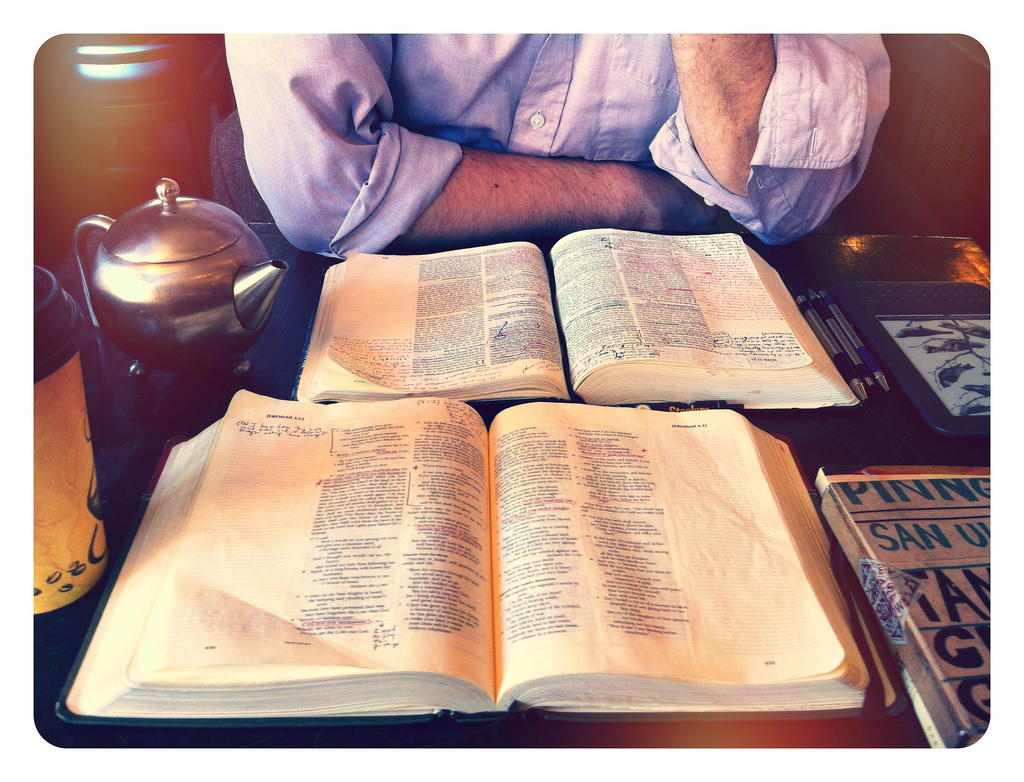
schrott-bibles-paul-coffee

I’ll be honest. It’s been years since I’ve been able to find a way to regularly read the Bible that sticks and works for me. To be frank, readings plans usually don’t work for me because I get bored. Depending on the plan, you’re either stuck in the same book for long stretches of time or you’re jumping around so much that you lose the sense of the whole.
This year, I think I’ve started a regimen that is clicking: the M’Cheyne Bible reading plan. At any given time, I’m going through four completely different part of Scripture and for me, this is keeping me really engaged. As I’ve gone on through the plan these past couple of months, I started highlighting and writing up little notes on random verses here and there. Lots of themAnd I’d like to share them with you.

So today, I’m introducing a new little part of this blog called Marginalia, where I’ll be posting these short little meditations on Scripture as I go through this plan.
Continue reading

Abraham almost loses his son & he worships?! | Genesis 22.13-14


 And Abraham looked up and saw a ram, caught in a thicket by its horns. Abraham went and took the ram and offered it up as a burnt offering instead of his son. So Abraham called that place “The LORD will provide”; as it is said to this day, “On the mount of the LORD it shall be provided.”
Genesis 22.13-14

This is right after the whole “sacrifice Isaac” thing. To me, this such an odd response. Not only does Abraham worship God after this, which is crazy enough as it is, but he also sets up a memorial to remember this by! If I were him, I’d need some space from this God for a bit and I’d want to forget this incident as soon as possible.

I’ve always thought it odd that the book of Hebrews puts such an emphasis on Abraham and calling him the “father of faith” and extols his faith so much. Whenever I read that I think about how he had Ishmael with Hagar, due to a lack faith, and (twice) gave his wife up to be the wife of someone else because he was scared they’d kill him–another example of a lack of faith!

But then I read things like this and I think to myself, “Oh yeah, now I get it.”

See other Marginalia here. Read more about the series here.

What Draws Out Jesus’ Compassion? | Matthew 15.32


Then Jesus called his disciples to him and said, “I have compassion for the crowd, because they have been with me now for three days and have nothing to eat; and I do not want to send them away hungry, for they might faint on the way.”

Matthew 15.32

What evokes Jesus’ compassionate response and provision? Faithfulness, neediness, and weakness. That’s it. Not performance, not even belief. Just walking with him while being needy.

Further, we can be confident that he knows our need and knows we will “faint on the way” without him responding. And respond he will.

See other Marginalia here. Read more about the series here.

Advent & Hoping for God to be With Us


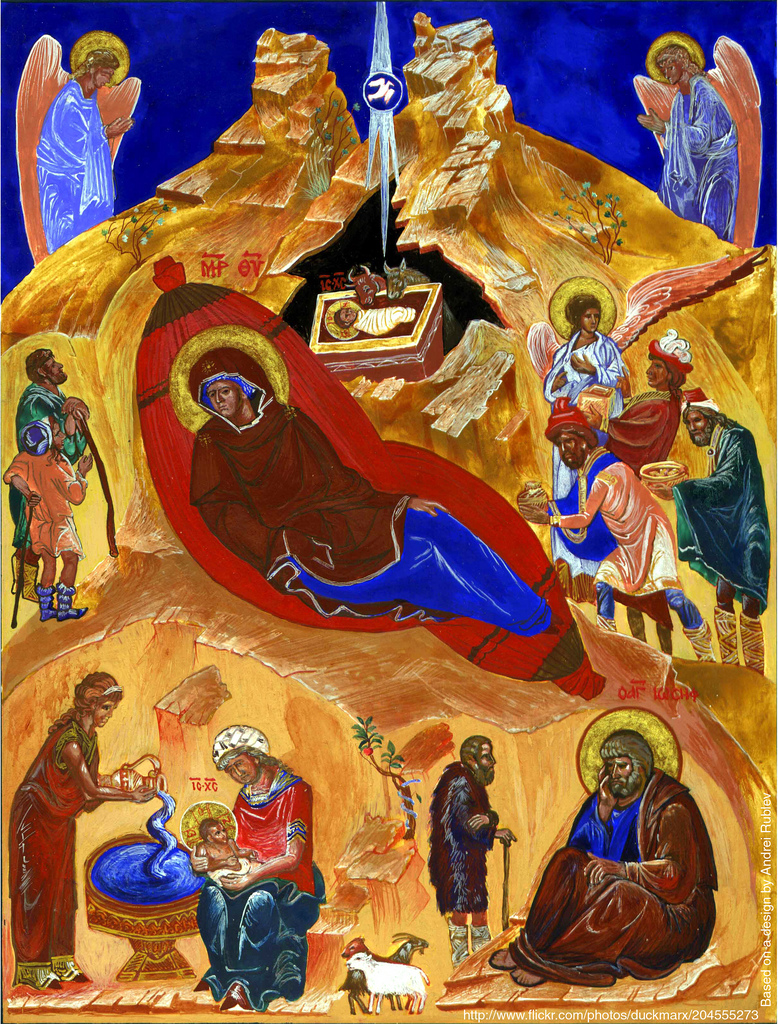
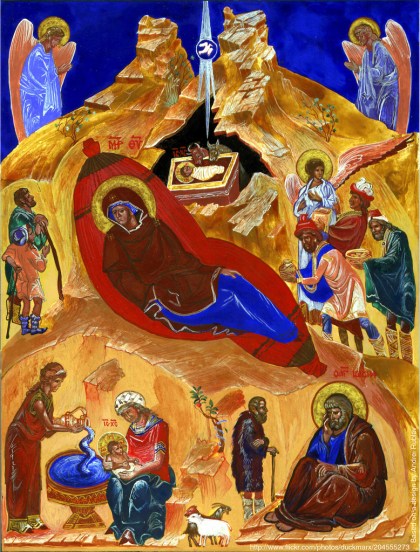
icon-Nativity-christmasThis is the meditation I wrote that appeared in this weekend’s reading and reflection in Liberti Church’s Advent 2013 Prayerbook, which can be downloaded for free.

The Reading:

Again the Lord spoke to Ahaz, saying, Ask a sign of the Lord your God; let it be deep as Sheol or high as heaven. But Ahaz said, I will not ask, and I will not put the Lord to the test. Then Isaiah said: “Hear then, O house of David! Is it too little for you to weary mortals, that you weary my God also? Therefore the Lord himself will give you a sign. Look, the young woman is with child and shall bear a son, and shall name him Immanuel.

If you’ve been keeping up with this Prayerbook (or any Advent guide), then congratulations! I hope it’s spoken to you and you have experienced God in its readings and meditations.

That being said, you might be wondering: why is this Prayerbook continuing after Christmas Day?

It was only a couple of years ago I found out that in the Church Calendar, Christmas is not just a day—it’s an entire season! Advent Season leads into Christmas Season. Why is this? Advent has a similar relationship to Christmas that Lent does to Easter: it’s meant to be the time of reflection, preparation, and repentance that prepares us for the unbridled, no limits, over-the-top celebration and joy of Christmas. Our spiritual ancestors knew that celebration takes time and preparation. That’s what Advent has been.

But now we’re in the Christmas Season—the time of complete unfettered celebration. But why?
Continue reading

Advent & Longing for Home


Sandorfi-MadeleineThis is the meditation I wrote that appears in a reading and reflection in Liberti Church’s Advent 2013 Prayerbook, which can be downloaded for free.

There is an incredibly profound way in which we don’t feel at Home in our own humanity.

Too often, Christians see their own personal spiritual growth as a loss, a lessening, or an abandoning of their own humanity. This can lead us to subtly use people and things to try and find our soul’s Home. And so we awake to find anxiety, manipulation, doubt, guilt, and self-loathing ruling and reigning so many parts of our lives and relationships. (Am I alone in this?)

We can sometimes think of Christianity as a process of our souls leaving the “Home” of their weakened humanity and finding a “new, spiritual Home” in Jesus. The logic goes that you were originally one way, then Jesus “saved” you, and now you are able (and are commanded) to be something else, now that you are His.

But Advent radically flies in the face of this.
Continue reading

Advent & Hoping for Justice


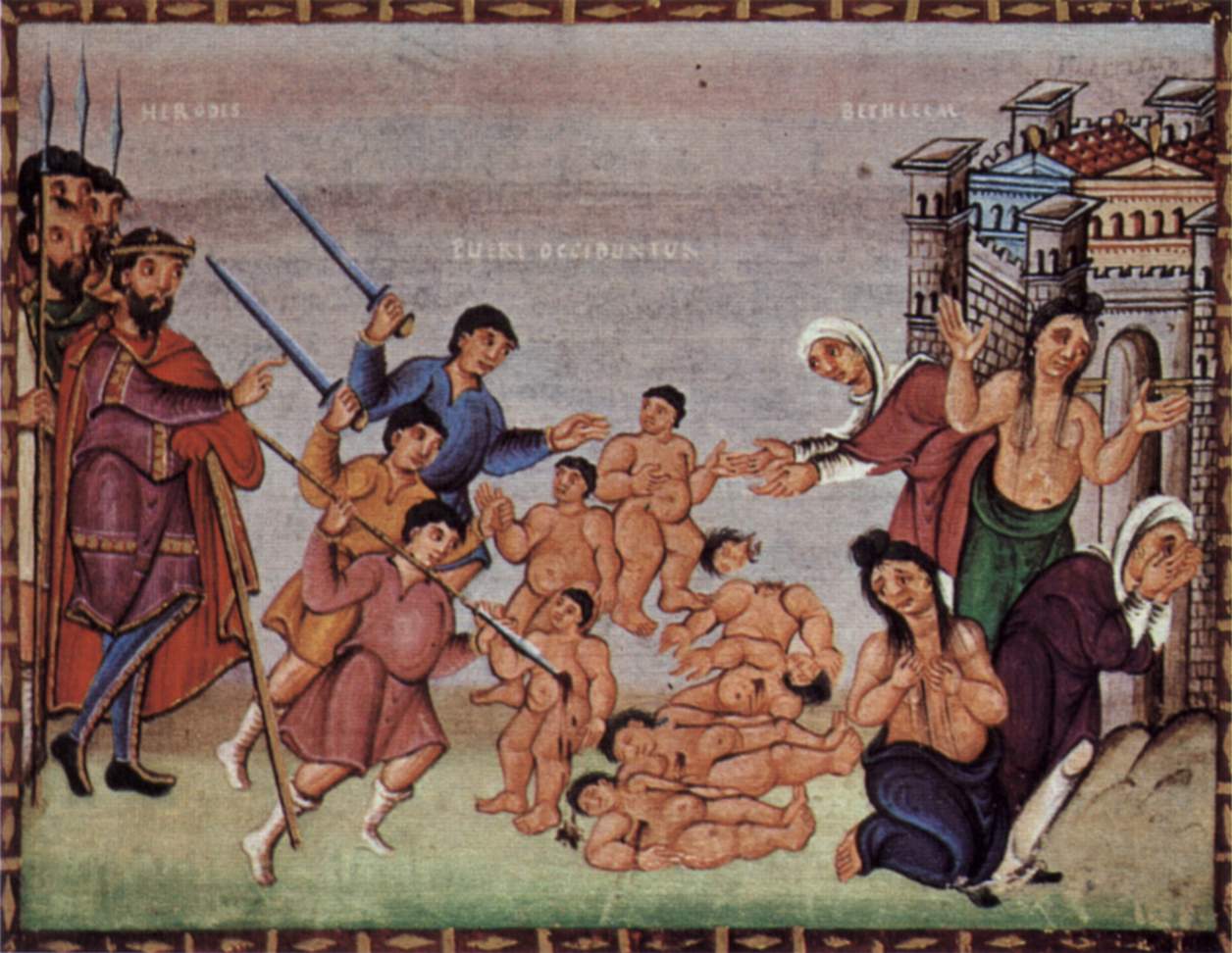
Massacre-of-innocentsThis is the meditation I wrote that appears in today’s reading and reflection in Liberti Church’s Advent 2013 Prayerbook, which can be downloaded for free.

First, a question.

Think back on the Christmas story. After Jesus is born, when he’s about three-years old, King Herod puts out a decree calling for the death of all infants, trying to kill Jesus. An angel comes to Joseph in a dream and tells him to flee to Egypt to prevent Jesus from dying in this slaughter.

Here’s the question: why flee to Egypt?

If they stayed and Herod killed the child Jesus, wouldn’t that still be the Son of God dying unjustly at the hands of a Roman provincial governor? Why go to all that effort to wait 30 years later for the same thing to happen on a cross?
Continue reading

Advent & Hoping for Peace


Rothko-untitled-2This is the meditation I wrote that appears in today’s reading and reflection in Liberti Church’s Advent 2013 Prayerbook, which can be downloaded for free.

This world is anything but peaceable. Humanity is constant in its injustice and wickedness inflicted upon one another across this world. It makes you wonder if “humane” is a misnomer. And we can’t just blame all of this on free will, either. The natural world rages against us with its own violence with staggering regularity. And all of this hits home the most when it’s those closest to us that suffer under this world with little peace on hand.

We look at all of this and ask that oldest of questions: “Why?” But when we open the pages of Scripture, we don’t find answers to this seemingly core thread running through our existence. The God of the Bible seems far more concerned with answering “what” questions than “why” questions–what is the nature of reality? what is the problem with the world? what is the solution?

But there is good news for all of us that struggle against the violence of this world: Advent.

In Advent, God does not merely see our why‘s and disregard them as silly and human; he does not simply leave us to our own to wrestle and struggle and doubt. He doesn’t answer our whys. He simply looks at us and the world with compassion, acknowledges to us the way things are, and rolls up his sleeves to address it.
Continue reading

For Advent 2013: a Free Liberti Prayerbook & Devotional


GiottodiBondone-Adoration-Magi-icon-advent

As of this past Sunday, the Christian Church finds themselves in the season of Advent. I don’t know about you, but this season has snuck up on me (admittedly, I was a little occupied). I’ve been working on a new Advent Mixtape, but it’s not done (you can find last year’s here). I have an idea for an Advent series, but I haven’t fully thought through the concept (see past series here). I’ve had devotionals and reading plans set up on my phone to do, but I haven’t done even one day of them all this week.

But one of the beauties of the Church Calendar is that it doesn’t depend on us. The realities pointed to in these weeks are objective realities that happened (and are happening) in spite of us, and not because of us. Another beauty of the Calendar is that it happens every year, so even if we don’t engage one year like we’d like or hope, there’s always next year.
Continue reading

The Children’s Bible: my favorite devotional [casual fri]


Okay, once again, I find myself in what many past saints have referred to as a “spiritual dry season”. I can’t count how many times on this blog I’ve bemoaned being here. And honestly, this is because I think I’ve spent more of my Christian life in these times than out. It’s kind of the norm. Don’t worry, I’m finally getting help.

As is the case with most people experiencing times like this, one of the first casualties is any personal Bible reading. I get to that place where I just don’t want to read the Bible–or, more precisely, I want to, but I just don’t have the spiritual strength to do it (anyone who’s been a Christian for any length of time probably knows what I mean).

But there’s one tool that God has given me that he consistently uses to draw me back to himself. I found myself picking it up again this past week and wanted to to share it all with you.
Continue reading

Ruminations on Rhythm & Life


Do you have any rituals? Last week, I wrote about about how I would love to find a steady “rhythm” to my daily existence. Do any of you have that? Is it realistic to desire that? My roommate Tim gets up most every morning at around the same time, makes a french press of coffee and sits out our kitchen table and reads his giant red-leather ESV Study Bible. I love that. It’s weird whenever I come downstairs and he’s had to go to work early or something and isn’t doing that.

Me? A couple of days ago, I actually got to bed sort of early (for me) at around 11:15. I set my alarm for 7am, knowing I had to walk out the door by 8am. I figured I could take a shower and have some time to just relax and maybe pray or read my own Bible in the morning (for the first time in God knows how long).
Continue reading

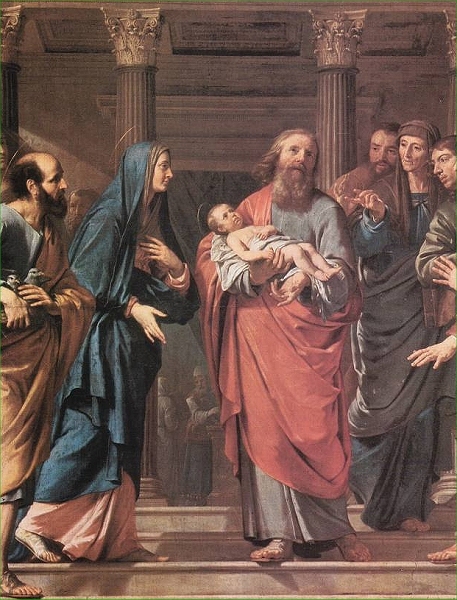
Holy Day Meditations: Jesus Presented at the Temple


The backbone of my morning and evening meditations and prayer has become the Anglican Book of Common Prayer. It has taken me a while to figure out how to use it (with a lot of help from a friend), and I’m still clumsily trying to make my way along, but it is an amazing book. It gives just the right amount of both freedom and structure to give me both guidance and excitement. I’m really enjoying it. Secondly, I am a relatively new member of a church that belongs to the Reformed Church in America. Both of these things has led me to encounter ancient church documents, creeds, and traditions I was never exposed to as a Bible Belt Southern Baptist.

One of those newfound traditions that is really becoming a major part of my life is the Church Calendar. According to the calendar, we are currently in the season of Epiphany, where the church celebrates the travel of the Wise Men to see Jesus, therefore declaring him King and Lord among all the nations, and today is the Church Holy Day on which we celebrate Jesus’ presentation by His parents in the temple (forty days after Christmas) (Luke 2:22-40). As I went through the Daily Lectionary this morning, I found that focusing on this event and meditating on it bore some very real personal fruit that I wished to share.

Continue reading