Foreign Policy Debate: this is what Obama is doing around the world in our name


Here’s an article from Daily Mail about some legal challenges brought against American military officials for their drone activity in Pakistan. One key stat:

American Drone activities just in Pakistan have been confirmed to have killed 881 civilians, but only 41 terrorists.

Some things to notice about that statistic: (1) this is only from Pakistan. We’ve also been doing drone strikes in both Yemen and Afghanistan (and probably Libya here soon), with even more atrocious effects (especially in Yemen); (2) there were a few thousand total deaths, but these were the only absolutely beyond-a-shadow-of-a-doubt confirmed “statuses” of the victims–the number of civilians is probably still higher; and (3) these are only deaths due to drone strikes. In Iraq and elsewhere, many additional civilian deaths have come about through other means.

For all my “I’m going to vote for Obama because of social justice issues”. Take note: if you add these numbers to the other civilian death numbers in other countries, Obama’s policies have killed far more impoverished people around the world than he has helped here (and he got the Nobel Peace prize!).

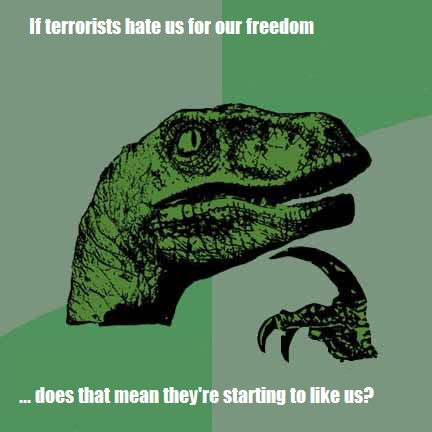
This story came out two days ago, and I can’t find a single reference to this information in any other major American news outlet (a friend on Facebook said he heard something on NPR a couple of months ago, though I think he was referring to a different special report they had done). This is what makes our reputation in the world, this is what creates new terrorists–not “our freedoms”, and this is what will define our history–not tax law. And so, for all those criticizing me for voting third-party: yes, yes. Let’s try and change things through the existing political parties. We have plenty of time. I’m sure the rest of the world (including these victims’ families) will be fine with us waiting. (More debate-prep here)

In other news, unmanned aerial drones are now surveilling Americans around the country. How long before they’re armed? Yeah, we’ve got plenty of time to try and choose between two guys who both support this.

Can no politician do enough to lose your vote?
The Atlantic gets it right on Obama’s civil liberties abuses & the value of your vote


Yesterday, Conor Friedersdorf (Twitter) wrote an amazing piece for The Atlantic in which he explains why–no matter how liberal he is–he is not voting for President Obama. He writes:

Sometimes a policy is so reckless or immoral that supporting its backer as “the lesser of two evils” is unacceptable. If enough people start refusing to support any candidate who needlessly terrorizes innocents, perpetrates radical assaults on civil liberties, goes to war without Congress, or persecutes whistleblowers, among other misdeeds, post-9/11 excesses will be reined in.

I found this link on Facebook through J.R.D. Kirk. I absolutely agree with every word of this post. I shared it to my own Facebook wall, and….wow…I got some major pushback, mainly over my inclination to vote for a third-party candidate. People through around the same phrases I’ve heard the past few weeks about “wasting my vote” and “throwing it away” and “de-valuing it”. I found this odd for a few reasons.
Continue reading

I almost voted for Obama, but then I remembered…


[Updated below]

Having neglected my favorite columnist and favorite podcast as of late, it was easy to forget. As I said in my post about almost voting for Romney, I let the Conventions sort-of sweep me up. I swore I’d never give in, but oh those sirens were such smooth-talking mistresses.

First, as I mentioned last week, the big shift for me towards Obama was Clinton’s speech at the National Convention. I thought it was amazing. But, this speech ended up being not as factually accurate as it sounded. And (speaking of how it sounded) as Dan Carlin said (as I was finally catching up with his podcast), this speech was only our generation’s introduction to the kind of politician Clinton’s always been. This was simply vintage Clinton, and I admit, I developed a little man-crush.

Continue reading

I’m a one issue voter: specific abuses of Executive power {pt.3}


This is an ongoing series talking about how, for this Presidential election, I am a one-issue voter. I will be making my decision for President based on what the candidate believes about Executive Power and Civil Liberties. Read Part 1 and Part 2 for more. In this post, I outline specific ways the Executive is increasingly abusing its power. The hope is that this will show others how this should be a legitimate concern of all Americans.

Did you know . . . 

The President, on New Year’s Eve, signed legislation making it absolutely legal for him, personally, to order you imprisoned indefinitely with no charges being filed against you and no lawyer being offered you. Be sure to read this Al-Jazeera article bemoaning the loss of American freedom because of this. (more here and, for a snarkier analysis, go here).

The Administration reserves the right to simply have any American citizen killed without a trial or any chance to offer evidence in their defense. Obama is the first known President to ever authorize this.
Continue reading

I’m a one issue voter: some responses & clarifications {Pt.2}


“Free people, remember this maxim: We may acquire liberty, but it is never recovered if it is once lost.” –Jean-Jacques Rousseau

[UPDATE: Part 3, “specific abuses of Executive Power” is up]

Yesterday, I wrote a post about how I’ve become so burdened by the abuse of civil liberties by the Executive branch, that I have decided that this is a big enough of a deal–and the time is crucial enough–to warrant this being the one issue I use to determine who I’m voting for this Presidential election.

I knew I was brief yesterday, but wow. That post ended up causing a lot of emails, texts, comments and Facebook posts from people really cautious about what I had said, and had a lot of clarifying questions for me. Some issues will become clearer as I continue to write about this, but I wanted to address some crucial things up front.

First, some definition

As Wikipedia puts it: “Civil liberties are simply defined as individual legal and constitutional protections from entities more powerful than an individual, for example, parts of the government, other individuals, or corporations.” To put it another way, our “civil liberties” are what is clearly laid out in the Bill of Rights.
Continue reading

For now, I’m a one issue voter: a President’s Day lament {Pt.1}


“The preservation of the sacred fire of liberty…is finally staked, on the experiment entrusted to the hands of the American people” — George Washington

[UPDATEPart 2, “some responses & clarifications” is now posted.]

[UPDATE II: Part 3, “specific abuses of Executive Power” is up]

America’s Founding Fathers consistently referred to our country as a  “grand experiment”, and on this President’s Day–and good ol’ George’s birthday–I want to meditate on this for a little bit. What was (is?) so “experimental” about America?

There seems to be a repeated  “life-cycle” to nearly every great power in the entire history of the world. In the beginning of most of these nations, the “power” and authority is more or less decentralized (perhaps in a localized, tribal, or feudal system–or in our case, States).

Over the course of time, though, this “power” becomes increasingly centralized: first, into one part of society (usually to the wealthy and their businesses), then it gathers into one part of the government, and then it continues onward until it is ultimately centralized in one person.
Continue reading

I sort of want this health care bill to die.


[graphic design by kilroyart]

UPDATE: more thoughts on Health Care and the Health Care Summit that occurred in February 2010 can be found here.

[You can read more of my recent thoughts on health care over at Reform & Revive Magazine in an article entitled “Explaining Health Care Reform and ‘Christian’ Reflections Thereof“]

I think I really want to see this whole health care thing goes down in flames.

This came as a shock to me today as I greedily consumed as much news as I could concerning the Massachusetts Senate race. Something in me sort of stirred joyfully at the thought of all of this collapsing. This really surprised me at first, but upon further reflection I began to see why I felt this way.

First off, the emotional argument. I have been having frustrations and angst over our lack of control as Americans. I wrote about some of this back in July. At the time, I was focusing more on Capitalism and corporate greed, but the same definitely goes for the government. Politicians are supposed to work for us. We are not called to serve their whims which they decide on our behalves. They are supposed to be our employees and civil servants, not our elected managers. As of yesterday, the latest Rasmussen Report finds that only 38% of Americans are in favor of the health care bill, and 56% oppose it outright. In my mind, I’m forced to ask — why are we still having this discussion then? Democrats made their pitch, the people don’t like it as it is. Either change it or drop it.

Continue reading

NPR, News, & the Politics of Change


npr search

I encountered one of the most fascinating things the other day. In the picture above (click for a larger version), you will see a search I recently did on Twitter for “npr”. I was trying to find their various Twitter accounts so I could follow, get news updates, and the like. I was shocked to see that with 1,448,766 followers, NPR’s Politics account is by far the most popular. NPR News is a distant second with only 123,086 followers.

Why is that?

This has been giving more pause than it should. Why are there more than ten times as many people wanting to follow NPR Politics than NPR anything else? Of course, there are many factors I don’t know that could contribute to these results. The Politics account could be the oldest account, and the News one being a relatively new one. They all could have been started around the time of the election. The Politics account could have been advertised more. I don’t know, but still: would those variables fully account for the inequality?

Are Americans really that much more interested in Political news as opposed to general News? Actually, maybe. I know that prior to this election, I only got obsessed with politics for the five or so months leading up to voting night, and then dropped it like a bad habit the next morning. But not this time. For some reason unbeknownst to me, I have kept up with my political engagement – perhaps increased it, in fact. My personal addiction to NPR, The Economist, the Politics section of the New York Times and Slate magazine, various editorials and opinion columns, and all things Social Justice-y has only increased since November.

Could this be a reflection of the amount of hope and anticipation a completely new guard promised to bring? That Americans freely ascribed to? That all of us knew was needed? Perhaps. Personally, I think that the academy is moving past postmodernity into what I’m currently calling “neo-pragmatism” (some good friends would rather call it “critical realism”, and they have some good points). But either way, I feel like modernity preached to us the mind, postmodernity the heart, and now “neo-pragmatism” the legs. In short, I think people are seeking a “whatever works” approach. The great fulfillment promised by the previous two major philosophical epochs never happened, so now people are willing to do whatever it takes – throw off any convention, question so many presuppositions, and change ideologies – in the hopes that something might actually effect change and lasting growth in our lives.

Perhaps this simple Twitter search is a reflection of this? Maybe there really is a much greater interest in the mechanisms of change in the world because people know we need it, they want it, and want to know how their leaders are trying to help them accomplish it. Need I mention more than Obama’s campaign-winning slogan? It wasn’t Ideology you can believe in or even Truth you can believe in. It was Change. And politics is much more likely to accomplish change than news (for better or worse).

I think we’re right in looking for change. I think we’re right in looking for that which will actually be readily applicable in our everyday lives. I think we’re right in looking for what works.

I just fear we’re looking in the wrong place.