Evil & the Essence of God {1}: the discussion


Update: Part 2 is now up.

Yesterday, I wrote some meditations on the world’s suffering and evil in light of the incredible Beauty I saw this past weekend on a trip to western Pennsylvania. One of my very best friends, Austin (who’s written for this site before), appreciated the post but had some thoughts on some of the theological implications of my thinking, and talked about where/how he differed. I love his mind (and his heart), and I see where he’s coming from, but it’s a place I can’t go. I want to offer you all his comment, and then my perspective on all of this, hoping to offer all of you some things to think about and a space to discuss anything that strikes you as off.

Continue reading

Christianity: paradox & Paradise, fall & Fall


I had the privilege of spending a long weekend these past few days in western Pennsylvania under the kindness and hospitality of my girlfriend and her family. It’s a place that is hard to describe without falling into cliches of big sky, clear air, and bright stars. It’s near the area that Johann Jacob Burkhardt, my first ancestor in America, settled in 1754 after sailing from Germany and landing in Philadelphia exactly a week ago today. I made almost the exact same trek as Johann and his family, from the rivers of Philly to the rural countryside of unsettled Pennsylvania.

Strangely, in the rest of Pennsylvania that I have seen, the trees are still mostly green and just starting to turn for the Fall. But here, this weekend marked the peak of that beautiful transition. The pictures above and below should testify to this (click them for larger versions). They were taken only a couple of days ago–with my phone (fun fact: the picture directly above this text was taken from Mt. David, the highest point in Pennsylvania).

I can’t express to you the beauty my eyes and soul were able to behold.
Continue reading

Debates with Atheists (And Good News for Them)


Recently, a friend sent me a link inviting me to a debate between a prominent evangelical intellectual and a prominent atheist thinker. It made me remember how I used to eat those sorts of things up when I was in college, and I really appreciated this friend sending it, but at this point in my life, I genuinely had no interest whatsoever.

Eventually, you realize that every debate of this sort goes the exact same way. At some point–without fail– there’s comes a moment when the evangelical says something to which the atheist responds with “well, what proof [or “evidence” or “basis” or “reason”] do you have to make such a claim!”, to which the evangelical responds with something like “well, it’s faith” (or something like that).

And then the debate should end. The fool’s errand of these events has been exposed.

Continue reading

What do we make of the atrocities of the Old Testament?


This is a slightly edited version of an excursus I wrote in this week’s notes for the Bible Survey Class I’ve been teaching at my church. Follow that link for more information on the class. Also, I’m well-aware that the second half of this is exactly the “angle” talked about in the venerable Pete Enns’ recent blog post. I wrote this before he posted that, but still, I wanted to put it up on the off-chance this articulation might be helpful to others.

In the books of Numbers and Joshua, God commands the Israelites to commit genocide on many different people, including their women and children. He also commands them to forcibly enslave others. And in still another story, he commands Moses to take the remaining virgins of this particular people of which they disobediently did not kill all, and divide them evenly among the soldiers and the “rest of the Israelites”. We can only imagine what for.

A few quick thoughts:

Continue reading

Yep. Still Easter. (and you’re already Resurrected)


As I wrote a couple of weeks ago, it’s still Easter. Yesterday was only the fourth Sunday of Easter (out of seven).

We’re only half-way through Easter!

The fundamental thing happening at the Resurrection was this: God was ushering in the first part of what would be called the “New Creation”. We usually think of something being “resurrected” as being “brought back”, but what Jesus did was far more than simply moving the clock backwards and rising again. In a sense, he was instead  “brought forward.

As my pastor loves to say, “Jesus is God’s future in our present”. Or, as Eugene Peterson put it in The Message translation, Jesus is “leading the resurrection parade” for the rest of us (I’ve always loved that image).

But how do we personally relate to this Resurrection/New Creation now? When I think of “Resurrection” and “New Creation”, what usually comes to my mind is Jesus, the World being glorified, institutions being made just, a bunch of future stuff that I’ll participate in, and my role in ushering in New Creation; I don’t so much think about my participating in it right now in the present.
Continue reading

a note on Grace from a friend (I miss you, Michael Spencer)


Two years ago (almost to the day), a dear friend of mine passed away. Michael Spencer (or, the “Internet Monk” as he was more widely known) encouraged me for years with his blog writing critiquing the wider church with both wisdom and bite (the site is being continued by one of his good friends and avid readers). He died of cancer, and in that death, the Church lost a great man. His one published book, Mere Churchianity, was published several months later. It’s a great summary of his life and thought. I highly encourage anyone to get it.

While he was still living, I wrote on this site about how he influenced and affected me. I also wrote this piece for Patrol Magazine after he died (I still remember the tears blurring my vision as I typed that up).

Anyway, another dear blogging friend, Lore Ferguson, is going on sabbatical from her own amazing blog and asked me to write a guest post on–of all topics–grace. I told a couple of my friends this the other night, and one of them said, “Wow! That’s you favorite topic!” It certainly doesn’t feel that way.

As I was thinking through that, I was reminded of the best thing I’ve ever read on grace, and I wanted to share it with you all. It’s an essay by Michael Spencer. I cried through this piece as well (a lot of crying in this post. Hmm…). It was the inspiration for the sermon I delivered at my church’s prison ministry that later was turned into a five-part series on this blog called “Holy Week & the Scandal of Grace“.

I want to give you the link to the article, an extended quote, and then the end of his piece that I adapted as a benediction at the end of the sermon. Enjoy. And grab some coffee. And some tissues.

Link: Our Problem with Grace: Sweat. Hand-wringing. “Yes, but…”
Continue reading

Going Medieval on my Atheist Self (on art & assurance)


Even back in my hyper-Calvinist days–assured that I was chosen, secure, and Elected unto salvation–I recognized the reality that if I were not a Christian, I’d certainly be an Atheist. If there was some way that I could be convinced that Christianity was a fraud (and here are some ways), I would not face any temptation to be a Buddhist or New Age mystic or anything of the like. No, No. I would be a hardened, militant Atheist.

How do I know this? Well, Christianity has the idea that within each believer is the “Old Self” and the “New Self”. This Old Self is, essentially, who we are apart from God.

That Old Self, though we fight it our entire Christian lives, won’t actually be fully snuffed out until the end of all things. And so, in a sense, if we’re sensitive to it, we can sometimes “feel” that “without-God” version of ourselves rolling around in there somewhere in our hearts.
Continue reading

Philly’s Outdoor Feeding Ban: Good for the City, the Church, & the Gospel (ii)


Yesterday I wrote a post about the Philadelphia ban on outdoor feeding of the homeless. I wrote about how the issue here is not about hunger, it’s about choice. It’s also not a religious freedom issue, as some groups say. These feedings have been one way that Christians have tried to accomplish their call to serve the homeless. Banning these outdoor feedings does not ban our service, just one particular way we’ve done it. Lastly, I talked about how honoring someone’s dignity is more about acting for their greatest good more than it is about creating space for them to choose whatever they want.

Today, I want to talk about how this ban is actually good for the Gospel in this city.
Continue reading

The Slain God of Evolution | Lent {6}


This Lent, we’ve been going through a series meditating on some of the implications of the fact that we worship a God who was “slain before the foundations of the world”–in eternity past–and therefore has some aspect of “slain-ness” to his very nature.

In the last couple of posts, we’ve been focusing on what this means for the many references in which the Bible says that the world was created “through Jesus”. What might it mean that the world came into being through a suffering and slain Lord? What might it mean for our own suffering?

This got me thinking about Evolution.

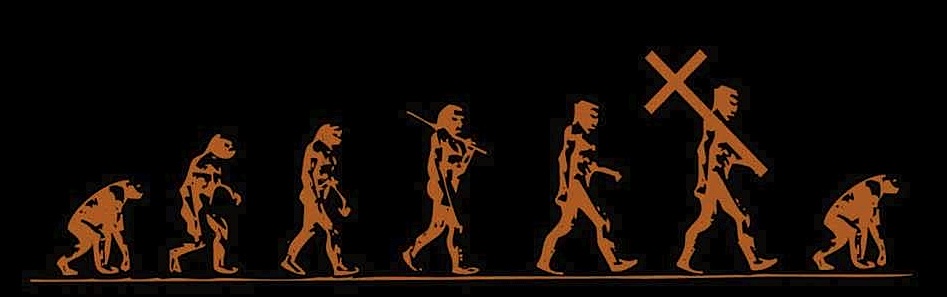
Obviously, the main vehicle driving Natural Selection is death and dying. This is one of the biggest hindrances that Christians have to the idea of Evolution. If our usual categories are correct of a “good” creation “falling”, and only then ushering “death” into the world, how does the thoughtful Christian deal with the realities of Evolution?

I think this Lenten idea of God’s “slain-ness” can help.
Continue reading

HAPPY ADVENT!! {10}


Well, it’s here. The day we’ve been building up to and meditating upon. This is the day we joyfully celebrate the King who broke into our reality and ushered in His Kingdom and our salvation by coming in the form of a little child.

Even though this time can be tough for some (my grandfather died a year ago tomorrow), I do hope and pray that we are all able to have at least one good laugh this year and see the smile of at least one person we love and that we know loves us. And eat good food. And drink good drink. And listen to bad, cheesy music. (On a side-note: the picture above is a picture of the wall-hanging that went up in my house every year as I grew up. And now I have it. I love it.)

Don’t worry, this isn’t really a whole other post. This Advent season has been an especially fruitful time for my writing (as my Facebook Wall obviously shows). I want to thank everyone that has been telling me how helpful these posts were–or even those that just told me they were reading them in the first place!. I can’t tell you how much it affects me, sticks with me, and encourages me. But anyway, I just wanted to write this post so I could put up all these posts in one place for you easy reading pleasure, should you so desire. Happy Advent!
Continue reading

What is the True Gospel of Advent? {9} (hint: it’s not your salvation)


As I mentioned in my previous post, my church has been doing an Advent series called “The Other Christmas Stories” where we’ve been looking at various texts (outside of the traditional Christmas narratives) that comment on the Advent event. Last week, our pastor preached from the book of Revelation, including some of these verses:

Then I heard a loud voice in heaven say: “Now have come the salvation and the power and the kingdom of our God, and the authority of his Messiah. For the accuser of our brothers and sisters, who accuses them before our God day and night, has been hurled down. They triumphed over him by the blood of the Lamb and by the word of their testimony; they did not love their lives so much as to shrink from death. Therefore rejoice, you heavens and you who dwell in them!”
–Revelation 12:11-12

Continue reading

our failed function, God’s full faithfulness | Advent {3}


This week, I’m meditating on a few particular aspects of the Advent event. I’m thinking through and writing about how, in Jesus, God inhabited our creaturely form, care-taking function, comprehensive fallenness, and communal formation.

As I said in the teaching I gave over the summer about the Nature and Narrative of the Bible, the opening chapters of the Bible describe this divine act of creating in very architectural terms; the same words are later used in describing the building of the tabernacle and the temple. In this we see that God’s act of creating was, in essence, building this world as his temple in which he would rest (for more on this see John Walton’s amazing book, The Lost World of Genesis One, or just watch this short video).

In the story, he builds and establishes this Temple-World, and then creates and ordains two priests–Adam and Eve–to be his representatives in this temple to care for it and work in it faithfully. In the ancient world, temples were usually placed in the midst of large and beautiful gardens which acted as extensions of the temple itself; to care for the garden was to care for the temple, and to make the garden larger was to expand the scope and size of the temple.
Continue reading

a beautiful quote on life & pain


One cannot cut the lines of experience out of one’s face, like the rotten bits in an apple; one has to carry them about in one’s face and know that one carries them; one sees them, as in a mirror, every day when one washes oneself, and cannot cut them out, they belong there. But all the same, it is a festive waiting, full of joy and sorrow and remembrance and good-bye for ever.

— from “Death of the Adversary” by Hans Keilson, our December book club selection for Staché

Posted from WordPress for Android on my Droid X

The Pain & Substance of Gratitude. Happy Thanksgiving.


Sorry that this isn’t your typical feel-good Thanksgiving post.

On Tuesday, my job had a large Thanksgiving lunch for all the staff and clients we serve. I got my food and sat down next to some of my coworkers and across from a client I had never seen before. She was very friendly. She didn’t ask me my name or anything; she just began asking me questions about what I was doing for the holiday, where I was going, if my parents were still alive/together, if I had any siblings, so on and so forth.

As she kept firing one question about my Thanksgiving week after another, I started to feel an awkward tension developing because I wasn’t returning any of these questions back to her. I wondered if my coworkers thought this was odd of me to do, but it was very intentional.
Continue reading

My February: Resolutions, Justice, Health, & Lent


This year has been an interesting year for my personal convictions.  Over winter break I read the amazingly helpful book Everyday Justice: The Global Impact of Our Daily Choices by Julie Clawson.  It goes through seven major and “mundane” parts of our lives and shows how there are major global inequities, amoralities, and injustices being perpetrated behind the scenes of all these spheres of living.  She explains, with both nuance and care, these issues and then offers super-practical, nitty-gritty suggestions for living life more justly in light of these things.

My New Year’s Resolution was to take one of her seven issues each month and try to incorporate a more just way of living into that.  The issues (in chapter order): Coffee, Chocolate, Cars/Oil consumption, Food, Clothing, Waste/Pollution, Global Debt.

January for me was officially Just Coffee Month.  Other than an Irish coffee I picked up at an Irish pub (which I couldn’t confirm its trade method),  I have not spent one cent on coffee that has not been ethically traded and certified as such.  Special thanks to my friends at Elixr Coffee (on Yelp), the new best coffee-shop in Philly, for offering amazing Direct Trade coffee choices (which is far more ethical than “Fair” Trade Coffee). Continue reading