 A couple of days ago, I laid out some reasons why “Christian” Existentialism was not the end-all-be-all philosophical orientation for the Christian. But, as I explained in my first post in this series, Philosophy is not the enemy of theology. Rather, it can help us understand other finer points of theology by giving us new categories to think in. So, I proceeded to give three ways that Existentialism can inform our theology. The first way was that it helps us see sin in regard to our personal orientation to God. This post continues with two more ways:
Secondly, a big discussion in Existentialism the relationship between our “existence” and our “essence”. I pointed out in the previous post that when god was asked by Moses “what’s your essence?” God answered “I exist”. This is the way it is with God. His nature and being are equated with His existence. He simply “is”. The big question concerning these two things in Existentialism is “which comes first?”. Classic Existentialism holds that our existence comes first and our essence is formed and shaped by our existence. This brings up some problems for the Christian. The Bible talks about our essences being known by God before we ever existed, but it also says that there’s something of our essence that is corrupt at its core. When God “knows” us before we exist, does he know our corrupted selves? Does God create us depraved? The Bible seems fairly clear in its representation of the nature of God that He doesn’t create and form our essences as corrupt, so it look likes the question is a bit more complicated than just “which comes first”.
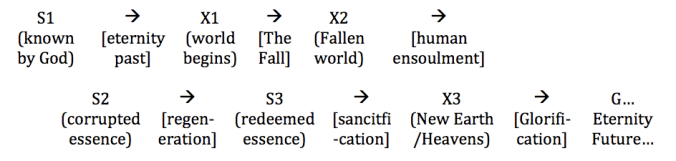
Best I can figure, it looks like both essence and existence have narrative frameworks and are seen as whole things that are shaped through eternity past and future. In short, the story goes like this: God knows and forms our essence-1 (S1), which is pure and good in his sight. He then creates the world of existence-1 (X1) which is made good but then falls and gives way to a different realm of existence, existence-2 (X2). At the moment this essence-1 enters into existence-1 (X1), it comes into the fallen world and becomes essence-2 (S2) which is corrupt. Christians, then, at conversion are changed at the very level of their essence such that they then become pure in essence (essence-3) living in a corrupt existence (existence-1 still). The rest of the life of the Christian is a slow work by God and others to bring more and more of this Christian’s life and existence in line with their now pure essence-3 (s3), to prepare them for existence-3 (X3). Existence-3 is when this created world/realm within which we exist is restored and glorified and finally our pure essences-3 are able to live in freedom and peace in pure existence-2 in glorified eternity. Here’s what it looks like graphically:
__________
__________
Lastly, there is a very important service that Existentialism lends to the spirituality of the Christian life. In Existentialism, there is a loss of the objectivity of knowledge. All we know is our existence, and that is a very small sphere of knowledge indeed. What this tenet of the philosophy does is create a very strong sense of angst. Existentialists carry the reputation for being very depressed people, seeing as they can know nothing more than (1) they exist, and (2) they can’t know more than that. We can be sure of no other knowledge. This makes you feel very small in a world of chaos that you can do nothing to change. This sort of worldview should make people very despairing, and it has for people such as Samuel Beckett and Albert Camus. But for others, like Jean-Paul Sarte and Soren Kierkegaard, Existentialism seemed to create a humble sobriety that actually allowed these men to enjoy life in a way many Christians could learn to do.
The Christian life is angst. It’s messy. It’s sloppy. That’s why it’s lived by faith – i.e. “trust”. Reality is such that we will be forced to have to trust our Creator to save us, because there really are no objective grounds (that we can know) upon which His salvation is based. This is because God knows He is the greatest of all things and our tendency is to drift from Him. It’s His love that makes us need to draw near. But, when we do, it shows us even more where we fall short and we cry out to God more. He draws even nearer and we are able to experience that One for whom our soul was made. Faith is not neat. Faith is not tidy. Faith is not naive. Faith is not imbecilic. Faith is having the courage to admit your finitude and inadequacy in order to be joined to and in communion with the Joy of joys, Peace of peaces, King of kings, and Lord of lords.
As one friend put it: “I will not resolve to embody that kind of [naive] faith ever again. So, I will read Scripture, asking God to communicate to me what in me is broken, what is unreconciled, what needs restoration, liberation, salvation. And I will sit at the foot of the cross, in the pain of who I am. And I will ask God for reconciliation, restoration, liberation, salvation. On the other side of it all, I will trust Christ more deeply. This is sanctification. This is working out my salvation in fear and trembling. And then, hopefully I will have caught my breath, and it will all begin again.”
Existentialism helps us recapture the “fear and trembling” part of working out our salvation (hence the title of Kierkegaard’s famous work).
I’ll end with perhaps my favorite set of quotes I have ever read. These have had such a profound impact on me and so reflect how I understand these things to be. These words are from the poet Joe Weil in an interview with Patrol Magazine. I leave you with these words that could have been written by the most quintessential existentialist:
“I once described faith as something I got on my shoe and can’t kick or wash off. I’m stuck with it. My poems are the trespasses and blasphemies of a malpracticing Christian, one who can’t stop ogling an attractive leg, or wanting to be first, who is venial, foolish, seldom at peace, horny and lonely, and so far from the kingdom of God that his whole life becomes the theme of that distance, someone knowing he is in deep shit. It’s the perfect place to be, where you can’t fool yourself into thinking you’re on the right track…The only thing I have to offer God is my sins. I am interested in mercy when it appears in places where you would never expect it. I am interested in love that shovels shit against the tide. I am interested in grace…It is better to be annihilated and crushed by God, if you are in love with God, then it is to have no relationship at all. Better God smite you then merely be absent. God does not ‘tolerate’ me. God loves me.”
 I found myself sitting in our joint Maundy Thursday service alongside the other congregation from which we rent space, frustrated. I was a little distracted because I had arrived late and my adrenaline was still going, making my senses heightened and my self-diagnosed ADD kick-in. I was also mad at myself for my own liturgical snobbiness, which had taken note that the service was technically a Good Friday liturgy that they were using on Thursday.

 the long way home