Crazy thought of the day: God Died. [QUOTE]


“The task of witnessing to the gospel is to vitalize the astonishing fact of the gospel. The message “the Son of God has died” is indeed most astonishing…. God has died! If this does not startle us, what will? The church must keep this astonishment alive. The church ceases to exist when she loses this astonishment. Theology, the precise understanding of the gospel, must be seized by this astonishment more than anyone else. It is said that philosophy begins with wonder; so theology begins with wonder. The wonder of philosophy pales before the wonder of theology. The person astonished by the tidings “God has died” can no longer be astonished at anything else.”

Kazoh Kitamori, Theology of the Pain of God

Lament & Remembrance (Nostalgia Can Hurt)


paul-window-bw-schrott

Lately, I’ve found myself getting very nostalgic, remembering past relationships, friends, places I’ve lived, and people I’ve known. And honestly, I don’t know why my remembering and thinking through all of these things in the past has caused more tears than laughter, especially in the area of relationships.

I have found myself lingering on the Facebook profiles of old roommates whom I’ve completely lost touch with inexplicably. I have been reading through old emails and blog posts that remind me of spiritual fathers and mothers with whom disagreements over the past several years have led to very real divisions..

And yesterday, I heard a song that reminded me of a situation a couple of years ago that was incredibly painful for me. It wasn’t really any one’s particular sin or moral failings that ended up causing all the hurt and pain; just the collision of people’s own baggage and immaturity and struggles. As I thought back on it I remembered the false ideal picture of reality I had blindly painted for myself at that time. I remembered the slow, painful process that was this picture being broken down brick by brick over the course of several weeks. I felt again the shadows of the anxiety and pain from that time.
Continue reading

Father Abraham, had many sons; and many sons, Moses did not.


Rothko-9-White-Black-Wine-1958So…I had my mind blown this past week.

I’m taking this class on the idea of “worship” in all its dimensions, and we read a few pieces that gave me an entirely new framework to understand the Bible, particularly the Old Testament, and how God works in those stories. And no, I’m not exaggerating.

In Genesis 15, God makes a covenant with Abraham, and it’s a little weird, mainly because it’s entirely on God. He promises that he will be Abraham’s God. He promises he will give him many descendants. He promises to make those descendants a blessing to the world. And, most importantly, he takes all of the potential negative consequences of breaking the covenant on Himself. In essence, he makes this covenant with Himself on Abraham’s behalf.

What’s Abraham’s part in this whole thing? “He believed the Lord; and the Lord reckoned it to him as righteousness”, the text says (and he’s supposed to circumcise his kids as a visible mark of his belief). This is one of the earliest and clearest depictions of the unconditional grace-driven nature of God’s relationship to humanity and the world–a relationship that would later be called “The Gospel”. In fact, the Apostle Paul would look at this moment in Genesis and say:

Just as Abraham “believed God, and it was reckoned to him as righteousness,” so, you see, those who believe are the descendants of Abraham. And the scripture, foreseeing that God would justify the Gentiles by faith, declared the gospel beforehand to Abraham, saying, “All the Gentiles shall be blessed in you.” For this reason, those who believe are blessed with Abraham who believed.

Okay….so what?
Continue reading

A Brief History of Christian Thoughts on Discernment


Caravaggio-Inspiration-Saint-MatthewThis is a post in our series exploring the ancient Christian Practice of Discernment.

In the last post of this series, I went through the short history of how decision-making had been done outside of a church context. I said that the main thing that unified all of these approaches was that they were all fairly impersonal. They appealed to abstract “forces”, “principles”, chance, or even technology help make difficult decisions. I concluded by saying that Christianity gives a very different approach to Discernment and decision-making; one that is personal, intense, risky, and terrifying.

Today I want to talk about that. The history of Discernment in the Christian Church has had a very interesting story. Hopefully you’ll see, along the way, the incredibly different ways Christians have approached this; but hopefully, you’ll also see the deep ways in which it has stayed constant throughout our history.
Continue reading

On Not Following the Christian Blogosphere (a plea)


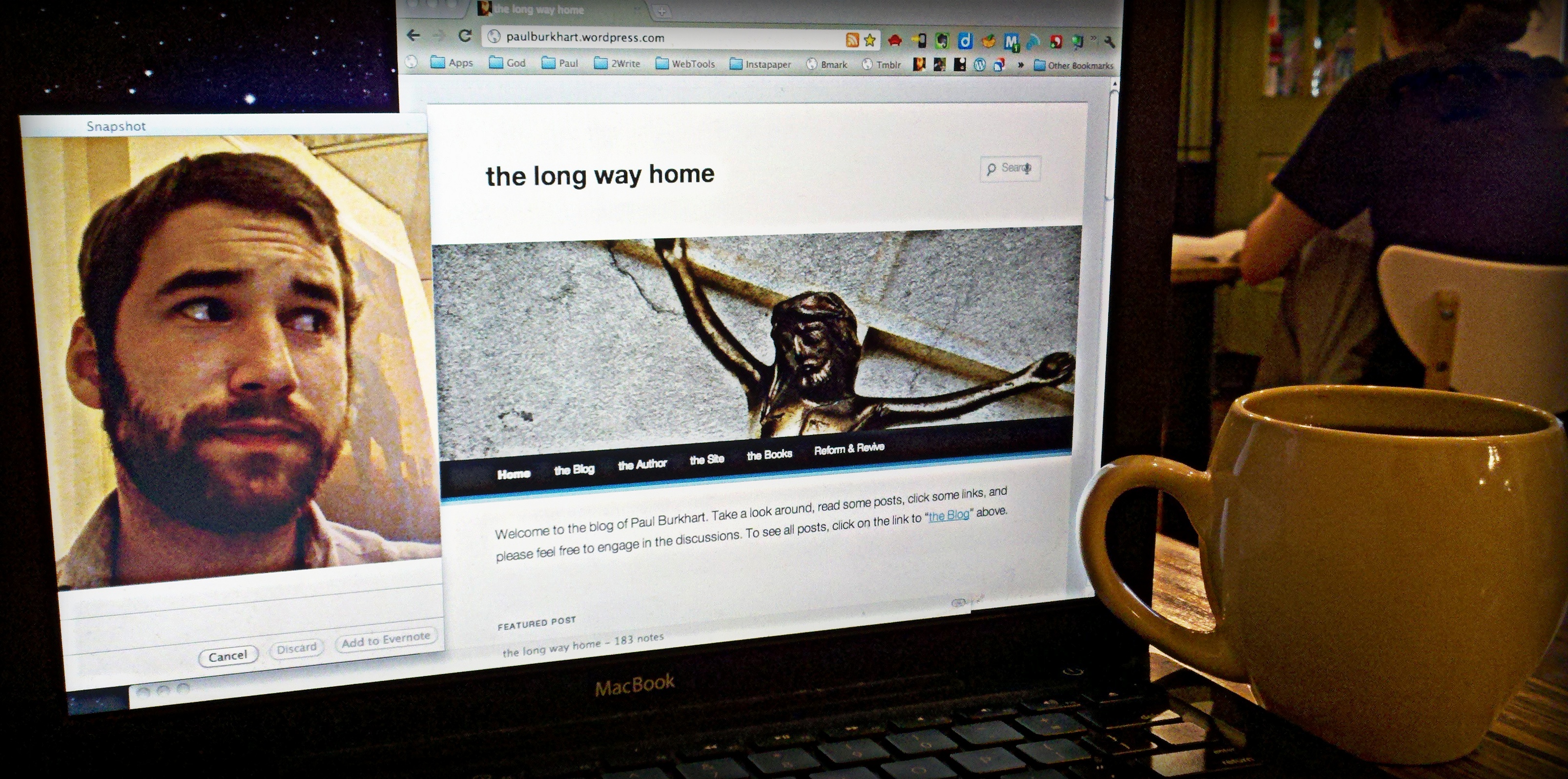
paul-blog-coffee

I pride myself on thinking that a large percentage of the readers of this blog have no idea of this odd subculture/alternate universe that is the “Christian blogosphere”. So for those that don’t know: there is a very large labyrinth of (largely evangelical) blogs and conferences and podcasts and websites that are dedicated to talking about “the” “Christian view” on any manner of things that (1) really don’t affect much of people’s real lives or (2) seem kind of weird to have a “Christian view” of.

It’s not simply talking about things from a Christian perspective (like this blog), but rather doing so with a particular reactive, evangelical, tribal “flavor”. I’m sure I fall into that at times here, but I’m not proud of it and I try to act against it.

the dangers of the Christian blogosphere

There are two primary things about the nature of these sites that more easily lend themselves to human weakness, I feel.
Continue reading

The Best Communion Prayer my Church has ever had


eucharist-bw-waferFather, your table proclaims to us your undying love for us. This table tells us that you do not simply endure our presence. This table tells us that you delight in being with us. You have invited us to feast in your presence.

So we have come to eat and drink deeply of your love for us. May we interpret our lives through this table. May we understand that we are a people with whom you are well pleased. May this reality energize us as we move into our world. May we live out our lives as your deeply loved, anointed children. Fill us with joy as’we labor for you in this world. Amen.

Liberti Church, 10/20/13

Are Cities too broken for Christians to fix them?


philly-city-hall-1As I go through these seminary discussions and readings concerning the relationship between Christians and cities, two things are pretty certain for me. First, God loves cities and had/has great intentions for them. Second, things went horribly, completely, and utterly awry.

I have the privilege of taking these courses along with incredibly thoughtful people. They haven’t just taken wholesale this newly “rediscovered” urban emphasis of Christian faith. They get the reality that God and the Bible have an urban-centric feel to them, but they really want to fight for a conception of God’s work in the world that comes to bear upon every person in every type of place in the world–not just city-dwellers.

And so I’ve been wondering: is this “urban call” to Christians a general one, or does it only go out to a very specific type of person? Are the difficulties in cities so big, so intractable, and so unique that only certain types of Christians with certain types of giftings could find a place for Kingdom work?
Continue reading

A Brief History of Liturgy (for those interested)


emergent-tree-house-churchYesterday, I posted some brief thoughts on liturgy and how it shapes us.  Those words were primarily taken from a document I wrote up a few years ago to train those leading liturgy. Today, I wanted to post another little section from that piece, going through an extremely brief history of liturgy in the Bible and how it developed in the early church.

Liturgy in the Bible

We see fairly early on that God intends for there to be a definite pattern or shape to worship among his people. He spends chapter after chapter talking about both the space and structure of the worship of the Israelite people in both the Tabernacle and the Temple. This continues in the Jewish community even today.

But at this point in the story of the Bible, the fullness of all that God will do to bring about our worship is incomplete, and so this worship is merely anticipatory of something that is to come. But throughout the Bible we get glimpses of a definite pattern to how God relates to his people–to how this story will eventually look in it fullness. This story–this pattern–is what forms the structure of our liturgy even today.

Throughout the Bible, repetition of form and phrases is used to shape the people of God. In the Psalms, the same phrases are used over and over again in the music. In the Old Testament, verses from other parts of it are meditated upon and repeated for worship.
Continue reading

How Liturgy Shapes & Makes Us


schrott-cross-church-office-apartment

UPDATE: I posted a brief history of liturgy and its movements.

A couple of nights ago, those that help lead and facilitate the worship service at my church met to discuss how we should continue to grow and remain faithful to our mission in the city of Philadelphia through our liturgy and music. It reminded me once more of how much I love being a part of this church and its tradition, and how excited I am to live life with these people.

Meditating on these discussions about our liturgy, I was reminded of the myriad of ways that the structure of one’s worship service forms the people that sit there each Sunday. I thought of how liturgy functions. If you go to a church, it has a liturgy: some structure that proclaims a certain story and shape of existence, and it changes people to fit into that shape and story.

And this got me thinking of a document I wrote up a couple of years ago to help train and encourage those leading liturgy at our church. In it, I wrote about six “facets” of the diamond that is liturgy. And that’s what I wanted to post here today.

These are some ways that liturgy acts to shape us. After each thing, I’ve given a sample topic and tried to show how liturgy functioning in that way can speak to and shape someone in that area. This was originally meant as a guide for people that introduce the service and try to acclimate people to the liturgy.

I hope this reminds us that liturgy matters, and being intentional about your liturgy is such an important part of leading and ministering within your church context. If you don’t serve as a leader in this aspect of your church’s life, and don’t really speak to liturgy formation, I hope this helps you recognize the formative nature of your church’s liturgy, and that it helps you connect to and engage with your church in a deeper, more intentional way. For more on this, I could not suggest more highly James K.A. Smith’s book Desiring the Kingdom.

Continue reading

Postscript: J. I. Packer’s Helpful Evaluation of Praying in Tongues [QUOTE]


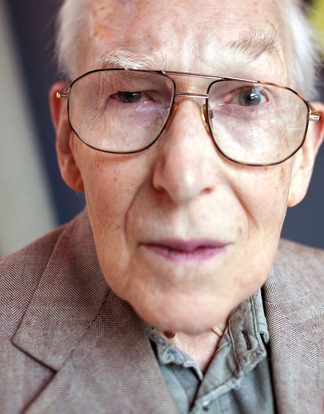
ji-packerI just have one more thing to post in this little series on my charismatic sensibilities. Yesterday, when writing about praying in tongues, I quoted from this long piece that J. I. Packer (the spry man to the left) wrote evaluating the charismatic movement as a whole. It’s a heavy article, but if you get to his conclusions, they are very interesting.

Packer is a Reformed Anglican, and believes that the “sign” gifts (the “extra-crazy” works of the Holy Spirit) have now ceased and were only used for a time to “get the church going” as it were. (If it weren’t clear, I think this designation of “sign gifts” is incredibly arbitrary and I think you have to twist the Bible backwards to prove that these things simply stopped at some point in time. I think they are still very much with us, however neglected they may be.)

But still, he is incredibly gracious to the charismatic movement and sees it as a legitimate expression of God’s people seeking a greater communion with him, and even believes that they need to teach the old Reformed fuddy-duddies (is that how you spell that?) a thing or two. I found his comments particularly on tongues especially delightful, and I thought it would be a fitting post-script to these posts I’ve been writing on my own charismatic side. The paragraph breaks in this quote are my own, for ease of reading. Continue reading

Charismatic Confessions, pt. 3: Praying in Tongues for Everyone!


flickr-sculpture-worship-kiss

{abstract: “Praying in tongues” is not really a “gift”, but rather a way in which God makes Himself known, and we commune with Him. Therefore, I believe it’s open to all of us, not just those with a “gift”. It is a sacramental, physical participation in the “real presence” of God praying within you. It may very well be random and not a “real heavenly language”, but nevertheless, God is sacramentally mediated to us in it. I conclude by offering some brief practical encouragements.}

Last week, I started writing some posts in response to a New York Times piece about research concerning the practice of talking in tongues. I wrote about how this piece reminded me of my own charismatic side and how I’ve been neglecting it. I then talked about my views concerning the use of tongues in a corporate Sunday church context. Today, I want to give people a realistic and (hopefully) sensible framework for understanding the private use of praying in tongues.

Continue reading

Charismatic Confessions, pt. 2: Tongues Don’t Have to be Weird


peter-preaching-statue{abstract: The Bible talks about two types of tongues that take place among the Church: speaking in human languages that get translated, and speaking a “heavenly language” that sounds like non-sense and an interpretation is given. The apostle Paul encouraged people to prefer speaking in regular human words rather than tongues, and this practice turned into the later historical practice of rooting authoritative Church speaking in Bible-based sermon preaching. Paul then encourages, and I have embraced, that we move speaking in tongues away from a corporate church usage and a private, prayer one. The next post will talk about praying in tongues.}

UPDATE: Part 3 is up, where I talk about the what, why, and how of individual praying in tongues.

Yesterday, I got thinking about my charismatic past. I mentioned an Op-Ed piece in the New York Times about recent research on the phenomenon of speaking in tongues. This got me thinking about my own charismatic past and experience of these sort of things, and reflecting on how little a part of my life those things are now. Except, that is, for personal praying in tongues.

A couple of nights ago, I raided my bookshelf and pulled down every theologian that may have said anything about this phenomenon and looked through all of them. Every person said something different. There are so many different opinions about tongues. I don’t write this post to sort out this issue or give a definitive account or defense of where I land. I just want to introduce some people to this idea who might otherwise be weirded out, strongly against it, or don’t really know what to think about it.

Continue reading

Some random, contradictory thoughts on Hell. Discuss.


Rothko-untitled-2Below, you’ll find a random assortment of 30 completely disjointed musings on Hell. Each paragraph is its own statement, in no particular order. This is not meant to be a discussion of where I currently land on this issue. I’d love to just get your thoughts. Respond as you like, below.

(1) In the past 10 to 15 years, the American Church saw a new emphasis on Idolatry as the foundation of sinfulness, rather than “Law-breaking”. I’m starting to see a new re-emphasis on Law-Breaking and Hell as punishment for this. And yet, the “Law” is always connected to God’s Image and Character, and so Law-Breaking is living by a wrong law, or image, and therefore is idolatry. We have an analogy for how a Judge responds to breaking the law, and this leads to the popular view of Hell since Medieval times. But what is the analogy for the response to transgressing an image?

(2) Can any Universalist tell me what the point of missions or Evangelism is in this life, if their perspective is true?
Continue reading

“Simplistic Atheism: a final response” by Daniel Bastian [GUEST POST]


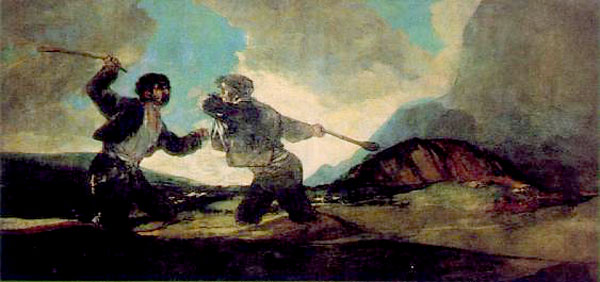
de Goya-fight with cudgels"

(Note: These exchanges are now complete. There is a Table of Contents to the discussion now available.)

Well, it seems that we were not in fact done with this little series. After my final post, Daniel chose to take me up on my offer to have the final word (as I normally try to do in exchanges like this). He has chosen to respond, point-by-point, to my list of what things would lead me to embrace Atheism. If you feel like any of the points still demand a reply from me, or if you have any questions about what Daniel says, feel free to to comment here, on Facebook, or get in touch with me privately. For my part, though, I consider this particular set of exchanges finished. Once again, I thank Daniel for this exchange. I hope you enjoyed it as well.

Paul,

When I initially decided to compile a list of criteria that would convince me my conclusion on the question of theism was wrong, I had sincere hope that a Christian, Muslim or other person of faith would tally up a corresponding register. I am glad to see you rose to the challenge and enrolled in this dialogue. It has been a wonderfully enlightening experience for me, and I do hope that sentiment is mutual.

I read your piece the day it was posted and while at first I found much of it persuasive, the more I reflected the more I realized it was probably the list I would have drafted two years ago, before I renounced my faith. Much of your criteria seems to rest firmly on the aesthetic appeal of the Christian narrative. And this would seem to slot right in line with your epistemological moorings-a concern for the communal connection, compelling force and overall mesmerism of a worldview over against its underlying facticity.

Yet it seems this only holds true up to a certain threshold, given a few of the items on your list. You seem to be OK with affirming the faith given its impact on your life, the power of influence you’ve seen it have on history, and the way it has shaped others with which you’ve crossed paths. But if you were to discover beyond reasonable doubt that this narrative was based on so much myth, that this loosely corroborated Yeshua the gospels are based on was a mere mortal (item #1), you would relinquish the faith forthwith.

Thus it seems to me that our epistemic divergence is one of degree, not of type. With that in mind, I’ll attach some brief notes beside the items in your list. Continue reading