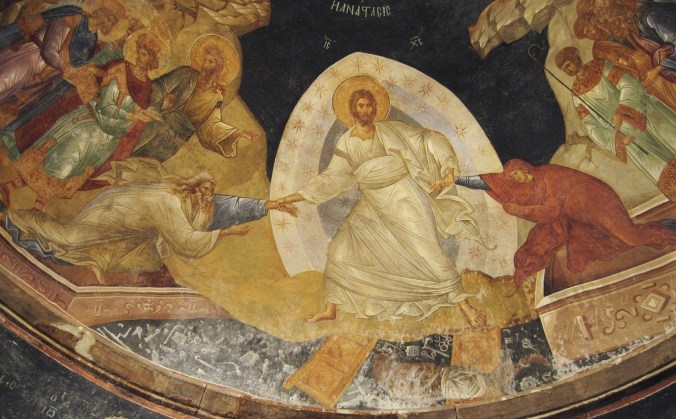
The Gospel: The Limitation of God


The question came from a friend of a friend; a fellow pilgrim, sojourner, doubter, skeptic, thinker, brother:

If God is omnipotent [all-powerful] can he use this attribute to limit his omniscience [all-knowing] or omnipresence [all- er…present]?

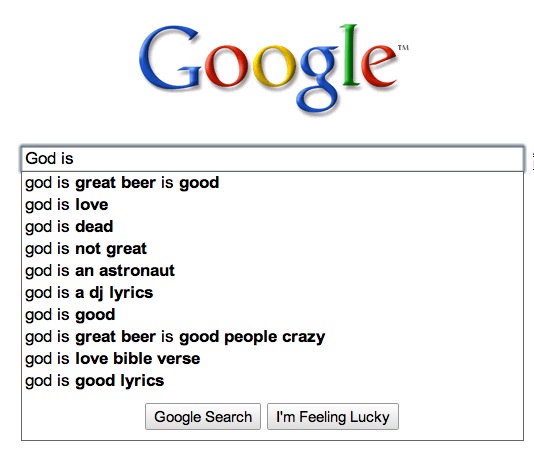
It’s an interesting question, similar to the whole can God create a rock that’s too heavy for him to lift? or (my favorite) can he make a burrito too spicy for him to eat? I think part of the issue here is how we view the idea of attributes.  In our Western, scientific, and post-Enlightenment mindset, we often think of people as fully assembled “systems” of interconnected attributes.  And so, like the chemical compounds that create our physical bodies, we assume that these attributes are separate things that have come together to make us who we are.

Continue reading

The Gospel & Hospitality (a liturgy)


[This was a liturgy I delivered at my church a couple of months ago, while we were going through our series “Practice Resurrection”. You can hear the sermon delivered that Sunday here.]

Greeting and Preparation

Leader: Alleluia! Christ is risen.
People: The Lord is risen indeed. Alleluia!

Hi, my name Is Paul. Welcome to Liberti: South Philly. We’re a community of believers in Jesus Christ wrestling and struggling trying to learn what it looks like to live in the tensions and ambiguities of an ever-changing world; of a world whose systems too often attempt to isolate and pull each other apart. Maybe you’ve graced these pews many times before, maybe you’re still trying to get over the shock that you’re actually sitting in here in the first place. Either way, we want to welcome you today. We hope your time here is meaningful and that you feel the freedom and invitation to wrestle and struggle alongside us.

The aspect of Christian faith we will be exploring today is hospitality. The God of Christianity is not a distant god demanding things of us; putting ever-increasing weights upon our shoulders. Rather, he is a God that removes our burdens, shows us what a well-lived life looks like and invites us in. He invites us into the experience of His Self and His Works.

Continue reading

Wright, the Neo-Reformed, & Unity in the Church (If you read one thing all day, let it be this)


easterDon’t worry, the title is not referring to this very blog post you are reading right now.  It’s actually referring to this article at Christianity Today by Brett McCracken:
Wrightians & the Neo-Reformed: ‘All One in Christ Jesus – A dispatch from Together for the Gospel and Wheaton’s Theology Conference with N.T. Wright

The article compares and contrasts the general ethos of two very different conferences that occurred very close to the same time.  One conference was the Together for the Gospel Conference and Wheaton College’s Theology Conference with N.T. Wright.

Continue reading

On Palm Sunday (or, “Oh, the Glory, the Beauty, & the Tragedy of Being Human!”)


This past Sunday was Palm Sunday, the Christian holiday that ushers in Holy Week. It celebrates the “triumphal entry” of Jesus into Jerusalem (Mk 11:1-11). Seen with the insight of hindsight, though, this is one of the oddest “triumphal entries” one could imagine. It is the triumphal kick-off for what will be the death of the Son of God.

Lately, I’ve been thinking about the common “courtroom” analogy for the Gospel. You’ve surely heard it: You are standing before a judge. You are guilty. The punishment is death. It is a right and just penalty for your crimes. But then Jesus comes in and freely offers to take your punishment for you on your behalf so you can be set free. Will you accept this gracious offer?

Many an atheist has pointed out the logical flaws in this analogy, but I think there are even bigger issues I have with it. Really, it only works if the parties involved in this switch are seen as equals. A pure man for a guilty man — seems like an even trade, right? But how does the death of this one man absolve the sins of a multitude? How is this even just?

Continue reading

On Holy Week, Idolatry, & Suicidal Ideations


This week marks the most important week of the entire Christian calendar. It’s Holy Week; the time we meditate upon Christ’s Passion — the last week he spent in Jerusalem during the Passover preparing to be the true and perfect Passover Lamb. This is also the final week of the Lent season. For weeks now we have celebrated the angst, tension, and pain of Lent. This has been a time where we have focused on the fact that we have not yet become who we will be, and we still live in much of that old way of life. This has been a time where we look our idols in the eyes, hear their whispers and discern what they have been promising us and what we have believed they can give. Love. Security. Affirmation. Rest. We seek all these things under the sun, but all these things find their Source beyond.

Continue reading

A Great Deal from the Westminster Bookstore


Just wanted to drop a quick note to let everyone about a great deal I saw at WTSBooks.com. I’ve long said that Westminster Theological Seminary’s Bookstore is the best bookstore I know of.  Between classes, it where we’d go to have fun.  It was like a candy store for all those theologically-inclined individuals.  They’re dirt-cheap (more often than not cheaper than Amazon) and usually have some good deal going on.  And this one is no exception.  Two brand new books.  $14.49.  Here’s the link:

You Can Change/ What Is The Gospel (Two Pack)- WTSBooks.com

I’m most excited about this first book, You Can Change: God’s Transforming Power for Our Sinful Behavior and Negative Emotions by Tim Chester.  A little while back I read a book he wrote with Steve Timmis, Total Church: A Radical Reshaping Around Gospel and Community.  That book changed my entire perspective on the Church, the Gospel, preaching, and simply living life as a Christian.  It put many of the pieces together in my mind concerning the Church and spirituality and their place in society.  I became convinced that these guys “get it”.  They have such a full understanding of the Gospel in a corporate context, so I’m so pumped to see Chester’s thoughts on the Gospel on an individual level.  Here’s the trailer for the book:

Continue reading

Open Mic: A Prolegomena of Transgenderism (pt.ii)


UPDATE: This series is finished. Part 1 can be found here and Part 3 is here.

Yesterday, I started a little miniseries on Transgenderism in response to a question a friend sent me. They were wondering how Christians are supposed to look at this particular issue. I laid out the questions and definitions involved here and asked for feedback (be sure to read all of those comments). Today, I’m talking about a “Prolegomena of Transgenderism”.

Prolegomena” is just a big (but appropriate) word that basically refers to all the things we must keep in mind before trying to answer big questions. For example, in Systematic Theology, Prolegomena is when we lay out the very foundation of our knowledge about the given topics and the presuppositions that will guide us through the rest of the endeavor. That’s what this post is. I want to explore a couple of perspectives that have driven a lot of the answers I’ve seen about this before trying to come to firm conclusions in the next post. So, with all that being said, let’s get started.

Continue reading

The Bible, Slavery, & Atheism: Part 1b


this is real (I did it myself)

The next post is pretty much done, but I wanted to send out this quick note before moving on. The previous post revealed a lot of things that I neglected to make clear. My fault. Sorry.

First and foremost, the last post was not meant to settle the question on slavery and the Bible. I just wanted to get out what the Bible actually says about it. The most I wanted to accomplish toward addressing the issue was to let people see a clear trajectory within Scripture wherein no part is inherently contradictory to the parts before or after it, no more than a seed is contradictory in nature or form to a fully blossomed flower. I also wanted to give a sense of the complexity of the issue. In every passage that lies out even the most comprehensive sets of morality and ethics for the Israelite people, you never see slavery there. It was never an action that was consistently seen as something moral. It’s not a freedom that the Israelites are free to use whenever they desire; it’s used sporadically, meaning that there must be something else going on beyond some explicit commentary by God on the moral nature of slavery. The New Testament is clear that the crucifixion of Christ was something that was foreordained and ultimately brought about by God, but this neither expunges the moral responsibility of the people that actually did it, nor says that God is all about crucifixion and thinks it is “morally neutral” or “ethically okay”. He clearly thinks it is wrong and evil, and yet He clearly ordained it, allowed it, and used it to bring about his promised redemption to the world.

Continue reading

The Gospel is Beautiful{12} | it is finished


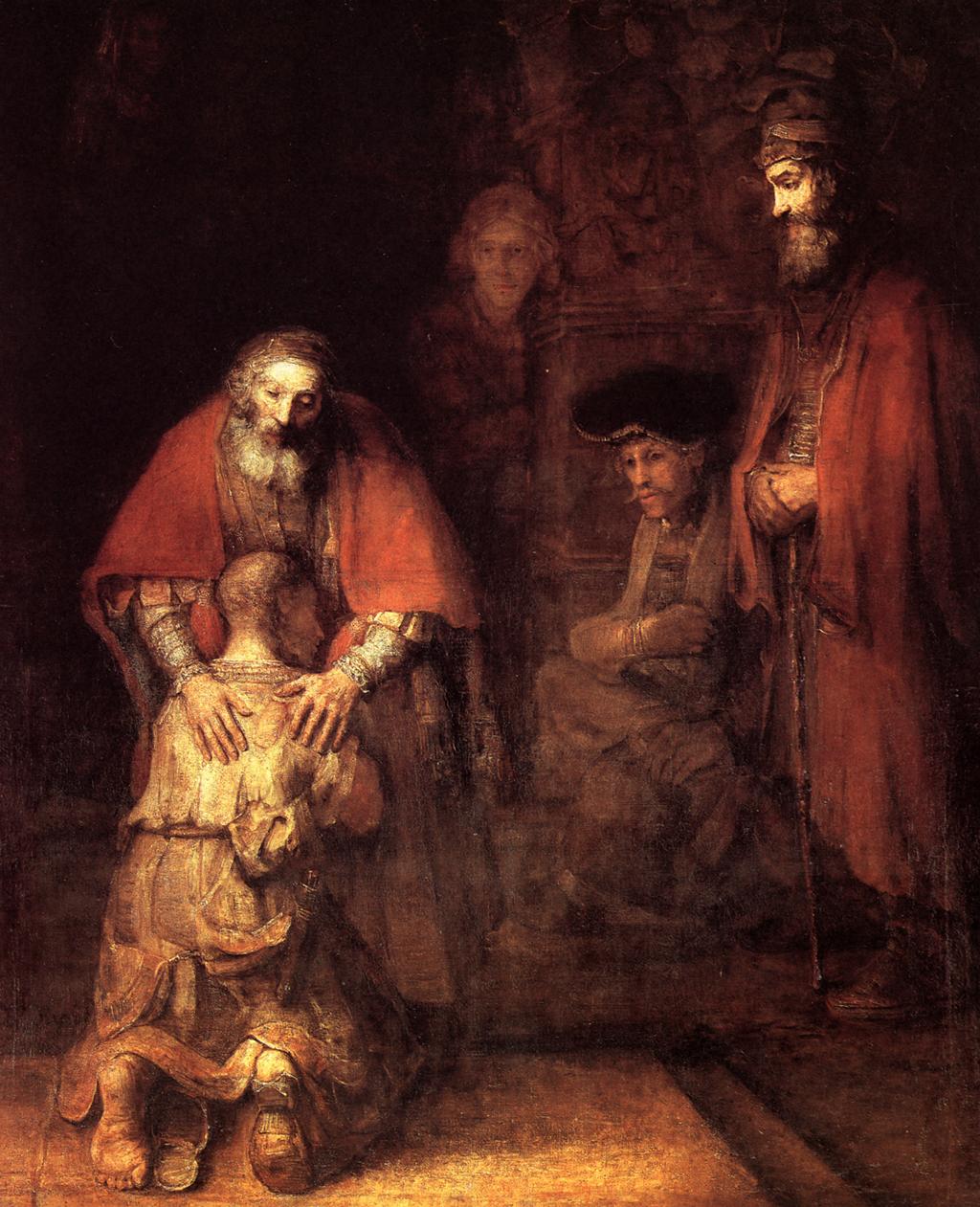
Rembrandt-Return of the ProdigalWell, it’s done. This is the end of the Beauty series. I won’t say too much, because this part is long enough already. I would just remind all of you of two things. Firstly, this whole piece began with the story of the most beautiful thing I have ever seen: the city of Edinburgh as I stood above it on top of a hill in the city. Secondly, our definition of Beauty: Beauty is the attribute of something that expresses complexity, simply. It what takes the complex strands of the world, reality, experience, or God and weaves those complexities into a simpler tapestry which we can perceive with our physical and spiritual senses. The more complexity expressed more simply, the more beautiful something is. And with that, let’s finish this thing out. What’s coming next? I have a post ready for that that I’ll post up in a couple of days. We pick up right where we left off

In conclusion, I want to talk about the thing that ties every one of these things together. The thing in which there exists in a glorious and beautiful harmony between all the different things we’ve talked about tonight. The last part of our text tonight, Ecclesiastes 3:15 says “That which is, already has been; and that which is to be, already has been; and God seeks what has been driven away.” God seeks what has been driven away.” In conclusion, the Gospel is Beautiful. The Gospel, in short, is the story and message of Christianity. It comes from the Greek word meaning “good news”. So what is this good news for us? The news that God did the ultimate act of beauty. The ultimate act of condescension of filling this finite world with the most Infinite of Beings for the sake of knitting it together again, and actually ultimately filling it with Himself. You see, God began History and ordered it in such a way that it was beautiful. He filled this simplicity with the marks of Himself, so all things pointed to Him and reflected Him perfectly. Humans came on the scene and were made in His image so that they as well truly and purely reflected, represented, and “Imaged” (that would be the theological term) this God on earth. But sin entered into the world, and made this world fallen from its original place of beauty. And we have followed suit. You see, sin is not finding certain things, people, or places beautiful. It’s that we find them more beautiful than God and these responses that are due God, we give to other things. We worship and “image” and express fallen simple things rather than the Holy complex God. We all have done this. I have done this. You have done this. You have soiled your beauty and abandoned it to your lusts! You no longer represent the One whom you were meant to mirror and reflect and therein find your beauty! You merely represent the world. The lowly fallen world. Fallen people imaging fallen things. There’s no beauty in that.

But God, being rich in mercy. Though we have abandoned God’s beauty and our own true beauty, God has not abandoned them. He loves His Beauty. And He loves the Beauty of His creation. So this God, for the sake of the worship His own beauty, and our own own joy in His Beauty, comes. The most perfectly knit together tapestry in the universe chooses to come and express the most Holy Complexity in the most intimate simplicity. This perfectly woven tapestry walks the earth, lives the perfectly woven life, and then stares into the cup of God’s perfectly woven wrath reserved for all things and people that are not beautiful in this world. And he drinks it. This perfect tapestry of complexity expressed simply goes to the cross willingly and allows the tapestry of His soul to be torn apart strand by strand by strand as the wrath of God that hung over everyone who would believe was gathered by God and poured it on Himself. That wrath that hung over many of us in here. That wrath that hangs above some of us tonight, that will be poured out on something. Either on Christ at the cross, or in you in Hell. Did you know that Hell is beautiful? Not for those that are there, but it is. It is pure, white, Justice and Wrath poured out on all that was wrong in the world. So God’s wrath will be poured out either in Hell or the Cross.

And history revolves around this cross. Because at the same time that Christ, Beauty Itself, was literally being torn apart, he was reconciling all things to Himself. In other words, he was taking every stray strand in the universe – every bit of evil, suffering fallenness there will ever be in history – and reserving its proper place in the final tapestry of History that we call heaven. He was making Himself the common glorifying thread that would reknit the broken fabric of a broken creation. And so we live now in the process and story of God putting all those strands in their proper place. As more and more beauty floods the earth He is still inviting his people to join Him in this epic story. He is calling his people to praise Him and draw near to Him, and out of the overflow of that to proclaim His Beauty to others and make more beauty, so as to usher in this new creation – or to put it in our terms tonight – the New Tapestry of Creation. Better than before. It is the one that has woven in it the purpose for all pain, sickness, death, and dying that God has ordained and allowed to take place so that this tapestry might make good on it all to the praise of the Beauty of God’s name.

And we, His people, His Bride, those that are “in Christ”, that are simple people Imaging and expressing the most complex of Beings, are woven into that tapestry that is Heaven and the New Creation. We’re not just going to live in it, we are part of it. Second Corinthians 5:17, in most Bibles reads: “if anyone is in Christ, he is a new creation. The old has passed away; behold, the new has come.” But that’s not what it says in the Greek. It doesn’t say “if anyone is in Christ, he is a new creation”. There is no “he is”. The Greek literally says “If anyone is in Christ: new creation!” More accurately, I think it should be translated “If anyone if in Christ, this is the new creation. he old has passed away; behold, the new has come.” I remember an old professor at Westminster named Richard Gaffin. He used to go up to students, stop them, and just say to them “you are just as resurrected now as you will ever be”. We often forget that. Yes, we will get new bodies and the penalty, power, and presence of sin will be done away with, but as far as our souls go, we are as resurrected now as we will ever be.

We are the new creation. The new tapestry. We have been woven into the fabric of this ever-increasingly redeemed world that is being flooded with the Beauty of God. The new has come in Christ. Through the Gospel. The good news of our salvation is that all that has been ugly with the world and in ourselves has been conquered. Beauty is here, and Beauty is ever increasingly filling the earth, and this Beauty is our salvation from ugliness and sin. George Marsden in his incredible biography of Jonathan Ecdwards ends the whole book with this summary of Edwards’ view of all of life and salvation. He says that

“[Edwards believed that] God’s trinitarian essence is love. God’s purpose in creating a universe in which sin is permitted must be to communicate that love to creatures. The highest or most beautiful love is sacrificial love for the undeserving. Those. . . who are given eyes to see that ineffable beauty will be enthralled by it. . . They will not be able to view Christ’s love dispassionately but rather will respond to it with their deepest affections. Truly seeing such good, they will have no choice but to love it. Glimpsing such love . . . they will be drawn from their self-centered universes. Seeing the beauty of the redemptive love of Christ as the true reality, they will love God and all that he has created.”

The Gospel, this salvation, is beautiful.

And we receive this salvation by seeing its Beauty, turning our stirred affections toward this God, and trusting that we cannot reknit our own souls but Christ has reknit them for us. And as our affections are further stirred we press into Him ever increasingly as He draws ever-nearer to us. I pray, I plead, that those in here tonight that have not done so, would trust this beautiful God to have accomplished for them what they could not do for themselves. Please, consider this story, this message. See if it is not the most beautiful thing you could ever conceive. Just for a moment, see if something in you is stirred for this God. Even if you don’t believe He exists, or that He is this particular God that I have spoken of tonight, is there something in you that at least wishes it were true? Wishes it were this way? Wishes that God did in fact arrange everything to make it all beautiful in its time? Even if you won’t admit it, if that’s true, if you did wish this were the case, don’t ignore that. You have been designed to long for the Beauty of this Gospel, this story. Don’t ignore it. Sovereign, Beautiful Father, Lover, and Lord, save people that read this.

In conclusion, I’m going to break every rule I learned in my preaching class this last semester about how to end a message and end mine tonight with a poem. But not someone else’s poem. This is a poem I wrote in one take one particular afternoon through broken tears standing on top of a hill looking out over the city of Edinburgh as I was taken over by the most beauty I’ve ever seen. Let this encourage the weary saints reading this blog post, and let it perhaps woo those that have yet taste what these words are about. You can find the poem here, or just click in the section above entitled “The Site”.

Here are the links to the full manuscript and the full audio of my presentation of this material:

Click for Manuscript Pdf

Manucscript

Click here for sermon audio

Audio

Eternity in Our Hearts: The God of Beauty, the Beauty of God


Sargent - Madame Errazuriz-smallThis message was seven months in the making, and this past Friday I finally delivered it.  So, as promised, I’m posting both the audio and the manuscript here.  You can also find a general outline on my Sermon site, and you can also find it at my Podcast.

Click here for sermon audio

Click for Audio

Click for Manuscript Pdf

Click for FULL Manuscript

This is the message I gave at Epiphany Fellowship. The topic was Beauty. The attached manuscript is the full manuscript. It is 43 pages long and contains far more information than I was able to give in a 40 minute message. It includes an appendix where every form of every word in the Greek and Hebrew translated as “Beauty” or “Beautiful” in the English Standard Version of the Bible is ordered by frequency and includes the literal meanings and lexical range of each word.

I really cannot stress how much more is in the manuscript than was preached.  Every section has huge amounts of thought and prayer in it that was not able to be included in the final message.  That’s why throughout the next week or more, I’ll be blogging about every section of this manuscript.  Each post will focus and discuss the fuller version of each section.  If it gets to be too much I’ll spread it out as need be, but we’ll see.  This is where your thoughts and insights will be so helpful and needed, but if you have a question now, don’t feel like you have to wait for that blog post to come to ask.  Engage with any and everything now.

I hope this blesses all of you as much as it did me.  The feedback that evening was more than I knew how to handle and perhaps I’m still processing it.  Thank you all for your grace and affirmation.  For those that came out, I thank you. I very much enjoyed both preparing and delivering this message, and I look forward to further chances to do so.  If you’re interested in giving me such a chance, feel free to use the contact email on the sidebar to the right (or just click here).

Enjoy, and feel free to let me know what you think, and please at least look through some of the manuscript.  Until next time . . .

One small final note: on most every site and post I’ve used to discuss this message I’ve used the attached piece of art.  It is a piece called “Madame Erraruriz” and it is by my favorite American painter John Singer Sargent.  I got to see this painting in an exhibit of his at the Virginia Museum of Fine Arts and ever since seeing the brushstrokes in this simple painting and seeing the nuances and the subtleties that don’t quite come across from this digital shot, I have long found it to be one of the most beautiful paintings I’ve ever seen.  It is for that reason I have chosen it as the picture that has constantly been up for all these posts.  A few years back I even wrote a poem based on the piece called “Extended Engagement”.  I ended up writing two versions, one less structured than the other to better mirror the feel of the piece, but on this blog you can read both Version 1 and Version 2.  Let me know which you prefer.

The Bondage of the Will: An Exhortation to all Christendom


anastasis-resurrection-dead-hell
This post will primarily be a response to Tyler’s comment that the previous post on this site consisted of. A brief historical investigation surrounding the context of the piece I stole the title for this post from may help shed light on the passion I hope will come through.

[One quick note as a final point on the topic of the biases of the religious studies department at VCU: there is not a single full-time professor that is a professing Christian. All full-time professors in the religious studies department are either secular humanists or of other differing faiths.]

I want to put one more quote from Tyler on this post:

In reference to the other guy who posted here, Paul is an incredible orator and debater. He quite regularly makes atheists his unholy bitches on the record. He’s as committed to his faith as Stephen was, but he is smart enough to take you through an interesting dive into Judaism. His site can link you to some of the best arguments against the Bible on the face of the Earth, but the man is such an intellectual juggernaut that he builds a scaffold around the detractors, prays and then floats his way to the top.

The night I received this comment, I went to bed with the words “intellectual juggernaut” haunting my thoughts until I fell into my slumber. Sure, to an extent I was both flattered and encouraged by these words, but for the most part, I was deeply troubled and dismayed. I knew then that I needed to write this post.

This is to all Christians out there: I have known Tyler for over a year now, and consider him a dear friend and compatriot on this path called life. As he himself said in the comment, though, he is not a Christian, as most of my friends also seem to not be. We have had many, many talks. I have answered so many, many questions, read so many, many bible verses to him and for him and yet, he is not a Christian. Why?

It is true. I know a lot. I make it my business to know as much as I can about everything. I can theorize, postulate, formulate, philosphize, orate, debate, lecture, and preach with the best of them. I have read much, spoken much, debated much, and thought much. I can present the peculiar doctrines of the Christian faith in such form that little can stand up against it. I am indeed by all measures, forms, and fashions, an “intellectual juggernaut,” but what good has it done for Tyler? His soul now rests in the same state now that it did over a year ago. I have answered every question, withstood every refutation, stood in rooms surrounded on all sides by people differing in their beliefs from me in every way, shape, and form seeking only to see my demise, with him watching. I have presented the gospel in every way, with every scientific, psychological, historical, rhetorical, literary, philosophical, archaeological and spiritual backing, and to what end? None. As of yet.

My point in this whole post can be summed up thus: Christian, facts don’t save people, debates don’t save people, arguments don’t save people, intellects don’t save people, orators don’t save people, sermons don’t save people, philosophies and refutations don’t save people, nor do “intellectual juggernauts.” The Gospel of God by the power of the Holy Spirit through the atonement of Jesus Christ saves people. “For I am not ashamed of the gospel, for it is the power of God for salvation to everyone who believes.” (Rom. 1:16)

This Gospel of God has become so sweet and so precious to me in past year and a half, it pains me to see the affections of one I love so dearly, not turned to the only source of true delight in the midst of the inevitable sufferings life will bring. That is the Gospel. While we were yet sinners not seeking God, unrighteous not because of acts, but because of being; by nature children of wrath, who awoke every morning without God being their first thought, highest treasure, primary desire, most awe-inspiring thing, he sought us. He came and lived the life we were supposed to live and paid the price for the life we live now, so that those whose spiritual taste-buds are changed to have God and Christ be their sweetest desire, could be forever enthralled by Him, like 10, 000 sights of the supernova or the grand canyon. Not so that they could be delivered from pain and in that get joy and rest, but be given God Himself as our joy and rest so we can tread through the fires that all humans go through, not as a coping mechanism, but as a new being, rejoicing in all God gives them, good and bad.

Tyler, as I know you will read this, hear this: you are a vulgar, disgusting, evil man who has not only broken all the commandments of an eternal Creator, but also does not desire God, seek God, long for the grace of God to resurrect your dying soul and quench that eternal spiritual thirst for His life you know you need every time you ponder your life in the dark hours of the night before you sleep. Yet, though all this is true, God has found it to be His delight; His delight!; to see one such as yourself brought near to Him and have your affections changed so as to long for Him and receive Him as your joy and peace and happiness, that His “joy may be made complete in you,” that you may magnify his glory in this earth.

How can I say this with such confidence? Everything I just said is the story of my life. It is the story for every Christian walking this planet. It is the state of every Christian, at the point in their lives that their souls are called upon to see the revealed grace of God extended to them, to make them “white as snow,” and the make the only decision they possibly can: to long for God, and in that overflow want to obey Him. This is the Gospel that Jesus lived, breathed, and died. This is the Gospel that has saved every Christian since the dawn of time, from Abraham in Ur to Paul Burkhart in Richmond, VA to perhaps, Tyler Bass.

In summary, Christians, preach the Gospel, preach the Gospel, preach the Gospel! That is the only thing that can bring those we love to the only source and fountain of joy, peace,love, and rest they will ever desire, not our facts or knowledge.

Be not discouraged if you have not read every Lee Stroebel, Josh MacDowell, or C.S. Lewis book. Don’t feel useless or not “relevant” if people don’t call you an “intellectual juggernaut,” because those words will only haunt you as you realize the futility of all man’s wisdom, even that which defends God. How even that wisdom is only as good as God uses it to be. So desire that knowledge, seek it, but rely not upon it, for it is not the power of God for the salvation of all peoples. Only the sovereign work of God and the Holy Spirit can do that. So, preach what the Bible calls the “foolishness of God!” I mean, our savior died! According to the unChristian world, where’s the wisdom in that. It only goes to show you how this could not have been just “made up” by man. No human could ever come up with such a foolish story for a faith.

Only God could establish a story for redemption that was so wise beyond the perceptual framework of man that man would just have to push it off to the side and call it weakness and foolishness, when it has brought empires to their knees, for it is the power of God for the salvation of all those called to be His for His glory.

“For who has known the mind of the Lord, or who has been his counselor? Or who has given Him a gift that he might be repaid? For from Him, and through Him, and to Him are all things. To Him be glory for ever. Amen.”
–Romans 11:34-36

Regarding the seemingly bold statements made above about myself and my gifts. Christians, take note. I say all that in the Spirit of Paul when he said, “by the grace of God I am what I am, and his grace toward me was not in vain. On the contrary, I worked harder than any of them, though it was not I, but the grace of God that is with me.” (1 Cor. 15:10) All that I have done, said, and lived before Tyler has not been I, but the grace of God within me. I take no credit for the gifts given to me, but I will in no way demean them for the sake of a post-modern misconception of what humility is. I have great gifts, but they are not of myself, nor for myself. They are for the glory of God for the joy of all peoples.