What is Discipleship? A Definition.


discipleship-silhouette

For one of my spiritual formation classes, I had the privilege of reading Deitrich Bonhoeffer’s Life Together and Henri Nouwen’s In the Name of Jesustwo incredible books. Last night, after having read these books, we were then asked to offer our own one sentence definition of Discipleship, and then spend some time expounding on the definition. Here was my contribution. Feel free to add your own definitions below.

______________________________

Discipleship: The cultivation of an inner and outer life–with both ourselves and others–that is marked by a humble reliance on the work, words, life, and leading of Christ and His Spirit.

The thing that struck me most about these readings as it pertains to discipleship was the weird paradox of one’s inner- and outer-lives. In both Nouwen and Bonhoeffer, there is such an emphasis that our hearts’ goal should be nothing less than the heart of Christ Himself and our reliance upon it. And yet, the primary access point to this Heart is found in the simple, mundane bodily actions we take upon ourselves with regularity.

The way in is from without, I suppose.

Especially for those of us in seminary and who minister in a Church context, isolation in these endeavors can be such an easy temptation. I don’t even pastor a church, and yet as a deacon leading a home group or class or the Sunday liturgy, I feel that damnable desire just to be liked, and not be seen for who I really am.
Continue reading
Martin Luther on Baptizing Babies


“You say you don’t baptize children because they don’t believe. Why do you preach the Word to adults who don’t believe, unless perhaps in the hope that they may believe? You do it on the strength of God’s command alone. For if you baptize me because I say I believe, then you baptize on account of me and in my name. Therefore, since you don’t know whether I believe or don’t believe, you do it only because of God’s command. It isn’t necessary to exclude children, since as a rule you baptize all, whether they believe or not. It would be a terrible thing if I were baptized on the strength of my confession.”

– Martin Luther (Table Talk No. 549) on paedobaptism

Discipleship: Making Good Little Pharisees?


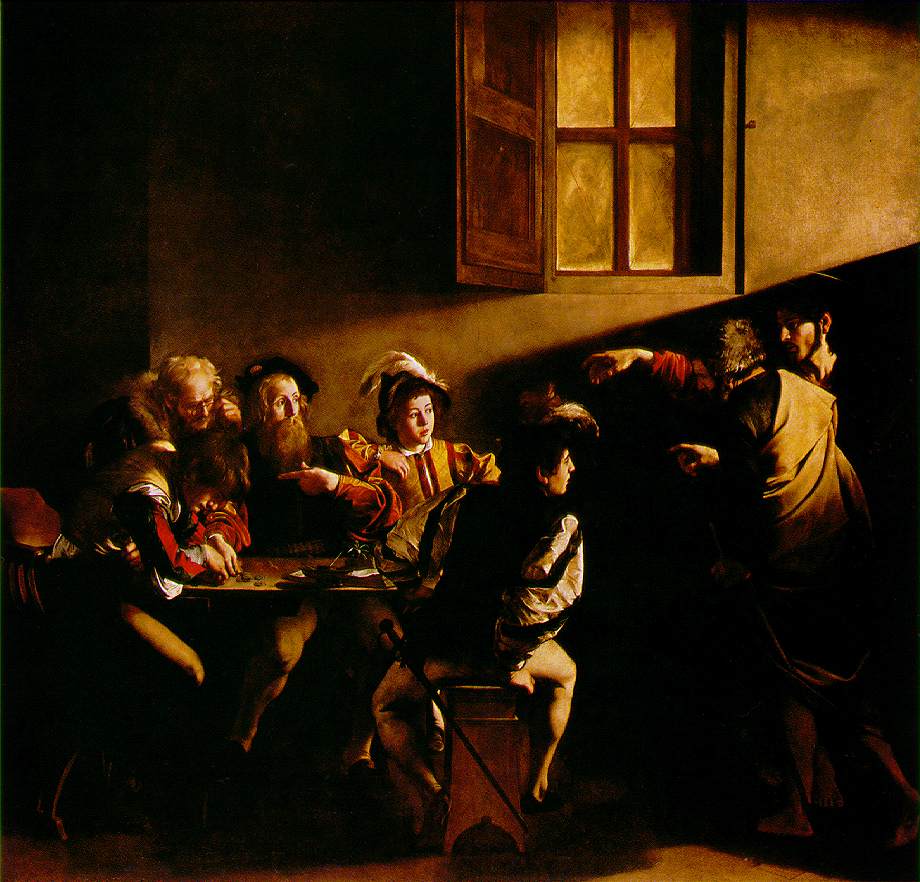
Caravaggio-The Calling of Saint Matthew{summary: the way we disciple others in the church is far too often a results-based process, and not a grace-driven one. Here, I explore Jesus’ example in Matthew as a guide for us. And, once again, we see Jesus’ radical application of grace to his Disciples’ lives.}

I’m taking a class on “The Practice of Discipleship”. Some discussions on our online message boards inspired these thoughts. Discipleship, as many people could tell you is all about “following Jesus”. After all, that’s how Jesus himself invited his disciples into it. But as I was thinking about this, I realized something: Pharisees had disciples too.

Now, with “Pharisee Discipleship” the point was to let that Pharisee get all up in your business so that you could become a good, well-behaved Pharisee someday. Christian Discipleship, as we are often told, is not about following Christians per se, but following Christians who are following Christ. The ultimate goal is to follow Christ and to help one another do that.

This is how it works in theory. I can’t speak for everyone, but at least in my experience, a lot of Christian Discipleship subtly looks more like the type that creates well-behaved Pharisees than the one that truly follows Christ.
Continue reading

Injustice & The Human Jesus (and some more Syria thoughts)


oldrich-kulhanek-untitled2For one of my seminary classes (which started this week) I’ve had to read the Gospel of Matthew. When you read a large chunk of a Bible book in one sitting, you really do get to make connections and get perspective you didn’t have before. I had many moments like that when reading Matthew yesterday, but I had one particularly poignant moment that relates to all of the Syria talk that’s going on in our country right now, and adds to my own comments a couple of days ago.

In Matthew’s Gospel, Jesus begins preaching on his own, gathers some disciples around him and continues teaching while they watch. Eventually, in Chapter 10, he sends this community of people, encouragement, and support off to do ministry in various towns in the wider area and to do what he has been doing among them.

Which means he is alone again.
Continue reading

A Brief History of Liturgy (for those interested)


emergent-tree-house-churchYesterday, I posted some brief thoughts on liturgy and how it shapes us.  Those words were primarily taken from a document I wrote up a few years ago to train those leading liturgy. Today, I wanted to post another little section from that piece, going through an extremely brief history of liturgy in the Bible and how it developed in the early church.

Liturgy in the Bible

We see fairly early on that God intends for there to be a definite pattern or shape to worship among his people. He spends chapter after chapter talking about both the space and structure of the worship of the Israelite people in both the Tabernacle and the Temple. This continues in the Jewish community even today.

But at this point in the story of the Bible, the fullness of all that God will do to bring about our worship is incomplete, and so this worship is merely anticipatory of something that is to come. But throughout the Bible we get glimpses of a definite pattern to how God relates to his people–to how this story will eventually look in it fullness. This story–this pattern–is what forms the structure of our liturgy even today.

Throughout the Bible, repetition of form and phrases is used to shape the people of God. In the Psalms, the same phrases are used over and over again in the music. In the Old Testament, verses from other parts of it are meditated upon and repeated for worship.
Continue reading

Some random, contradictory thoughts on Hell. Discuss.


Rothko-untitled-2Below, you’ll find a random assortment of 30 completely disjointed musings on Hell. Each paragraph is its own statement, in no particular order. This is not meant to be a discussion of where I currently land on this issue. I’d love to just get your thoughts. Respond as you like, below.

(1) In the past 10 to 15 years, the American Church saw a new emphasis on Idolatry as the foundation of sinfulness, rather than “Law-breaking”. I’m starting to see a new re-emphasis on Law-Breaking and Hell as punishment for this. And yet, the “Law” is always connected to God’s Image and Character, and so Law-Breaking is living by a wrong law, or image, and therefore is idolatry. We have an analogy for how a Judge responds to breaking the law, and this leads to the popular view of Hell since Medieval times. But what is the analogy for the response to transgressing an image?

(2) Can any Universalist tell me what the point of missions or Evangelism is in this life, if their perspective is true?
Continue reading

Millennials, Media, & Meta-Churching


coffee-client-mugFor those of you out there that keep track of the “Christian blogosphere” (and if you don’t, you’re probably better for it), there’s a very weird discussion happening amongst many different writers and thinkers about “millennials” (those born from the early 80s to early 2000s), and how they relate to the church.

A couple of weeks ago Rachel Held Evans wrote a post for CNN’s religion blog in which she said that millennials are leaving the church because they don’t find substance there; but rather, all they seem to find are hypocritical, judgmental, and bigoted people that want to fight over silly things. She said that this desire for substance is why the millennials that do stay in the church are leaning towards more liturgical traditions. She encouraged church leaders to look at millennials and consider whether their departure might be speaking to systemic issues that are plaguing the American evangelical church.

Continue reading

Ross Douthat on Reza Aslan & the “Historical Jesus” [QUOTE]


jesus-suffering-pmaHappy Lord’s Day!

Speaking of the Lord, I wanted to point you all to Ross Douthat’s new column in the Sunday edition of the New York Times. I really like Douthat, and this piece is a good example of why. He is responding to Reza Aslan’s new #1 New York Times Bestseller, Zealot: The Life & Times of Jesus of Nazareth.

As Douthat points out, Aslan’s books is just the newest shot in the two-century long war for the “Historical Jesus“, a series of “quests” in which the assumption is that the Jesus of history is entirely different than the Jesus represented of the Bible. (I’ve recently defended some of my own thoughts on this here and here).

Now some have effectively critiqued much of Aslan’s scholarship, and even his academic credentials to write such a book (it doesn’t seem he’s ever written a peer-reviewed piece on anything in the New Testament!). But Douthat, in usual style, zooms out to the 50,000-foot level and speaks to the bigger context in which these sorts of books seem to always be written. It’s fantastic, and you should read it. Here are the money quotes: Continue reading

Listen to the Hurting {ii}: how now shall we suffer?


Rothko-untitled-2Yesterday I wrote about how our offense and struggle with evil and suffering in the world is often detached from the feelings and words of those that actually endure much of it. I said that intense Suffering doesn’t seem to produce an extinguishing of faith to those that experience it.

People have often said that the deep suffering and injustice of the world is one thing that led them to Atheism or skepticism, but this seems to be more the case for those that observe and think about the idea of suffering, more than enduring it themselves. Yes, there are stories of those that lose their faith in the midst of their suffering, but they really are so few and far between.

This is one of the main themes of Dostoevsky’s Brothers Karamazov. The most powerful argument for Atheism I’ve ever read is in the famous “Grand Inquisitor” chapter. After reading it, I was so deeply shaken for a few weeks after. And it was written by a Christian.

One of the central themes of the book is that Atheism is an absolutely logical and reasonable system, but not one that can be consistently lived out. When observing the world and its injustice intellectually and from a top-down perspective, Atheism is probably more easily sensible than Christianity. But, as the book goes on to show, no matter the philosophical veracity of Atheism, no one can truly live real, actual human life as a fully-consistent Atheist and flourish as a human, in human relationships, and in human society.

Even if people think about suffering Atheistically, people usually live in the midst of it religiously.
Continue reading

Listen to the Hurting {i}: why Suffering is a silly reason to be an Atheist


Adolph Gottlieb-rolling

Update: Part 2 is up.

In the religious circles I walk in, I hear about injustice and suffering quite a bit. Theology friends constantly muse about how to view these things in light of biblical revelation. Atheist and skeptic friends constantly point to these things as the inherent illogical inconsistencies that undermine religious faith.

And caught in the middle are many, many more friends, who live their lives trying to navigate their jobs, families, and relationships the best they can–all while these questions haunt them in their quieter moments or right before they sleep. Unlike the other two groups above, they don’t feel like they have answers. And this can lead to periods of doubt, insecurity, and frustration.

For every group, though, questions abound in these conversations. Oftentimes, they have a religious flavor. Why does this stuff happen? How does this relate to the goodness of God? What does it mean for the reality of God? How is God just when this stuff is real? Why does God seem absent?

And yet…

These are almost never the questions I hear from the people actually going through the suffering.
Continue reading

Ascension: Our glory & the Bible’s hinge


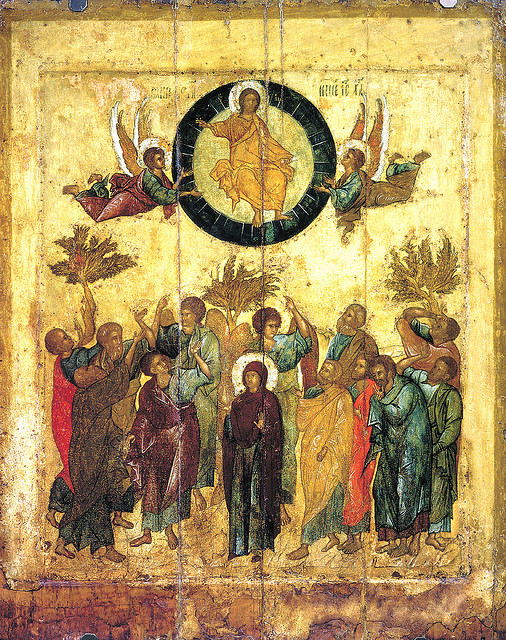
jesus-christ-ascension-iconToday in the Christian church calendar is Ascension Day, the day we celebrate Christ ascending into heaven 40 days after his resurrection and now sits at “the right hand of God the Father.” (You can read a prayer and poem I posted earlier for this Holy Day)

The Useless Ascension

The idea of “Ascension” doesn’t seem to get a lot of play nowadays in the Church. This, in spite of the fact that it is an essential part of all the Church’s earliest doctrinal formulations, and the subject of the most-quoted Old Testament verse in the New Testament:

The Lord says to my lord, “Sit at my right hand until I make your enemies your footstool.”

Compared to other, non-creedal things like Hell, homosexuality, and “attacks on biblical authority”, the Ascension isn’t really talked about. Maybe this is because the Ascension isn’t really a “doctrine”–it’s an “event” and a “declaration”.

And we western Christians love our systematic “doctrines” that we can pick apart as nauseam and/or figure out how we can “apply it to our lives” in such a way that we can feel like we’re “good Christians.” But honestly, the Ascension doesn’t have many direct applications for today.
Continue reading

prayer & meditation for Ascension Day


Grant, we pray, Almighty God, that as we believe your only-begotten Son our Lord Jesus Christ to have ascended into heaven, so we may also in heart and mind there ascend, and with him continually dwell; who lives and reigns with you and the Holy Spirit, one God, for ever and ever. Amen.

(from the the Book of Common Prayer & the site Morning Prayer)

Also read my own meditations on this Holy Day.
Continue reading

{Easter friday} | prayer & readings for Easter Week (2013)


For Easter Week: reading schedule/reflections.

prayer.

Almighty Father, who gave your only Son to die for our sins and to rise for our justification: Give us grace so to put away the leaven of malice and wickedness, that we may always serve you in pureness of living and truth; through Jesus Christ your Son our Lord, who lives and reigns with you and the Holy Spirit, one God, now and for ever. Amen.
(from the liberti Lent & Easter 2012 prayerbook & the Book of Common Prayer)

Continue reading

{Easter thursday} | prayer & readings for Easter Week (2013)


For Easter Week: reading schedule/reflections.

prayer.

Almighty and everlasting God, who in the Paschal mystery established the new covenant of reconciliation: Grant that all who have been reborn into the fellowship of Christ’s Body may show forth in their lives what they profess by their faith; through Jesus Christ our Lord, who lives and reigns with you and the Holy Spirit, one God, for ever and ever. Amen.
(from the liberti Lent & Easter 2012 prayerbook & the Book of Common Prayer)

Continue reading

{Easter wednesday} | prayer & readings for Easter Week (2013)


For Easter Week: reading schedule/reflections.

prayer.

O God, whose blessed Son made himself known to his disciples in the breaking of bread: Open the eyes of our faith, that we may behold him in all his redeeming work; who lives and reigns with you, in the unity of the Holy Spirit, one God, now and for ever. Amen.
(from the liberti Lent & Easter 2012 prayerbook & the Book of Common Prayer)

Continue reading