The Door to the Holy of Holies: on Love & Epiphany [QUOTE]


As our country is consumed with politics since last week’s storming of the Capitol and next week’s inauguration of Joe Biden, I ran across these words from Saint Maximus the Confessor, and thought they were an appropriate reflection for all of us, both for the political season we’re in, as well as the Christian season of Epiphany.

Love is therefore a great good, and of goods the first and most excellent good, since through it God and man are drawn together in a single embrace, and the creator of humankind appears as human, through the undeviating likeness of the deified to God in the good so far as is possible to humankind. And the interpretation of love is: to love the Lord God with all the heart and soul and power, and the neighbour as oneself.

Which is, if I might express it in a definition, the inward universal relationship to the first good connected with the universal purpose of our natural kind. Other than this there is nothing that can make the human being who loves God ascend any higher, for all other ways of true religion are subordinate to it. This we know as love and so we call it, not divisively assigning one form of love to God and another to human beings, for it is one and the same and universal: owed to God and attaching human beings one to another. For the activity and clear proof of perfect love towards God is a genuine disposition of voluntary goodwill towards one’s neighbour.

For he who does not love his brother whom he has seen, says the divine Apostle John, cannot love God whom he has not seen (1 John 4:20). This is the way of truth, as the Word of God calls himself, that leads those who walk in it, pure of all passions, to God the Father.

This is the door, through which the one who enters finds himself in the Holy of Holies, and is made worthy to behold the unapproachable beauty of the holy and royal Trinity. This is the true vine, in which he who is firmly rooted is made worthy of becoming a partaker of the divine quality. Through this love, all the teaching of the law and the prophets and the Gospel both is and is proclaimed, so that we who have a desire for ineffable goods may confirm our longing in these ways.

Saint Maximus the Confessor in a letter to John the Cubicularius (from Maximus the Confessor by Andrew Louth)

See other Epiphany thoughts here. Listen to the Epiphany music playlist here.

Art & Advent’s Intellect: Barnett Newman’s “Black Fire”


barnett-newman-black-fireIf you look at the top of every page on this site, you’ll notice there is a prominent header image. If you’ve paid any sort of repeated attention to the posts on this site, you’ll notice I have different headers for different themes and series. Lent, Easter, Women in Ministry, The Bible, Theology, Art, Personal, Political, Writing, and my upcoming Guatemala posts each have their own distinct headers.

Throughout this year’s Advent series, I’ve used a cropped version of the above piece as the header image. It’s called Black Fire by Barnett Newman. Until recently, it hung for many years in the abstract expressionism room in the Philadelphia Museum of Art. I’ve spent much time sitting in the presence of this piece, contemplating it’s meaning.
Continue reading

Advent & Sex-lessness: here’s to singleness & celibacy!


sandorfi-le-pardon-wide

Yesterday, I wrote a post about some implications of Advent on sex. And, of course, I stressed the goodness and beauty and transcendance of that act as God intended it.

And it was one of my least read posts in a long time (as an update, interestingly, this is to date one of my most-read posts of all time!). I’m wondering if people are tired of hearing Christians talk about sex ad nauseam.

It is my humble opinion that the American Church right now is currently obsessed with sex. Well, to be fair, it’s always been obsessed with it; but now, it seems, the obsession is with “taking it back” and yelling and screaming about how Christians are just as sex-crazed, sex-eager, and sexually exciting as the most ardent secular hedonist.

Of course, they all qualify it by saying (as I even said yesterday) that this (oh my god really amazing Christian sex that we value so much) has to be “within the confines of marriage”. And so, this sex-obsession often expresses itself in an equal obsession with marriage. Preparing people for it, encouraging people towards it, beating up guys that aren’t “pursuing” women (or at least “preparing to”), and giving women tips on how to attract a “good, godly husband.”

And yet, yesterday, when I was thinking about the Advent of God into the world in the person of Jesus Christ, and the idea of the Incarnation, I realized something:

What is the story of Advent but the story of a virgin girl who has a virgin birth of a man who will remain a virgin his whole life?

The story of the Incarnation is, relatively speaking, one of the most “sex-less” stories in the Bible.

Continue reading

Advent & Sex: we are holy ground


Huber-untitled-crop

Update: I’ve also written some Advent thoughts on singleness and celibacy.

In Advent, we celebrate that God came as a human, in a mysterious act called the Incarnation. But in this act, God didn’t merely clothe himself in humanity. Flesh and blood were not the trappings of God. Instead, he became human. It was no mere illusion, nor was it a facade God took on.

God became flesh and blood.

God found it suitable (desirable, even!) to take on a body–a created, formed, physical, material body. The implications of this are huge. Take sex for example.

Advent show us that the created world can contain God, and it still does not violate God’s Holiness–his “Otherness” or “Separated-ness”. He can know his Creation in such union and intimacy and yet still remain transcendent above it. Our bodies do not challenge his Holiness. He can take it on and still remain Other. He became “one” with us in a similar way to how we become “one” with others in sex. With this in mind, let’s unpack some implications:

Continue reading

Advent & the Connecticut Shooting: Ross Douthat’s “The Loss of the Innocents”


winter-snow-trees-bw

In the same spirit as today’s earlier post by Austin Ricketts, I wanted to share with everyone this incredible piece by New York Times columnist Ross Douthat (one of my favorite writers), entitled “The Loss of the Innocents”. It’s a beautiful and haunting reflection on the human condition and the theological senselessness inherent in events like last week’s mass shooting at an elementary school in Newtown Connecticut. He then concludes with these beautiful words of Advent hope in the midst of such darkness:

In the same way, the only thing that my religious tradition has to offer to the bereaved of Newtown today — besides an appropriately respectful witness to their awful sorrow — is a version of that story, and the realism about suffering that it contains.

That realism may be hard to see at Christmastime, when the sentimental side of faith owns the cultural stage. But the Christmas story isn’t just the manger and the shepherds and the baby Jesus, meek and mild.

The rage of Herod is there as well, and the slaughtered innocents of Bethlehem, and the myrrh that prepares bodies for the grave. The cross looms behind the stable — the shadow of violence, agony and death.

In the leafless hills of western Connecticut, this is the only Christmas spirit that could possibly matter now.

Read the full piece here.

Advent & Humor: stop taking yourself so seriously [casual fri]


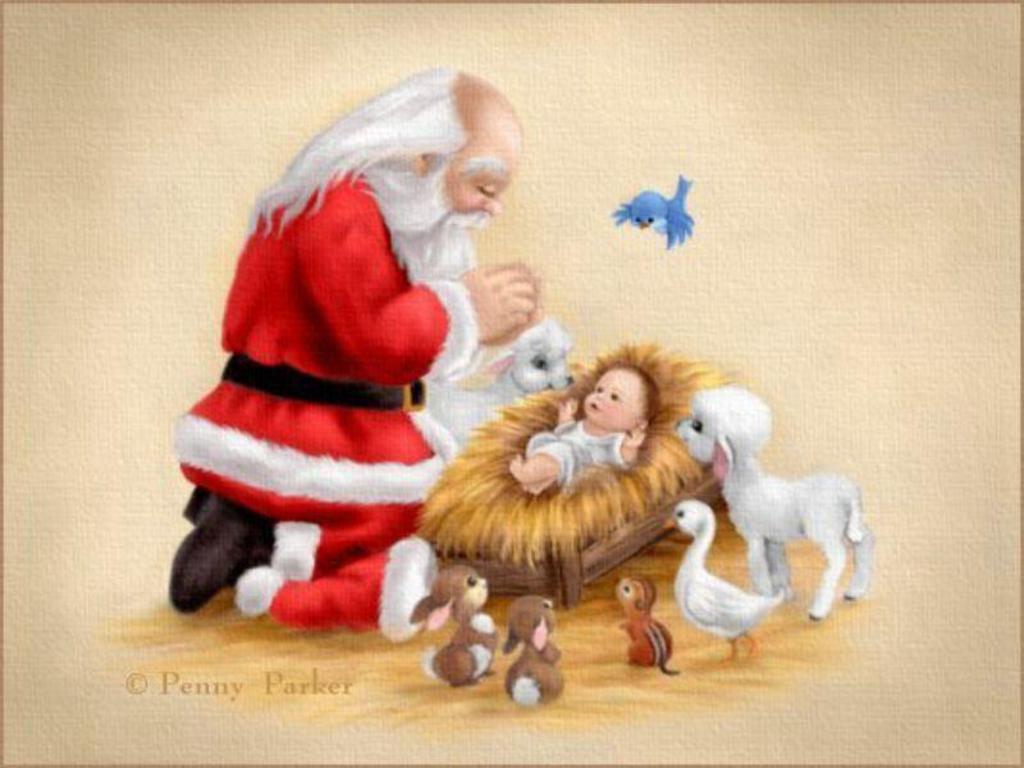
santa-baby-jesusIn one of the posts in last year’s Advent series, I posed this question:

“Why [did Mary, Joseph, and Jesus] flee to Egypt? If they stayed and Herod killed the child Jesus, would that not still be Jesus, the Son of God–the Incarnate God–dying unjustly at the hands of a Roman provincial governor attempting to cement the reign of the powers and principalities of the world? Why go to all that effort to wait 30 years later for the same thing to happen on a cross?”

The answer we discussed was that Christ’s purpose for coming was much bigger than the cross. He did not come just so he could die. As St. Paul said, “For if while we were enemies we were reconciled to God by the death of this Son, much more, now that we are reconciled, shall we be saved by his life.”

Jesus couldn’t die when he was so young, because the benefits we receive from his Advent are not limited to his death, but also his life. We receive his life of lived-out righteousness as our own when we come to know him.

I thought about this yesterday when pondering stand-up comedy.
Continue reading

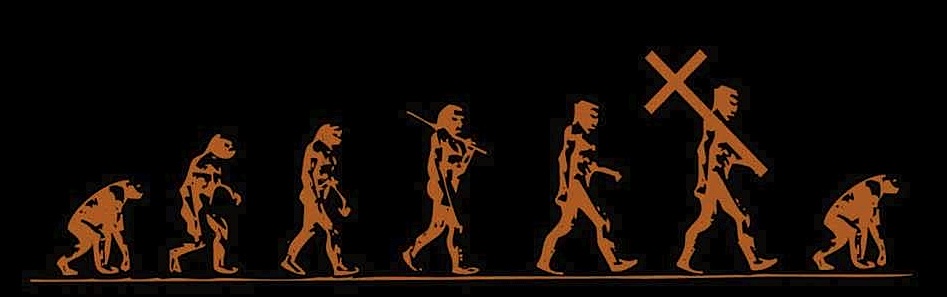
Advent, Evolution, & Absolution [RE-POST]


Today, I’m re-posting a piece I wrote exactly a year ago for last year‘s Advent series. During this year‘s, we’re seeing how the Advent event affects parts of our lives that we usually don’t associate with it. Today, it’s Advent and Evolution. You can follow the series here.

It’s Advent. A time where we especially orient ourselves towards rejoicing and celebrating the fact that God did not remain far off and merely create a “legal” or “dogmatic” satisfaction for the plight of his creation and creatures. Rather, he broke into it and came into his creation and among his creatures. In this year’s Advent series, we’re exploring how, in this Coming, Jesus took on our creaturely formcare-taking functioncomprehensive fallenness, and communal formation.

First, God took physical, human, creaturely form. In the study I did–and subsequent lecture I gave–on Beauty a couple of years ago, I defined “Beauty” as the attribute of something that expressed complexity simply. Is not this God-in-human-flesh (theologically referred to as the Incarnation) the most beautiful of all miracles to take place? The Infinitely Complex God inhabits the simplest of human forms: a child.

Continue Reading –>

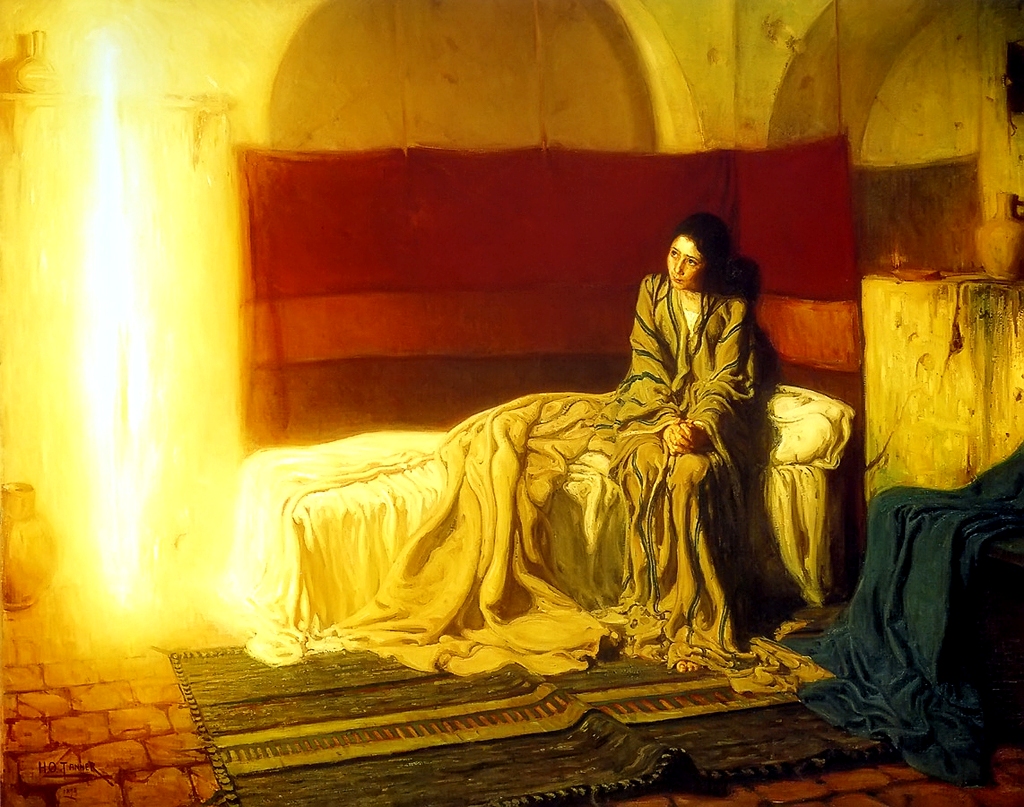
Advent & Mary: Ordained as Prophetess, Priestess, & Queen


Tanner-the-anunciation-mary

This Advent, we’re seeing how this season affects parts of our lives we usually don’t associate with it. Follow the series here. This post is also filed in the series “Catholics Aren’t Crazy” and “Women Leading Stuff in Churches“.

If a woman is revered by the church for giving the faithful their savior, then surely women are good enough for leadership roles in the church to save it. –Vishwanath Ayengar

I ran across that quote in some letters to the editor of Newsweek a couple of years back in response to a cover story arguing that if women were ordained as priests in the Catholic Church, there wouldn’t have been any sex abuse scandal. I don’t know if that’s true, but the quote is insightful and (hopefully) thought-provoking.

I can hear conservatives now: Well, God used a donkey to speak! He used Caiaphas the high priest to unknowingly prophesy about Jesus before sentencing him to death! He used Judas to bring about Christ’s crucifixion and therefore our salvation! It doesn’t mean that they were fit to be ordained pastors!

Yeah, yeah, I get it. This post isn’t necessarily meant as a “proof” or “defense” of women’s place in ministry (though it’s a part of my on-going series on the topic). I just want to revel a bit in some divine mystery. Can we all just put our swords down and marvel?
Continue reading

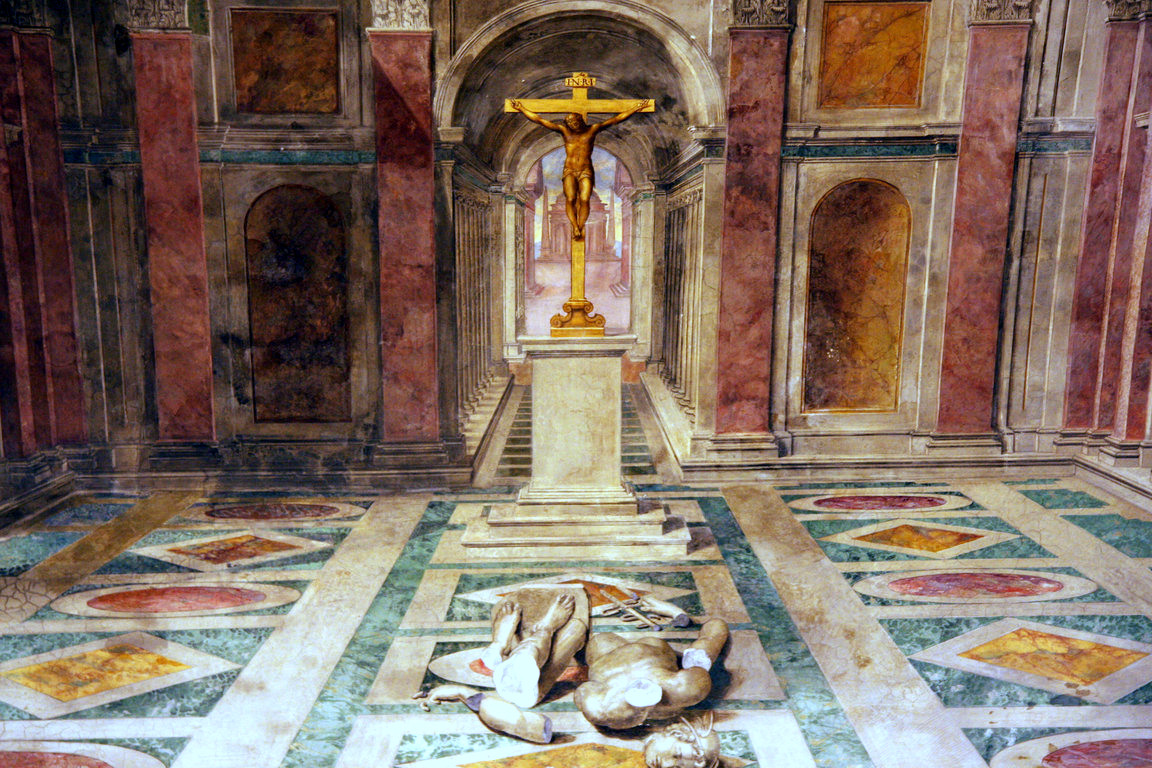
Advent & Politics: The Government is on His Shoulders


laureti-triumph-christianity-pagan-statue

This Advent season, we’re seeing how the Advent event affects parts of our lives that we usually don’t associate with this time. You can follow the series here.

The book of Isaiah is a minefield for biblical studies, mainly because of the development it seems its contents went through to get to its final form. It appears to be a strange stitching together of many writings, perhaps by many people, for several different purposes. But in all of its complexity and mystery, there is one theme that it consistently holds throughout its contents: politics. The political movements of the nation of Israel and the nations around it–and God’s movement in and through all of it–occupy most every chapter of the book.

Interestingly, this is also where many of the most dramatic and explicit messianic prophecies are found–specifically Advent prophecies. When telling the Christmas story, the gospels quote Isaiah (I believe) more than any other Old Testament book. Images of virgins, Emmanuel, Davidic lineage, “roots of Jesse”, and John’s “voice crying in the wilderness” all find their source here.

There seems to be an intimate connection between politics and Advent.
Continue reading

Welcome to Advent, 2012.


This Sunday marks the first Sunday of Advent. This is the New Year’s Day of the Christian Church Calendar. It’s the season in which we celebrate and meditate upon the “Advent” (latin for “Coming”) of Jesus into the world in the Incarnation. This season begins this Sunday and lasts until Christmas.

In this time, we stare deeply into the reality that the Creator God of the universe came into human form by way of human birth.

The season is marked (as with every Church season) with a profound tension. We meditate on the darkness into which Christ entered the world, as well as the light he brought in his Coming. Advent is a time that we sit in the tension of past, present, and future, and see how this most-differentiating belief of Christianity has profound implications on these places in time, and indeed, the whole of human life and experience.

This is why, for this year’s Advent, I’ll be doing a series meditating on how Advent affects seemingly unrelated parts of human life: art, politics, sexuality, singlenesswomen’s ordination, social justice, Evolution, suffering, humor, the city, and more.

There are several other ways you can engage in this season:
Continue reading

Top 10 Reasons Why Men Shouldn’t Be Ordained [casual fri]


In this on-going series on women in the ministry of the church, I’ve certainly tried very hard to not be snarky, sarcastic, or ungracious to those that disagree with me on these issues. Nevertheless, this was a bit of fun I could not resist. It’s from a post on the (now defunct, it seems) blog Christian Feminism (of course). It was originally a comment left on one of their posts. I loved this list so much, I decided to post a few of my favorites from the list. Enjoy.

Top 10 Reasons Why Men Shouldn’t Be Ordained

10. A man’s place is in the army.

9. For men who have children, their duties might distract them from the responsibilities of being a parent.

8. Their physical build indicates that men are more suited to tasks such as chopping down trees and wrestling mountain lions. It would be “unnatural” for them to do other forms of work.

7. Man was created before woman. It is therefore obvious that man was a prototype. Thus, they represent an experiment, rather than the crowning achievement of creation.

6. Men are too emotional to be priests or pastors. This is easily demonstrated by their conduct at football games and watching basketball tournaments.

5. Some men are handsome; they will distract women worshipers.

4. To be ordained pastor is to nurture the congregation. But this is not a traditional male role. Rather, throughout history, women have been considered to be not only more skilled than men at nurturing, but also more frequently attracted to it. This makes them the obvious choice for ordination.

3. Men are overly prone to violence. No really manly man wants to settle disputes by any means other than by fighting about it. Thus, they would be poor role models, as well as being dangerously unstable in positions of leadership.

2. Men can still be involved in church activities, even without being ordained. They can sweep paths, repair the church roof, change the oil in the church vans, and maybe even lead the singing on Father’s Day. By confining themselves to such traditional male roles, they can still be vitally important in the life of the Church.

1. In the New Testament account, the person who betrayed Jesus was a man. Thus, his lack of faith and ensuing punishment stands as a symbol of the subordinated position that all men should take.

Women & the Church: 2 things that began changing my mind


the journey

If it’s not obvious so far, I wanted to make something clear before we begin: these posts in this series on Women the Church are walking through the same path my own journey took get to where I am.

In my last post, there was a concern that a friend brought up that I didn’t get to talking about the biblical texts enough. Well, this is because both egalitarians and complementarians are looking at the same biblical texts. In my own shifts on this issue, the key changes were not “new” Bible verses I found.
Continue reading

Women & the Church: we’re ALMOST to the Bible, but first…


Well, we’ve gone through some of my own journey and some of the ways this discussion goes, but the real meat of this discussion centers around a few key biblical texts. Various refutes and refutations’ refutes can be found with any easy Google search. I don’t necessarily want to re-hash the more widely-publicized textual minutiae of the issue, though some of that will be necessary.

In this post, I could easily just list the three primary offending texts and then talk about how my view differs from others’ views. But those other people’s views don’t come out of thin air. They are based in many more (and, epistemologically more important) assumptions and bigger issues that usually never get touched on.

And so, as I continue this series, today I just want to touch on the ways people go about using the Bible in this, and then defending how I feel like we should use the Bible here. After this post, beginning next week, I promise we’ll start getting into actual biblical texts. But we need to do this first.

Because, as anyone that has studied theology begins to realize, everything comes back to your chosen interpretive method and filters–what’s usually referred to as a “hermeneutic”.

Continue reading

Hope of the Earth: a political eschatology (we can all breathe)


November 7th, we will wake up to front pages declaring with finality the results of the American Presidential Election. Most of us will see these headlines and have some sort of emotional reaction (especially those of us that stayed up as late as we could to know the results early).

Depression? Fear? Anger? Injustice? Sadness? Joy? Elation? Ecstasy? Worship? Peace?

I remember after the 2004 election when Bush beat Kerry. Going to a large, urban University dominated by idealistic and passionate liberal youth, the campus was in mourning for the rest of that week. People walked in silence, hugged one another, and I saw a good number of people crying as they resigned themselves to what they felt would be the end of every good thing they’d ever thought about this country.

This election cycle, I was certainly active–probably more so than ever before (especially on this blog, at least). I’m almost certain that I have been blocked from my fair share of Facebook feeds and removed from some feed readers in the past six months or so. I’ve been quite passionate on those few issues that have guided so much of my writing and reading.

But I haven’t lost a bit of sleep over any of that stuff. I’ve been able to enjoy good books and beers, and pipes and peers, without any discussion of politics or debates or elections.
Continue reading

Evil & God {2}: I’m a Heretic, I Fear


This is my final post in a discussion I’ve been having with a very good friend of mine, Austin Ricketts, about the relation of Evil to the Nature of God. For more on the background of this discussion, see  Part 1 of this reply, although you should be able to gather a good idea of the conversation from this post. After this, I’ll let Austin have the last word, if he’d like.

Pressing into the Story of God’s Nature

I’ve been saying that God’s Nature is not static, but, just like us humans, it’s like a Story, unfolding in time (click here for more). Further, it’s a Story that includes Evil and Death within in. Hopefully I can clarify some points all the more by drawing out the “Story” metaphor further (because, at the end of the day, that’s all this whole “Narrative” framework is).

When I write a story about redemption and healing, I include evil in that story–evil that ends up being resolved and healed in the end. The thought of that evil (whatever it may be) is borne from my mind and existence. Just because the thought of that evil has “existed” in my mind, does not, however, make me evil.
Continue reading