Evil & God {1}: a refutation’s refute


Update: Part 2 of this post is up.

Last week, I wrote a post about being overwhelmed by God’s beauty in Western Pennsylvania. In it, I talked of the beautiful paradox of a God who would incorporate within his own divine life both Beauty and Suffering. My good friend (and huge theological influence) Austin Ricketts (who’s written on this blog beforetook issue with these statements, saying that he fears that they lead to making God the author of Sin and Evil. I wrote a reply to his comments in which I asked whether the very nature of God might be “narratival” and unfold over the course of history, and perhaps suffering and even Evil itself are “motifs” or “themes” in that “Storied Essence” of God–a story that eventually does away with these things. He wrote a reply in which he countered some of my views on revelation and some biblical texts.

Here, in the two parts of this post, I plan on (1) responding to Austin’s refutation, and (2) writing up some final thoughts (and fears) on my end. I’ll leave the final word to Austin if he so desires. Feel free to also chime in with your own thoughts if you like!
Continue reading


God is Light: A Refutation [GUEST POST]


Koelle-job
I love when I get to do some back-and-forths on the blog. My good friend (and blog contributor) Austin Ricketts wrote a comment on my post earlier this week about beauty and suffering in the world. I posted his comments, and then I wrote a reply to them. Well, as is the nature of these sorts of things, here is Austin’s “refutation” of my post. You will see he has a great mind and sensitivity to these weighty issues. Usually, I let the other person have the last word in these things, and I’d usually end this exchange here, but I actually have some thoughts I’ll spend the weekend pondering and writing; I’ll post it on Monday.

Update: my response to this post is now up.

First things first, I always enjoy a spirited debate among brothers and friends.  Iron sharpens iron.  Paul is a very good friend of mine, one of my best friends.  And I love that he and I can disagree deeply and yet remain quite close.  I know my friend Paul’s logic quite well.  I was once in a similar position as he.  Previously, I wrote an article entitled, “Love—The Beginning and End of Divine Suffering”.  I set forth an argument to state that there is a notion of death entailed in God’s being.  I write now officially to recant that position.  A new assessment of the Trinity will have to be written.  For now, I write in refutation of the notion that there is evil in God, by writing a refutation of Paul’s most recent article.
Continue reading

Evil & the Essence of God {2}: a storied solution?


Updates: Austin has replied to this post with his own thoughts. I have also edited this post to correct some of my incorrect Hebrew grammar Austin pointed out.

Earlier, I posted some comments that my good friend (and occasional contributor to this blog) Austin Ricketts wrote on my post yesterday about the relationship between evil, beauty, and the nature of God. Read those words if you would like his beautiful and articulate wrestling with this idea. Here is my response.

At some point in their lives, most people face the question: Can God stop this suffering? If not, is he God? If he can, but doesn’t, what kind of God is he?

Most of the time, attempts to push this question to a solid conclusion lead to unfortunate results. Many have abandoned God altogether over this, and still others, who maintain their faith, end up doing the mental gymnastics only to end up in positions entirely foreign to the Bible or that are even more illogical than when you began.

Here’s my attempt at a response, fully aware of the dangers that come with doing so. Please be gracious. Please reply. Point out my heresies, And please allow me the room to change my mind later on.

Continue reading

Evil & the Essence of God {1}: the discussion


Update: Part 2 is now up.

Yesterday, I wrote some meditations on the world’s suffering and evil in light of the incredible Beauty I saw this past weekend on a trip to western Pennsylvania. One of my very best friends, Austin (who’s written for this site before), appreciated the post but had some thoughts on some of the theological implications of my thinking, and talked about where/how he differed. I love his mind (and his heart), and I see where he’s coming from, but it’s a place I can’t go. I want to offer you all his comment, and then my perspective on all of this, hoping to offer all of you some things to think about and a space to discuss anything that strikes you as off.

Continue reading

Jesus’ Wife fragment judged a fake [casual fri]


hmm… so did you hear about that fragment found recently that talked about Jesus’ wife? (By the way, here’s a great segment Jon Stewart did on this.)

Daniel B. Wallace's avatarDaniel B. Wallace

“News flash: Harvard Theological Review has decided not to publish Karen King¹s paper on the Coptic papyrus fragment on the grounds that the fragment is probably a fake.” This from an email Dr. Craig Evans, the Payzant Distinguished Professor of New Testament at Acadia University and Divinity College, sent to me earlier today. He said that Helmut Koester (Harvard University), Bentley Layton (Yale University), Stephen Emmel (University of Münster), and Gesine Robinson (Claremont Graduate School)–all first-rate scholars in Coptic studies–have weighed in and have found the fragment wanting. No doubt Francis Watson’s comprehensive work showing the fragment’s dependence on the Gospel of Thomas was a contributing factor for this judgment, as well as the rather odd look of the Coptic that already raised several questions as to its authenticity.

View original post

What do we make of the atrocities of the Old Testament?


This is a slightly edited version of an excursus I wrote in this week’s notes for the Bible Survey Class I’ve been teaching at my church. Follow that link for more information on the class. Also, I’m well-aware that the second half of this is exactly the “angle” talked about in the venerable Pete Enns’ recent blog post. I wrote this before he posted that, but still, I wanted to put it up on the off-chance this articulation might be helpful to others.

In the books of Numbers and Joshua, God commands the Israelites to commit genocide on many different people, including their women and children. He also commands them to forcibly enslave others. And in still another story, he commands Moses to take the remaining virgins of this particular people of which they disobediently did not kill all, and divide them evenly among the soldiers and the “rest of the Israelites”. We can only imagine what for.

A few quick thoughts:

Continue reading

The Gospel Coalition & Sex as Conquest: it’s still misogyny, however unintended {2}


Yesterday, I talked about a recent brouhaha over some comments by Douglas Wilson and Jared Wilson (no relation) over at The Gospel Coalition about gender and marriage. Jared quoted a book by Douglas where he says, among other things, this:

…the sexual act cannot be made into an egalitarian pleasuring party. A man penetrates, conquers, colonizes, plants. A woman receives, surrenders, accepts.

His (and Jared’s) main point was that they believe there’s an inherent “loving” “authority” exercised by men in marriage, even in the sexual act. Further, this is God’s loving design that Christians are to embrace. They believe that some of our culture’s male addiction to porn and female addiction to S&M bondage fantasies stem from our culture’s rebellion from this “proper”  and “loving” exercise of male authority over women, causing them to turn to “improper” ways of exercising these God-given drives.

Needless to say, they got a lot of flack over this. They insisted time and time again that they are not advocating forcible marital sex or that women should just be treated as passive “receivers” of sex. They defended themselves, attacked their critics, and yet, (inexplicably, to them) critics kept saying these harsh things about them. Yesterday, I wrote about the background of this, the responses, and then wrote some words to Jared Wilson. Please go to that link for that relevant information. Today I want to give more of my specific perspective on this:
Continue reading

a homosexuality post-script & conclusion


Most of last week on this blog was spent discussing some recent “conversations” about the Evangelical church’s relationship with the homosexual community. I first addressed conservatives, and then progressives (as well as some thoughts on the “willful persistence in sin” comment I hear from conservatives a lot). This week, we move on. But not yet. In response to some of the ways people have responded to these posts, I felt I needed to write this.

In conclusion to it all…

These posts I’ve written got a lot of circulation around the web (and to those who commented/posted links, I thank you), and so for anyone that runs across them, I want to make something clear:

It might seem odd that I’ve typed far more words and dripped more sarcasm in attacking the more conservative side of this issue, all while ultimately agreeing more with them at the end of the day. In the end, even with all of my many theological and social disagreements, I cast my lot with them, even though I know most of them would not have me.

These posts, hopefully, have been written in the same spirit as Mark Noll’s blistering attack on Evangelical anti-intellectualism, The Scandal of the Evangelical Mind, which he calls “an epistle from a wounded lover”.
Continue reading

Pentecost is Coming: on Law & Spirit (p.s. Easter is forever.)


On the night of Passover, a lamb was killed so that God’s people would live. Fifty days later, God offered his law to his people–a picture of who he was, a mark of who his people would be, and the equipping of his people for the purposes God had for them.

And that’s the New Testament version.

Easter officially comes to an end this Sunday. Then comes Pentecost, the season in which we celebrate the Holy Spirit falling on the apostles, fifty days after Jesus’ death (hence the name Penta-cost). This day is celebrated as the “birthday” of the Church. Jesus had told the disciples to go out into the world ministering this Gospel to the world, but first, to wait. What would be so important as to put the brakes on the mission of God in the world?

The Holy Spirit.
Continue reading

The Early Church: not so big on grace, so why are we so obsessed?


As promised, today Lore Ferguson, over at Sayable posted my second guest post on her blog, as she is on a sabbatical. My first post went up yesterday. Originally, Lore had asked me to write a post on grace. Ironically, this was the first post I wrote for her (almost an anti-grace article–even thought it’s really not). Anyway, I hope you enjoy it. Leave comments and, like I said yesterday, follow her blog. You won’t regret it. Here’s a preview of today’s post:

I grew up in a pretty stereotypical Evangelical setting, which led to a pretty stereotypical back-and-forth between guilt and self-righteousness. That is, until I heard the Gospel of radical Grace.

Many of us have this same story, where it has been so healing to hear that how God relates to us is not, in fact, based on our performance. Instead, everything necessary for God to be pleased with us has been accomplished on our behalf by his Son.

And so, in response to this, we fall in love with God’s Grace. We pray for it, long for it, and cry for it. We read books about it, write about it, and blog about it (I even did a five-part series on it myself). We try and speak it into others’ lives while trying to figure out why we don’t apply it to our own. We joyfully build our relationship with God on the glorious foundation of His Grace. It is fundamental, primary, and essential.

In short: we love Grace.

Imagine my surprise, then, as I fell in love with liturgy and forms of worship that were centuries-old, to begin noticing the utter lack of “grace” from the prayers and worship of the earliest saints.

Continue reading →

Sinning Into Our Day of Grace (and God’s Joy in it)


One of my favorite bloggers, Lore Ferguson of the blog Sayable, has taken a sabbatical from her writing for the month of May, and asked me to write a couple of guest posts on her site about grace. My first one is up todaythe second will be up tomorrow (Update: the second post is up). Feel free to read my and comment there. And be sure to follow her blog. She’s an amazing writer that can find God and beauty in the most seemingly mundane of things. Here’s a taste of my post today (it touches on some similar ideas as yesterday’s post):

Pharisees grumble: why do you eat with sinners?

He tells them a story about a lost coin and the joy one has when they find it. He then goes on to tell similar stories about a lost lamb and a lost son.

We love to jump from the coin to the lamb and the son, but Jesus says something very interesting between those sections. He reminds the Pharisees of a central truth to the heart of God:

“there is more joy in heaven over one sinner who repents than over ninety-nine persons who need no repentance.” (lk15.7)

Did you catch that? He doesn’t say: “there’s more joy over one sinner who repents over ninety-nine that do not repent.” He focuses not on our action, but on our need.

It seems there is more joy in the heart of God over his creation needing forgiveness than if it had never needed forgiveness at all. God takes joy in forgiving and being gracious, but this implies there needs to be sin to graciously forgive.

Perhaps our sin can be good news to God.

Continue reading →

Christianity as Sin Management?


Anyone that follows this site regularly has probably noticed I’ve been taking it easy on the blogging this week. As my want to blog slowly began turning into a need, I knew I had to take a step back and approach it a little more leisurely.


This past week, our Executive Pastor preached a great sermon on the “I am the Vine, you are the branches”/”Abiding with Christ” section of John, and it really re-enlivened my taste-buds for time spent with Jesus. I knew I had to reassess my priorities. My near-daily blog writing was only possible because I was sacrificing sleep to do it (as I’ve done before), which in turn made it all the more difficult to wake up in the morning and do anything resembling communing with Christ.

And so, this week, I have been able to get up more easily, make my coffee, pour some cereal and do some devotional time.
Continue reading

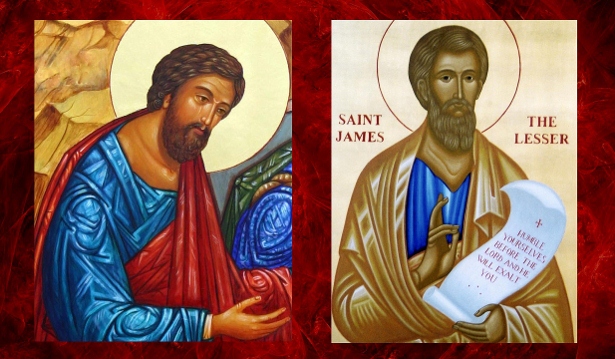
a prayer, a creed, and some history for the Holy Day of Apostles Philip & James


prayer.

Almighty God, who gave to your apostles Philip and James grace and strength to bear witness to the truth: Grant that we, being mindful of their victory of faith, may glorify in life and death the Name of our Lord Jesus Christ; who lives and reigns with you and the Holy Spirit, one God, now and for ever. Amen.
(from the Book of Common Prayer)

apostles’ creed.

I believe in God, the Father almighty, creator of heaven and earth.

I believe in Jesus Christ, his only son, our Lord.
He was conceived by the power of the Holy Spirit and born of the Virgin Mary.
He suffered under Pontius Pilate, was crucified, died, and was buried.
He descended to the dead. On the third day he rose again.
He ascended into heaven, and is seated at the right hand of the Father.
He will come again to judge the living and the dead.

I believe in the Holy Spirit, the holy catholic Church, the communion of saints, the forgiveness of sins, the resurrection of the body, and the life everlasting. Amen.
Continue reading

Yep. Still Easter. (and you’re already Resurrected)


As I wrote a couple of weeks ago, it’s still Easter. Yesterday was only the fourth Sunday of Easter (out of seven).

We’re only half-way through Easter!

The fundamental thing happening at the Resurrection was this: God was ushering in the first part of what would be called the “New Creation”. We usually think of something being “resurrected” as being “brought back”, but what Jesus did was far more than simply moving the clock backwards and rising again. In a sense, he was instead  “brought forward.

As my pastor loves to say, “Jesus is God’s future in our present”. Or, as Eugene Peterson put it in The Message translation, Jesus is “leading the resurrection parade” for the rest of us (I’ve always loved that image).

But how do we personally relate to this Resurrection/New Creation now? When I think of “Resurrection” and “New Creation”, what usually comes to my mind is Jesus, the World being glorified, institutions being made just, a bunch of future stuff that I’ll participate in, and my role in ushering in New Creation; I don’t so much think about my participating in it right now in the present.
Continue reading

a note on Grace from a friend (I miss you, Michael Spencer)


Two years ago (almost to the day), a dear friend of mine passed away. Michael Spencer (or, the “Internet Monk” as he was more widely known) encouraged me for years with his blog writing critiquing the wider church with both wisdom and bite (the site is being continued by one of his good friends and avid readers). He died of cancer, and in that death, the Church lost a great man. His one published book, Mere Churchianity, was published several months later. It’s a great summary of his life and thought. I highly encourage anyone to get it.

While he was still living, I wrote on this site about how he influenced and affected me. I also wrote this piece for Patrol Magazine after he died (I still remember the tears blurring my vision as I typed that up).

Anyway, another dear blogging friend, Lore Ferguson, is going on sabbatical from her own amazing blog and asked me to write a guest post on–of all topics–grace. I told a couple of my friends this the other night, and one of them said, “Wow! That’s you favorite topic!” It certainly doesn’t feel that way.

As I was thinking through that, I was reminded of the best thing I’ve ever read on grace, and I wanted to share it with you all. It’s an essay by Michael Spencer. I cried through this piece as well (a lot of crying in this post. Hmm…). It was the inspiration for the sermon I delivered at my church’s prison ministry that later was turned into a five-part series on this blog called “Holy Week & the Scandal of Grace“.

I want to give you the link to the article, an extended quote, and then the end of his piece that I adapted as a benediction at the end of the sermon. Enjoy. And grab some coffee. And some tissues.

Link: Our Problem with Grace: Sweat. Hand-wringing. “Yes, but…”
Continue reading