The Gospel Coalition & Sex as Conquest: it’s still misogyny, however unintended {2}


Yesterday, I talked about a recent brouhaha over some comments by Douglas Wilson and Jared Wilson (no relation) over at The Gospel Coalition about gender and marriage. Jared quoted a book by Douglas where he says, among other things, this:

…the sexual act cannot be made into an egalitarian pleasuring party. A man penetrates, conquers, colonizes, plants. A woman receives, surrenders, accepts.

His (and Jared’s) main point was that they believe there’s an inherent “loving” “authority” exercised by men in marriage, even in the sexual act. Further, this is God’s loving design that Christians are to embrace. They believe that some of our culture’s male addiction to porn and female addiction to S&M bondage fantasies stem from our culture’s rebellion from this “proper”  and “loving” exercise of male authority over women, causing them to turn to “improper” ways of exercising these God-given drives.

Needless to say, they got a lot of flack over this. They insisted time and time again that they are not advocating forcible marital sex or that women should just be treated as passive “receivers” of sex. They defended themselves, attacked their critics, and yet, (inexplicably, to them) critics kept saying these harsh things about them. Yesterday, I wrote about the background of this, the responses, and then wrote some words to Jared Wilson. Please go to that link for that relevant information. Today I want to give more of my specific perspective on this:
Continue reading

Pentecost is Coming: on Law & Spirit (p.s. Easter is forever.)


On the night of Passover, a lamb was killed so that God’s people would live. Fifty days later, God offered his law to his people–a picture of who he was, a mark of who his people would be, and the equipping of his people for the purposes God had for them.

And that’s the New Testament version.

Easter officially comes to an end this Sunday. Then comes Pentecost, the season in which we celebrate the Holy Spirit falling on the apostles, fifty days after Jesus’ death (hence the name Penta-cost). This day is celebrated as the “birthday” of the Church. Jesus had told the disciples to go out into the world ministering this Gospel to the world, but first, to wait. What would be so important as to put the brakes on the mission of God in the world?

The Holy Spirit.
Continue reading

A Shout-Out to My Mennonite Pacifists Out There…


Being in Pennsylvania, I meet lots of people that either consider themselves Mennonite, or at least were raised that way. One of the most well-known aspects of Mennonite belief is their unwavering commitment to pacifism (or, as a commenter corrected me below, the Mennonite “doctrine of nonresistance”). Hanging out with one of my new raised-Mennonite friends the other evening, she showed me (with pride) the above picture that has hung in one of their family’s houses for a long time. It struck me as beautiful as well, especially the second quote. Here it is, nicely typed out for optimal readability and convenience:

“It is our fixed principle rather than take up Arms to defend our King, our Country, or our Selves, to suffer all that is dear to be rent from us, even Life itself, and this we think not out of Contempt to Authority, but that herein we act agreeable to what we think is the Mind and Will of our Lord Jesus.”

–Thirteen Mennonite Ministers of Pennsylvania, May 15, 1755

Continue reading

Join Us for a Tour of Biblical History at the Penn Museum this Saturday!


For those those in Philadelphia or nearby, I’ll be leading a tour of The University of Pennsylvania’s Museum of Archaeology of Anthropology focusing on Biblical History (mainly Old Testament). They have a very rich collection of items from the regions in which most all of Biblical History unfolds: Mesopotamia, Canaan, and Egypt. We will be following the unfolding storyline of the Bible as we travel to each section, learning the context and the history that set the stage for the faith many of us now call our own.

If you’re interested, meet us at 12pm on Saturday, November 19th in the courtyard in front of the main entrance (pictured above). The cost is $10 for adults and $6 for students (and well worth the price). The museum is located at 33rd and Spruce (map), right across the South St bridge. (Parking advice: park on the east side of the South St bridge in the Graduate Hospital area and then walk over the bridge). See you there!

An Open Response to Some Atheist Friends Regarding Slavery & Biblical Ethics (pt. 1)


[First off, this is a long one, and only part 1 of 6, so beware before you start reading.]

On Facebook, there appeared a status by an old atheist friend of mine from undergrad named Larry (supported by another friend Christopher). Here was the thesis of the post:

Regarding moral relativism the christians are hypocritical. They say they believe in a moral objectivity given by god…but how is it then, that they believed slavery was a product of the old days, as it was applicable to the time it was practiced (and sanctioned by the bible) but now condemn it? The bible, last I checked did not change. I think this is a PRIMARY example of moral relativism exhibited by the church and christians. So how can they sit here and tell us that a proof for god is moral objectivity?

In other words, how could the ethics of Christians change over time if the book they supposedly base their ethics upon has not changed? Either the God that inspired the Bible was completely incompetent in his revelation or there was no God revealing anything at all. The note caused a discussion that resulted in almost 90 comments, and I quickly realized that if I were going to respond, it would need to be in a more lengthy manner than a Facebook comment (which is not the most helpful of mediums of debate). So here it is. I’d like to respond to the ideas that came out in the discussions. I want to disagree with them on the basis of five ideas:

Continue reading

{3John11} | Of Translations, Repentance, and Worship


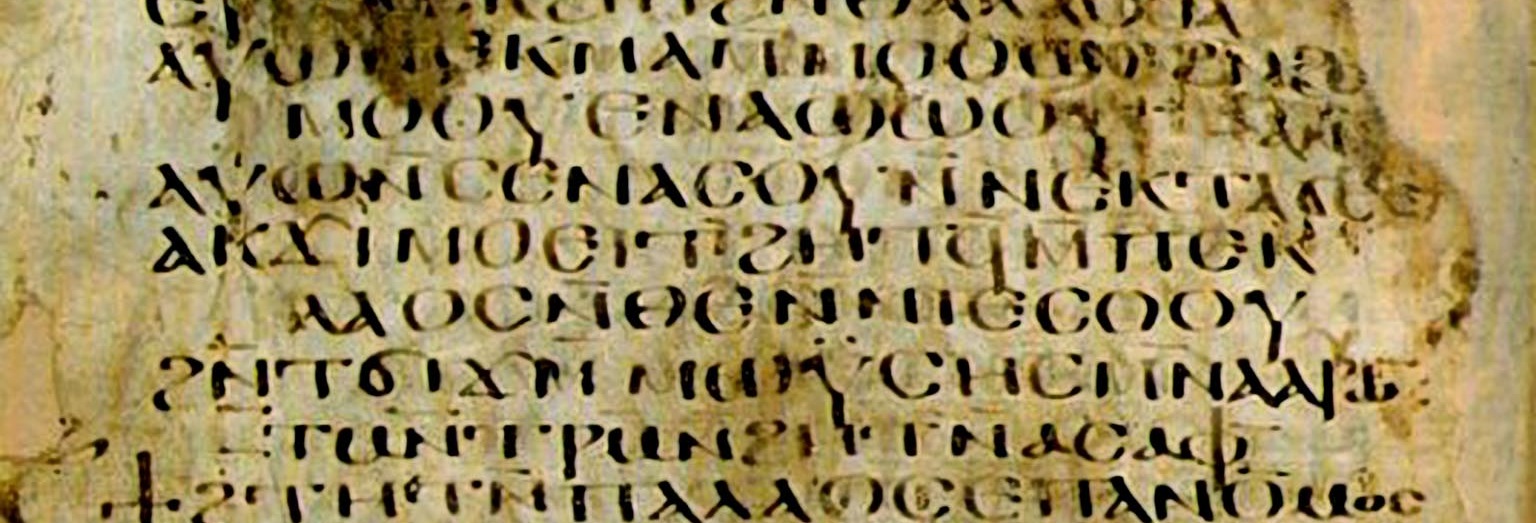
bible-greek-manuscript

ὁἀγαθοποιῶνἐκτοῦθεοῦἐστιν· ὁκακοποιῶνοὐχἑώρακεντὸνθεόν.

[ho agathopoion ek tou theou estin; ho kakopoion ouk heoraken ton theon.]

The one who does good is

[of/from/because of/in the manner of/apart from/part of/controlled by]

God.

The one who does evil has not seen God.

{3John11}

Forgive these fragmented and perhaps poorly-written or elementary thoughts. I write this post not to “show off my Greek” (today was the first I had opened it up in the past couple of months) nor to confuse people by talking very technically. I (hopefully) write this as worship.

I finished translating 3 John today. I’m starting with the shortest New Testament book and just continually trying to translate up to the longest. It’ll probably never be done, but it’s some sort of system, so it works for me. I always know what’s next so that’s helpful.

Anyway, like I said earlier, this was the first day I had gone back to 3 John in a couple of months. I only had a few more verses left so I quickly finished it and then started the first couple of verses of 2 John. I then began to shut my books and move on to the next item on my reading list when I realized something: I couldn’t even remember vaguely what I had translated in 3 John. I had been so concerned with just translating and “getting it done” that I forgot to even meditate or think on it.

I turned to my translation and looked over what I had written and the above verse popped out at me. So, I’m writing this as my act of both repentance for having this gift of the ability to translate and not using it to know God more, and as my act of worship, that I might explore some nuances in this text.

The problem with this verse is a problem common in any language: the preposition. That word εκ [ek] means any of the bracketed things above. Most simply, it’s translated as “of”, but the question always turns to “what does ‘of’ mean here? “Which of the myriad of possible translations does this mean? Well, you look at the context.

What I noticed is that whatever it means, it’s supposed to be a contrast to “The one who does evil has not seen God”. So whatever this “of God” means, it is in contrast with “not seeing God”. It also means that being “of” or “from” God is a matter of seeing him. To see Him is to be joined to Him, to be of Him, or to be from Him. I don’t know enough about Greek to make a definitive call about precisely which translation is correct, but this idea is enough for me: walking obediently so as to please God is a matter of seeing God, and those that continue in disobedience show that they have not.

The way this is phrased let’s us know that whoever is walking obediently can take no credit for this, because their obedience is of/from God. But at the same time, those that are still walking in disobedience bear the full weight of responsibility for their disobedience because they have not seen Him. It is a mystery that leads to God’s greatest Glory and our greatest joy.

So for those saints weary under the weight of their sin and disobedience, be encouraged: obedience and doing good is not a matter of striving and fighting your own will. It is a matter of seeing Him and therefore being joined with Him so that all our being, living, and moving is from/of/in the manner of God. Seeing and therefore being joined to Him through Christ allows us to move according to His nature and will. All disobedience, sin, and evil results from not seeing God. He is our hope. He is our salvation.

Let us therefore fix our eyes on Him, and run.

Textual Criticism & the Glory of God


Here is the summary of my final paper for the Textual Criticism portion of my New Testament Intro class.  Enjoy:

My ultimate goal in all these classes is doxological.  That’s how I’m judging my success; not by grades, but whether not I have a greater affection for Christ at the end of each course.  I can say I have that at the end of this course, but it’s not without a price, I feel.

What do I do with, say, the ending of Mark?  How do I preach that text?  Though I absolutely disagree with the Textus Receptus-only arguments, I must say there’s something romantic and (dare I say) “Reformed-sounding” in their arguments.  The idea that God is Sovereign and Providential enough to bring about a final text, even with all its textual errors is enticing (probably because it removes all further critical thought from the process).

It’s ultimately more difficult to reject these notions, though, because you’re forced to face a few realities.

Mainly, what do we do with these texts, then?  If we keep them, then we’re Catholic because we’re placing tradition over the Word as it originally was.  If we get rid of them we seem liberal because we’re subjecting and changing the Bible based on an authority outside of itself.

What about the hypothetical stay-at-home mom that comes to me with the ending of Mark, wanting to know what it means?  Do I unpack textual criticism on her and tell her it wasn’t original so don’t worry about it?

In that case, what if Jesus’ words in John 8:1-11 have been such a comfort to her through the darkest of times?  Is that the Word of God, while the ending of Mark (snakes and all) is not?  How much doubt will it give her to know that there are words in her Bible that John Mark didn’t actually write?  In short, what are the pastoral implications of textual criticism? I don’t know.

Personally, I’m fine with things as they are—keeping very unlikely readings out of the text and just footnoting much.  I’m facing no faith-crises because of this.  I see how far God would go to condescend Himself and thereby draw me to Him, even amidst the messiness of scribal error and change.

I’m just in that very good spot of wrestling through things to see how they fit in a context of proclamation and ministry.  I’m sure they do—they must.

I’m finding that seminary accomplishes its very interesting call of answering many of your questions all while giving you many more, bigger, and deeper questions to grapple with along the way.  This is good.  This will certainly give me more nuance in my ministry of God’s word and His people—a greater understanding of the depth and complexity of God’s Word.

I see now things aren’t so black and white, and that’s by design.  If it weren’t, then we would trust God and His Word on a basis other than Himself.  He will force us to live this life by faith and by no other thing will we be able to fully rest upon—not even the individual black and white text on the page of the Bible, but rather on the Sovereign, Supreme, all-Beautiful, all-Righteous, all-Knowing, all-Just, and all-Gracious God of the Bible.