
Well, last night was the first debate in the 2012 Presidential Election. Be sure to check out the various Fact-Checks going around the web (here’s The New York Times and POLITICO). So far, it looks like Romney stretched the truth or was wrong more often, but that was because he said so many more specific things than Obama. These were some of my thoughts from the evening: Continue reading
obama
The Atlantic gets it right on Obama’s civil liberties abuses & the value of your vote
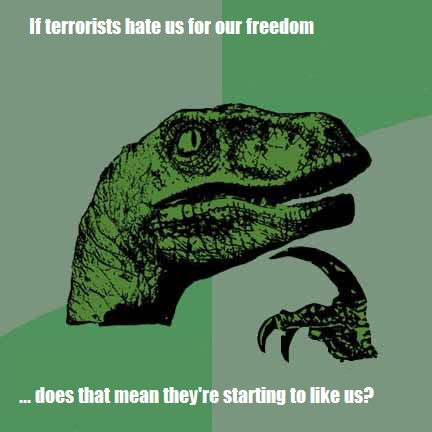 Yesterday, Conor Friedersdorf (Twitter) wrote an amazing piece for The Atlantic in which he explains why–no matter how liberal he is–he is not voting for President Obama. He writes:
Sometimes a policy is so reckless or immoral that supporting its backer as “the lesser of two evils” is unacceptable. If enough people start refusing to support any candidate who needlessly terrorizes innocents, perpetrates radical assaults on civil liberties, goes to war without Congress, or persecutes whistleblowers, among other misdeeds, post-9/11 excesses will be reined in.
I found this link on Facebook through J.R.D. Kirk. I absolutely agree with every word of this post. I shared it to my own Facebook wall, and….wow…I got some major pushback, mainly over my inclination to vote for a third-party candidate. People through around the same phrases I’ve heard the past few weeks about “wasting my vote” and “throwing it away” and “de-valuing it”. I found this odd for a few reasons.
Continue reading
“What if George W. Bush had done that?” (Opposites Coming Together) [Casual Friday]
Firstly, let me formally introduce “Casual Friday” posts. After all the seriousness in my posts on theology, politics, and such through the week, one could get the impression I can’t have any fun. Well, not so. Whenever I’m able, I hope to take Fridays to write up shorter, casual, and generally more light-hearted posts to talk about news, technology, entertainment, food, or whatever. Probably, it’ll mostly be me sharing some of my favorite things with all of you. Enjoy.
I subscribe to a great service called Summify. It analyzes my social feeds and gives me a reading list each day of the articles that my social graph has most-shared (don’t get too excited. It just got bought by Twitter and they will be shutting down the service shortly).
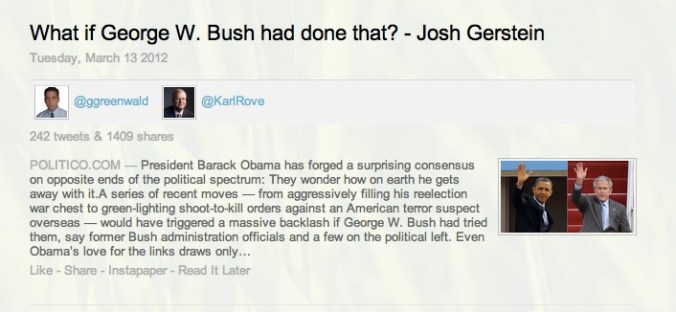
Anyway, in my email a couple of days ago, there was a link to this great article by Josh Gerstein showing both the (negative) similarities between Bush and Obama, and the blatant and (at times) comical hypocrisy of those that have hated/loved those respective men.
And what do you know? According to the screenshot above, this article was recommended by both Uber-Progressive Glenn Greenwald and Uber-NeoConservative Karl Rove (this was confirmed by each of their tweets). There could not be two more different men coming together to promote the same political article.
But anyway, the article is great, and if it was good enough for both of these guys to recommend it, then it should be worth all of our time and consideration. And as you do, remember all the things I’ve been saying. Like I said then: I promise, I’m not crazy. Other people are saying these things too.
Too Big Not To Fail [2]: the limits of Big-Gov
 A couple of days ago, I started this little “mini-series” on some of the more structural problems that seem to be messing the country up. I used the Obama Health Care law as an example of the limits of “Big-Corp”, and today I turn to the other behemoth in the room, Big Government.
The Shortfalls of Big-Government
Is the answer, then, in light of the breakdown of free market forces at the huge “macro” level, to bring in more Government? I don’t really know, but I don’t think so.
Big-Gov, it seems, suffers from the same shortfalls as Big-Corp. Our government, in a way, is structured to work on the same principles that are supposed to make Capitalism work well, and, in the end, suffers the same disadvantages as it increases in size.
Continue reading
Too Big Not To Fail [1]: the limits of Big-Corp
 [A little while ago, I wrote a little essay I never put out there on the virtues and troubles of sheer “size” when it comes to the entities that seem to govern most of our lives. I’ve decided to split it up into a couple of posts to get everyone else’s thoughts. Our nation was meant to be a nation of discourse and was built on the idea that with friction between ideas, something beautiful might happen. Let the friction begin…]
The Shortfalls of Big-Corporate
To begin, let’s use Obama’s health care law as a little case-study. A while ago, I was sent an 8-part series by Ann Coulter entitled “Liberal Lies About Health Care”. The first article opened with these lines:
“[Liberal Lie #](1) National health care will punish the insurance companies. You want to punish insurance companies? Make them compete. As Adam Smith observed, whenever two businessmen meet, “the conversation ends in a conspiracy against the public, or in some contrivance to raise prices.” That’s why we need a third, fourth and 45th competing insurance company that will undercut them by offering better service at a lower price.”
I’m a one issue voter: some responses & clarifications {Pt.2}
“Free people, remember this maxim: We may acquire liberty, but it is never recovered if it is once lost.” –Jean-Jacques Rousseau
[UPDATE: Part 3, “specific abuses of Executive Power” is up]
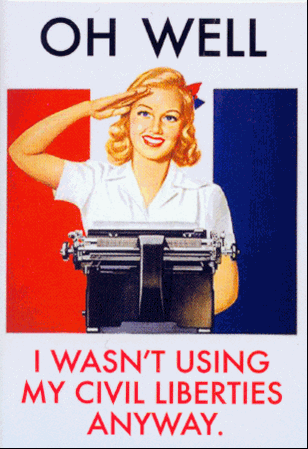
Yesterday, I wrote a post about how I’ve become so burdened by the abuse of civil liberties by the Executive branch, that I have decided that this is a big enough of a deal–and the time is crucial enough–to warrant this being the one issue I use to determine who I’m voting for this Presidential election.
I knew I was brief yesterday, but wow. That post ended up causing a lot of emails, texts, comments and Facebook posts from people really cautious about what I had said, and had a lot of clarifying questions for me. Some issues will become clearer as I continue to write about this, but I wanted to address some crucial things up front.
First, some definition
As Wikipedia puts it: “Civil liberties are simply defined as individual legal and constitutional protections from entities more powerful than an individual, for example, parts of the government, other individuals, or corporations.” To put it another way, our “civil liberties” are what is clearly laid out in the Bill of Rights.
Continue reading
A Call for Economic Reform & Justice in Exports {2:The Good News}
Part 1 of this essay outlined Obama’s current economic aspirations and the current, seemingly unrelated economic injustices America perpetrates in its dealings.
Liberty and Justice for All… Americans
And this is where I wanted to take this. For rapid supply-side economic investment to work, there needs to be people not only “demanding” your American-made exports, but people that can actually purchase them! Obama’s export plan is meant to boost America productivity while he travels all over the world, signing economic deals with other nations (as he mentioned the other night in his State of the Union address).
A President cannot create demand; countries can want our products as much as they want, but if, because of American protectionist economic policies, they do not have the resources to purchase these things, then we will only succeed in flooding the market with useless manufactured goods and therefore lowering the global cost of these goods, which will end up hurting America. Continue reading
A Call for Economic Reform & Justice in Exports {1:The Bad News}

[“Part 2: The Good News” of this post is also up]
Now, I know that these two posts will probably not get that much traffic, and not many will read all of it; it doesn’t fit the “niche” of this blog nor its usual readership. But I just had to get these thoughts out. For those that mainly read my writings for the “religious” angle, there’s some of that at the end and, ultimately, these issues (and their solutions) really are fundamentally theological. How we look at God and how He deals with us, His world, and where He’s taking both of them really affect how the Church is the Church to a broken world. So I encourage all of you that would normally not read something like this to go ahead and take a stab at it. Leave your thoughts. Push back a little. Help me understand this better.
The Current Plan
On my way to work yesterday, I heard a very interesting interview on NPR with Andrew Liveris, CEO of Dow Chemical and author of the new book Make It in America: the Case for Re-Inventing the Economy (which I’ve just started reading, and I must say, is pretty remarkable). In the interview, he focuses on manufacturing, talking briefly about the role of manufacturing in bringing about President Obama’s recent strong emphasis on exports in job creation. Continue reading
“BP, Obama, the Environment, and All That Other Stuff You’re Already Sick of Talking About”-Patrol

I have my newest article up on Patrol Magazine. It is joining in on a discussion happening between a couple of the writers at the magazine concerning ways to approach this oil crisis. My opinion? Stop trying to destroy BP. Why? Read on to find out. And please, give comments; I’d love to know what you all think. Here it is:
Open Mic: John Yoo, Torture, & Christian Ethics

Yesterday I wrote about how Catholicism views the idea of torture and how a possible response to it and it’s socio-political effects can be found in the Eucharist. That article was written because the idea of Torture has come front and center in the political discourse once more. For those not keeping track of the current political climate concerning the previous administration, John Yoo is a law professor at the University of California, Berkeley that was given the charge by the Bush administration and the CIA to define the nature and limits of “enhanced interrogation techniques“. He along with Jay Bybee authored the famous “torture memos” which gave legal justification for the use of waterboarding, sleep deprivation, and other techniques in order to get information from suspected terrorists.
Last year, the Office of Professional Responsibility wrote a report finding the two men guilty of professional misconduct and recommended the Justice Department do a full investigation. Ealier this month, both Bybee and Yoo were officially cleared of all wrongdoing in the eyes of the Department of Justice. Further, the DOJ strongly suggested that no further investigation nor disciplinary action from the bar should be sought. Last week the Department officially closed its investigation. Yesterday, the top ethicist of the Department of Justice said that not only did Yoo and Bybee do nothing criminal, but neither did they even act unethically. (Full summary of the metanarrative of all of this can be found here.)
Catholicism on Torture, the State, & the Eucharist

I know, I know — this seems like a weird topic to inaugurate this series. Today, in my ongoing series “Catholics Aren’t Crazy” I wanted to put up a post on a Catholic view of Scripture, inspiration, and inerrancy. They have some amazing things to say on these topics that Evangelicals could do really well to embrace. But alas, current events have changed that plan. Tomorrow I’m posting up a potentially controversial article here on a Christian view of Torture. I’m writing it in light of the recent developments, publications, and interviews concerning the legal and ethical exoneration of the “Torture Memo” authors, John Yoo and Jay Bybee. In my research I stumbled upon the following wonderful article by Andrew Sullivan of The Atlantic, posted on his blog on Ash Wednesday:
“May the Judgment Not Be Too Heavy Upon Us” — The Daily Dish
The article concerns Marc Thiessen, former speech writer for President Bush. Thiessen is on a tour of every news outlet it seems (I’ve seen him on like four different ones just this past week) to promote his brand new book, Courting Disaster, the point of which is pretty much as follows: Our “enhanced interrogation” techniques were moral, effective, and NOT torture; and President Obama has ended them, thereby “inviting the next attack” and putting everyone in America at risk of being slaughtered by Islamic extremists.
Health Care Summit Pre-Gaming

First and foremost, I need to admit that I think I was entirely wrong in the article I wrote last month on the Health Care bill. I feel like the comment left on that post by editor of Patrol Magazine, and friend, David Sessions was right on. I’m now super excited and pumped to see this stuff pass, hopefully soon. I’m mainly writing this post, though, to encourage everyone to tune in to the Health Care Summit going on tomorrow from 10am to 4pm (HuffPost). I believe most every news agency and network should be airing it both on TV and online. Also, I’m sure there will be several major New Media websites live-blogging the event or giving constant updates.
I really do think this summit could be so much bigger than just health care. It could begin a trajectory that determines both the results of the next fours years of elections and the very state of politics in America. It could transform political discourse. It could break the absurdity of the immature political feces-throwing that has defined how Washington has run. It could usher in a new era of bipartisanship for the sake of the American people.
Probably not, but in theory it could.
I thought liberals were all for diplomacy
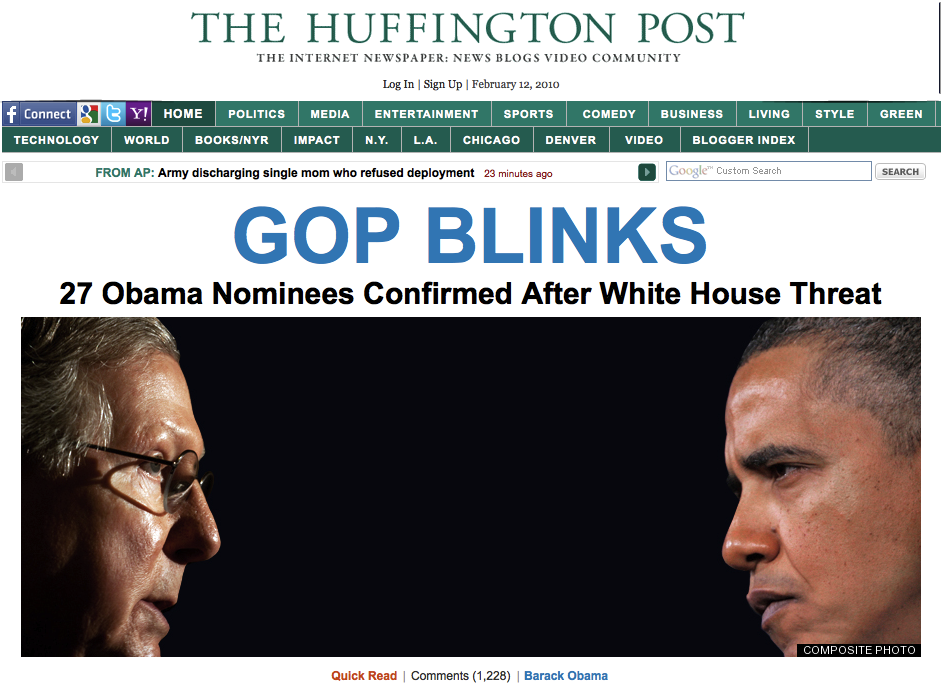
People have been right to criticize the Republicans and their political posturing and obstructionism. Jon Stewart, Rachel Maddow, and others were right to openly mock the way Republicans have seemingly overnight changed their views on historic planks of their platform just because Obama was putting forward those ideas. Obama was correct to plead with them with calm, reasoned explanations on how they were politically shooting themselves in the foot in the long term and freezing the work that needed to get done in this country. It was right to speak of Republican Senators that had absurd and asinine holds on Obama’s nominations as holding the government “hostage”. In short, it has been right to describe Republicans as “obstructionist”, and not for principle, but for politics. I personally resonate more with historic “conservative” visions of the government, but I have been disgusted by the abhorrent politicking that Republicans have been doing merely in the name of re-election. As Obama put it, far more concerned with their own job security than ours.
We have been right to cry out, editorialize, mock, rally against, be shocked by, and call for the end of these Republican political antics that have no basis in reason, discourse, or benefit to the American people or process.
NPR, News, & the Politics of Change

I encountered one of the most fascinating things the other day. In the picture above (click for a larger version), you will see a search I recently did on Twitter for “npr”. I was trying to find their various Twitter accounts so I could follow, get news updates, and the like. I was shocked to see that with 1,448,766 followers, NPR’s Politics account is by far the most popular. NPR News is a distant second with only 123,086 followers.
Why is that?
This has been giving more pause than it should. Why are there more than ten times as many people wanting to follow NPR Politics than NPR anything else? Of course, there are many factors I don’t know that could contribute to these results. The Politics account could be the oldest account, and the News one being a relatively new one. They all could have been started around the time of the election. The Politics account could have been advertised more. I don’t know, but still: would those variables fully account for the inequality?
Are Americans really that much more interested in Political news as opposed to general News? Actually, maybe. I know that prior to this election, I only got obsessed with politics for the five or so months leading up to voting night, and then dropped it like a bad habit the next morning. But not this time. For some reason unbeknownst to me, I have kept up with my political engagement – perhaps increased it, in fact. My personal addiction to NPR, The Economist, the Politics section of the New York Times and Slate magazine, various editorials and opinion columns, and all things Social Justice-y has only increased since November.
Could this be a reflection of the amount of hope and anticipation a completely new guard promised to bring? That Americans freely ascribed to? That all of us knew was needed? Perhaps. Personally, I think that the academy is moving past postmodernity into what I’m currently calling “neo-pragmatism” (some good friends would rather call it “critical realism”, and they have some good points). But either way, I feel like modernity preached to us the mind, postmodernity the heart, and now “neo-pragmatism” the legs. In short, I think people are seeking a “whatever works” approach. The great fulfillment promised by the previous two major philosophical epochs never happened, so now people are willing to do whatever it takes – throw off any convention, question so many presuppositions, and change ideologies – in the hopes that something might actually effect change and lasting growth in our lives.
Perhaps this simple Twitter search is a reflection of this? Maybe there really is a much greater interest in the mechanisms of change in the world because people know we need it, they want it, and want to know how their leaders are trying to help them accomplish it. Need I mention more than Obama’s campaign-winning slogan? It wasn’t Ideology you can believe in or even Truth you can believe in. It was Change. And politics is much more likely to accomplish change than news (for better or worse).
I think we’re right in looking for change. I think we’re right in looking for that which will actually be readily applicable in our everyday lives. I think we’re right in looking for what works.
I just fear we’re looking in the wrong place.
Some thoughts on our “Christian” Nation
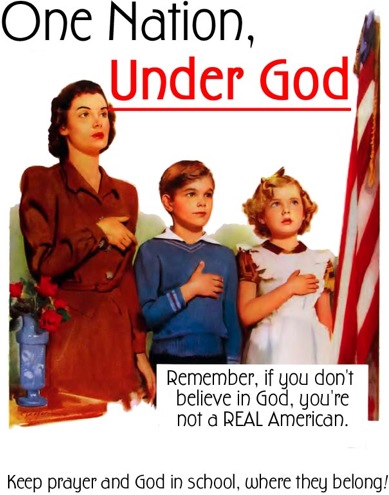 I recently received a facebook request to join the cause: “Tell Obama America is a Christian Nation”. Coming from the Bible-belt, this was certainly a worldview that I am very familiar with and one that I’ve thought through extensively ever since I was old enough to vote. I think I have come to a few conclusions concerning the matter. Please leave feedback.
America isn’t a christian nation.
First, “Christian” is never used as an adjective in the Bible. There’s no such thing as a “Christian” anything, except for a person. Sure, for most of its history most people living in America have been Christians, but if you have mostly Christians living in a certain apartment complex, would it suddenly be called a “Christian” apartment complex? Most all of America’s founders were Universalists (John Adams), Unitarians (Thomas Jefferson), Masons (Ben Franklin), and Deists (pretty much all the rest). Hardly any were Orthodox Christians in any recognizable sense of the word other than the fact that they used the words “God” and “Creator”, but so do a lot of other groups that clearly aren’t Christians.
Second, there’s a big difference between checking off “Christian” on a poll and actually being a Christian. Sure most people still check that off, but I would say that the percentage of people that are actually saved, born-again, living-the-life, actually loving Jesus Christians out there is less than half. It certainly feels that way living in the city, at least.
Thirdly, at the very least, even if America was “founded on Christian ideals”, the nature of a democracy/republic is that it changes with the public beliefs. Even if it used to be a Christian nation, the basic worldview of the citizenry has changed, so “what” the nation “is” has changed. The “public” define the nature of a democracy/republic, not its past.
Lastly, every time in history that Christianity has been used to describe a country, it’s never gone well (see: Constantine, the Inquisition, the Crusades, etc.). I pray America becomes a nation of Christians, but for the vast majority of its history, Christianity has done a lot better when it was in the minority (China, anyone?). We don’t fight for numbers of people or a percentage of a population or an office in politics.
We fight for the Glory of Christ.
Any thoughts?
Here’s a very balanced and helpful article from Patrol Mag, and here are some lyrics from a favorite Derek Webb Song of mine, “In God we Trust”:
In God we trust
and the government is on His shoulders
in God we trust
through democracy and tyranny alike
in God we trust
He uses both good and evil men
in God we trust
so we fight for peace and He fights for us
in God we trust
even when He fights us for someone else
in God we trust
even when He looks like the enemy
in God we trust
even though our hearts are bankrupt
in God we trust
for more than just the value of our dollar bills
in God we trust
but there’s no gold behind these notes of reserve
in God we trust
even through our great presumption
in God we trust
even though He favors no nation-state
in God we trust
even when the blessing is a curse
 the long way home