The Echoes of History & Abraham| Genesis 24.22-23


When the camels had finished drinking, the man took a gold nose-ring weighing a half shekel, and two bracelets for her arms weighing ten gold shekels, and said, “Tell me whose daughter you are. Is there room in your father’s house for us to spend the night?”
Genesis 24.22-23

On a random historical note, though it is clear that these stories come from older narratives and traditions written down much later, it is interesting that these stories still have features that would have been accurate for the time at which the story took place, millennia before the story was written down. You can see an example here. At the Pennsylvania Museum of Archaeology, you can see artifacts from this area and supposed time (where I have seen with my own eyes the type of jewelry that this would be referring to). From doing that, it really looks like things such as these bracelets and gold rings were used for currency a lot more at this particular time in history. Later on, in a story such as this you would have more references to gold, money, cattle, or more established forms of bartering.
See other Marginalia here. Read more about the series here.

Moses the Levite? | Exodus 2:1


Now a man from the house of Levi went and married a Levite woman.
Exodus 2.1

These are Moses’ unnamed parents. It’s interesting that the text makes a point to say they are both Levites, the priesthood branch of the family. Notice that both Aaron and Miriam, Moses is siblings, would have also come from the priesthood side of the family. I wonder if this gives Miriam a certain Priestley role in the community as well? Either way, I never noticed that Moses and Aaron are both Levites. This gives Moses a much more priestly, rather than prophetic, role in what he does, and the function he serves in the story and the community.

See other Marginalia here. Read more about the series here.

And the story moves from Abraham to Isaac… | selections from Genesis 26


Now there was a famine in the land, besides the former famine that had occurred in the days of Abraham. And Isaac went to Gerar, to King Abimelech of the Philistines.
Genesis 26:1

This reads like a later interpolation because of confusion between the two drought accounts.

The Lord appeared to Isaac and said, “Do not go down to Egypt; settle in the land that I shall show you.
Genesis 26:2

God’s first word to Abraham: “Go”. God’s first word to his son: “Do not go”. I love that. Not sure why, but I do.

Abimelech said, “What is this you have done to us? One of the people might easily have lain with your wife, and you would have brought guilt upon us.” So Abimelech warned all the people, saying, “Whoever touches this man or his wife shall be put to death.”
Genesis 26:10-11

Oh the mercy of God, and how he protects the vulnerable here. But how do we understand when he doesn’t act in protection like this?

See other Marginalia here.Read more about the series here.

Jesus came from some weird stock | Genesis 19.30-38


Now Lot went up out of Zoar and settled in the hills with his two daughters, for he was afraid to stay in Zoar; so he lived in a cave with his two daughters. And the firstborn said to the younger, “Our father is old, and there is not a man on earth to come in to us after the manner of all the world. Come, let us make our father drink wine, and we will lie with him, so that we may preserve offspring through our father.” So they made their father drink wine that night; and the firstborn went in, and lay with her father; he did not know when she lay down or when she rose. On the next day, the firstborn said to the younger, “Look, I lay last night with my father; let us make him drink wine tonight also; then you go in and lie with him, so that we may preserve offspring through our father.” So they made their father drink wine that night also; and the younger rose, and lay with him; and he did not know when she lay down or when she rose. Thus both the daughters of Lot became pregnant by their father. The firstborn bore a son, and named him Moab; he is the ancestor of the Moabites to this day. The younger also bore a son and named him Ben-ammi; he is the ancestor of the Ammonites to this day.
Genesis 19.30.38

Wow, the ancestral origins of Christ are incredibly odd.

See other Marginalia here. Read more about the series here.

Law & Grace, Law & Grace | Genesis 17.1-18


When Abram was ninety-nine years old, the Lord appeared to Abram, and said to him, “I am God Almighty; walk before me, and be blameless. And I will make my covenant between me and you, and will make you exceedingly numerous.” Then Abram fell on his face; and God said to him, “As for me, this is my covenant with you: You shall be the ancestor of a multitude of nations. No longer shall your name be Abram, but your name shall be Abraham; for I have made you the ancestor of a multitude of nations. I will make you exceedingly fruitful; and I will make nations of you, and kings shall come from you. I will establish my covenant between me and you, and your offspring after you throughout their generations, for an everlasting covenant, to be God to you and to your offspring after you. And I will give to you, and to your offspring after you, the land where you are now an alien, all the land of Canaan, for a perpetual holding; and I will be their God.”
Genesis 17.1-8

Those Lutherans are on to something. God really does seem to come at this on the front end with some works and law, and then does the covenant switcheroo.

See other Marginalia here. Read more about the series here.

The God of Chance & Randomness | Genesis 13.14-18


The Lord said to Abram, after Lot had separated from him, “Raise your eyes now, and look from the place where you are, northward and southward and eastward and westward; for all the land that you see I will give to you and to your offspring forever. I will make your offspring like the dust of the earth; so that if one can count the dust of the earth, your offspring also can be counted. Rise up, walk through the length and the breadth of the land, for I will give it to you.” So Abram moved his tent, and came and settled by the oaks of Mamre, which are at Hebron; and there he built an altar to the Lord.

Genesis 13:14-18

I find it really interesting that this promise comes after Abram more or less left this land allotment to chance and Lot’s choice. He let Lot choose what land he wanted, and then God pretty much says to Abram “everything else Lot didn’t choose is yours!” This becomes the Promised Land for the people of God. And it was essentially leftovers. Oh the tension between Providence and Human Action!

See other Marginalia here. Read more about the series here.

Covenantal Confusion (on my part) | Genesis 6:18


But[, Noah,] I will establish my covenant with you; and you shall come into the ark, you, your sons, your wife, and your sons’ wives with you.

Genesis 6:18

I really don’t get how the idea of Covenant fits into the narrative flow here. Is this covenant “different” than the Abrahamic one? How so? What happened to it? How do we know that the Abrahamic covenant isn’t just a new administration of the Noahic one?

See other Marginalia here. Read more about the series here.

Esther & Political Advocacy by God’s People| Es4.3,8 [DOUBLE-HEADER]


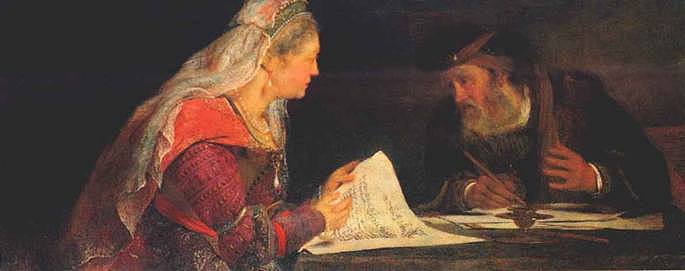
esther_mordechai-arent-de-gelderUpdate (3/8): This little seemingly inconsequential post caused quite the comment thread on Facebook and represented every reason I’ve started this series. I got challenged and my view of the book of Esther got broadened more than I ever could have imagine. I’ve reproduced those comments below.

In every province, wherever the king’s command and his decree came, there was great mourning among the Jews, with fasting and weeping and lamenting, and most of them lay in sackcloth and ashes. —Esther 4.3

Notice here that when the Jews are faced with political persecution, and an actual existential threat from the political authority, their response is not activism,  nor violence, nor lobbying, it is instead to pray, weep, lament, fast, and cry out to God, their true king and political leader.

Mordecai also gave him a copy of the written decree issued in Susa for their destruction, that he might show it to Esther, explain it to her, and charge her to go to the king to make supplication to him and entreat him for her people. —Esther 4.8

Well…Okay, okay. I see that only a few versus later, Mordecai does try to appeal to Esther, the political insider, to lobby on behalf of her people. So, that sort of goes against what I just said above.

But, notice that they still did not use violence or mass political demonstrations or mobilization. They peacefully engaged those from their community who were specifically equipped to engage politically. They didn’t see themselves as primarily political creatures,  nor their problems primarily as political problems,  nor the answers primarily as political solutions. The political piece was merely one facet in the kaleidoscope of human experience through which God works his will,  and not even the main one.

My not-so-subtle point: the Evangelical obsession with political activism and using politics to accomplish (what they view as) the goals of the Kingdom are anti-biblical and find no basis in Scripture.

See other Marginalia here. Read more about the series here.

[image credit: “Esther and Mordechai write the Second Letter of Purim” by Arent de Gelder]

Weirdest. Love story. Ever. | Genesis 29.10-12


Now when Jacob saw Rachel, the daughter of his mother’s brother Laban, and the sheep of his mother’s brother Laban, Jacob went up and rolled the stone from the well’s mouth, and watered the flock of his mother’s brother Laban. Then Jacob kissed Rachel, and wept aloud. And Jacob told Rachel that he was her father’s kinsman, and that he was Rebekah’s son; and she ran and told her father.

Genesis 29.10-12

Weirdest. Love story. Ever.

Also notice that he kisses her even before they’re betrothed.

See other Marginalia here. Read more about the series here.

Haha. Such a great narrative turn. | Genesis 6.5-8


The Lord saw that the wickedness of humankind was great in the earth, and that every inclination of the thoughts of their hearts was only evil continually. And the Lord was sorry that he had made humankind on the earth, and it grieved him to his heart. So the Lord said, “I will blot out from the earth the human beings I have created—people together with animals and creeping things and birds of the air, for I am sorry that I have made them.”

But Noah found favor in the sight of the Lord.
Genesis 6:5-8

Greatest narrative turn ever.

See other Marginalia here. Read more about the series here.