Death & Life; Names & Vows | Genesis 3.20-21


The man named his wife Eve, because she was the mother of all living. And the Lord God made garments of skins for the man and for his wife, and clothed them.
Genesis 3.20-21

I don’t know why I’ve never noticed this before. Why does Adam only name Eve after they sin? Further, of all the things to do after receiving the curse from God, he does this covenantal, marital act: he gives her a name.

I know this isn’t in this text, nor was it on the mind of the original writer, but it reminds me of the odd line in Revelation where God promises to give each person a new name that only He and they will know.

It seems that in the whole sweep of redemptive history, the Bride of the first Adam received a new name when he brought death, just as the Bride of the second Adam receives a new name when he brings life.
See other Marginalia here. Read more about the series here.

Abraham almost loses his son & he worships?! | Genesis 22.13-14


 And Abraham looked up and saw a ram, caught in a thicket by its horns. Abraham went and took the ram and offered it up as a burnt offering instead of his son. So Abraham called that place “The LORD will provide”; as it is said to this day, “On the mount of the LORD it shall be provided.”
Genesis 22.13-14

This is right after the whole “sacrifice Isaac” thing. To me, this such an odd response. Not only does Abraham worship God after this, which is crazy enough as it is, but he also sets up a memorial to remember this by! If I were him, I’d need some space from this God for a bit and I’d want to forget this incident as soon as possible.

I’ve always thought it odd that the book of Hebrews puts such an emphasis on Abraham and calling him the “father of faith” and extols his faith so much. Whenever I read that I think about how he had Ishmael with Hagar, due to a lack faith, and (twice) gave his wife up to be the wife of someone else because he was scared they’d kill him–another example of a lack of faith!

But then I read things like this and I think to myself, “Oh yeah, now I get it.”

See other Marginalia here. Read more about the series here.

Uh-oh (a Post-Script to my previous post on Moses)


image

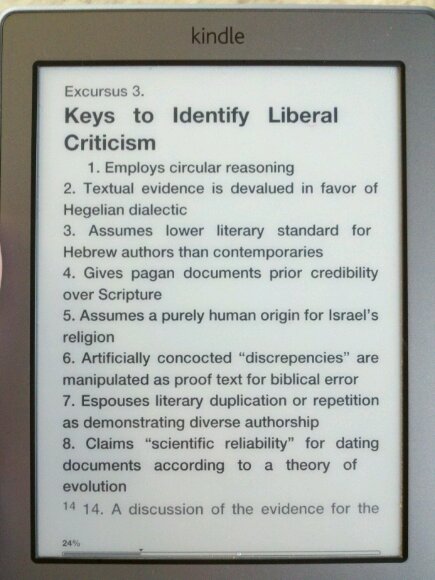
I just reached this part in the book I referenced in my post earlier on Mosaic authorship of the Pentateuch. This book was somewhat challenging the Documentary Hypothesis in my mind. I thought this book, in its recounting of Documentarians, was pretty fair and not too blindly fundamentalistic. But, now that he has turned from documenting the development of the field to laying out his own thoughts, I see I was wrong. Crap.

Posted from WordPress for Android on my Droid X

The Pentateuch: Moses vs. the Documentary Hypothesis [OPEN MIC]


imageUpdate: I realized I was wrong.

Okay, for many of you, this will seem silly and inconsequential; others will find it blasphemous. But bear with me for this quick post.

Starting in a few weeks, I’ll be teaching a survey of the Bible class through the summer at my church (I’m going to try and record it and post it here each week). To prep for this, I’ve been delving back into seminary-land, reading about 12 different OT Surveys, OT intros, and Pentateuchal commentaries to get ready for just the Intro to the Old Testament and Pentateuch parts.

And of course, this brings up the issue of the authorship of the Old Testament. Honestly, I don’t plan on going more than 2 minutes on the topic in this class, but I want that two minutes to be fair, informed, helpful, and above all, edifying to the people in the room. I want people walking away understanding that godly people disagree on this stuff and why they do. I don’t want to caricature and criticize unnecessarily.

The main issue I’m working through is what part Moses (or any other pre-10,000 B.C. ancient authors/editors/redactors) had in writing the Pentateuch.

Continue reading