“Is Twitter Really Killing Us?” – Patrol Mag


Do we form Social Networks or do Social Networks form us?

That’s the fundamental question raised by Peggy Ornstein’s recent article “I Tweet, Therefore I Am” in The New York Times recently.  It’s also the question I want to address in my recent article in Patrol Magazine.  So, whether you’re on Twitter, Facebook, or no Social Network at all, I promise the article has something for you, our culture, and the world in which we find ourselves.  Leave comments!  Here’s the link:

“Is Twitter Really Killing Us?” – Patrol Mag

You can read all my articles for Patrol Magazine here.

“Information Overload, Social Darwinism, Linguistics, & Nuclear Forensics”-Patrol


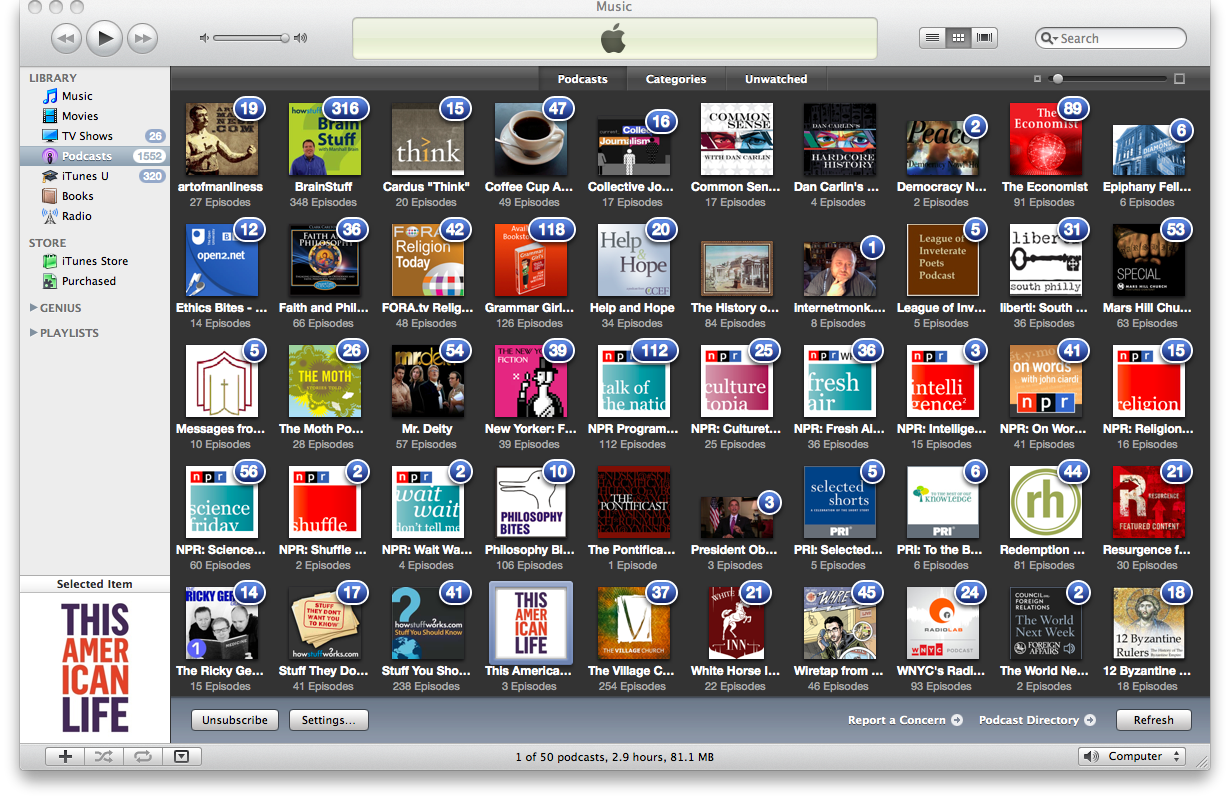
Look at that picture above.  Click on it to make it bigger.  That’s my iTunes.  As you can see, I listen to a LOT of podcasts.  And no, this isn’t just a  narcissistic  moment  to seem smart.  You see all those blue numbers above each podcast?  Well, those are just the episodes I haven’t listened to.  Also notice the 320 iTunesU lectures that have also been neglected.

And so begins my newest article in Patrol Magazine.  It’s about our culture’s (and my own) addiction to information consumption, how we should think about it, and where our hope is that something good may come of it.  I know, it’s some light reading, right?  Here’s the link:

“Information Overload, Social Darwinism, Linguistics, & Nuclear Forensics”

For all my previous articles at Patrol, click here.

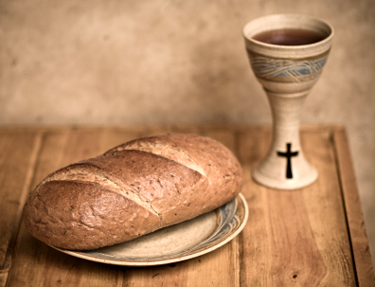
Catholics Aren’t Crazy: The Eucharist & Economics (pt.1 of ?)


I haven’t written a post in this series in a while, but I’ve been reading William Cavanaugh’s amazing book Being Consumed: Economics & Christian Desire as a counter to Jack Cashill’s Popes & Bankers, which I just finished.  It’s pretty remarkable.  Every Christian–nay, every person–should read this book.

Cavanaugh is a Catholic and this influences his thought greatly and wonderfully.  I’ve only made it through the Introduction and I already feel like I’ve been taken for a ride, with my economic thought swirling.  Once I’m done I’ll surely be posting a review here for all of you to enjoy.  He has this amazing paragraph in the Introduction I wanted to share here with all of you:
Continue reading

“Inception and the Art of the Review”- PatrolMag


Hello, I have about 5 or 6 separate articles/reviews I’m working on at the moment, and not just for Patrol Magazine, but also this site!  We finally have internet at my place, so if I can only find some time (and a little inspiration).  But, until those articles get up here, I have more Patrol articles to send you all (you can read my past articles here).  This week, I have a sort of review of Christopher Nolan’s new masterpiece Inception.  I say “sort of” because it’s more of a reflection on how the movie’s impacted me than an actual typical review.  Anyway, read and enjoy.

And see Inception. [Photo credit]

“Inception and the Art of the Review”- PatrolMag

Beauty: Revisited


Last year I gave a seminar/lecture/sermon thing at my old church, Epiphany Fellowship. The topic I spoke on was Beauty. I spent about nine months doing research, reading, talking, and thinking before ultimately delivering it last August. After the break is the full “Table of Contents” for each part of the blog series I did going through each individual part of the manuscript.  Those blog parts have not yet been updated.  Here are the the updated full written Manuscript, the audio of my “lecture”, and an appendix with the Greek/Hebrew breakdown of the words for “Beauty” in the Bible.

Full Talk
Full Audio
Language Appendix

Series Table of Contents:

Why do we long for Beauty?

What is Beauty?

What Things are Beautiful, and why?

How do we respond to this Beauty?

Conclusion

“Jack Bauer Must Die” -Patrol Mag


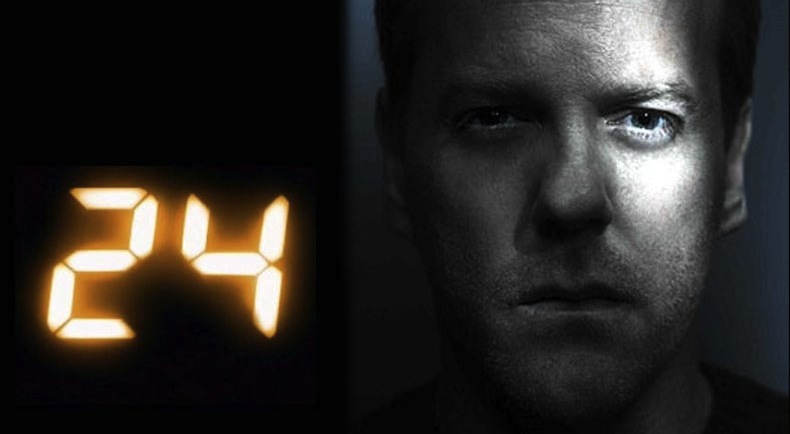
My original title for my article this week for Patrol Magazine (before the editorial chopping block) was I’m Calling It: Jack Bauer Will Die (On Morality & “24”).  The article concerns the television series 24 and it’s upcoming series-ending finale.  My theory?  They’re going to kill Jack Bauer, the show’s iconic main character.  Read the article to find out my reasons why:

“Jack Bauer Must Die” – Patrol Magazine

It’s far more philosophical than “televisional”, so don’t worry.  I did not intend to bog people down with plot minutiae and spoilers.  Speaking of, as far as spoilers go, there are only a couple concerning very recent episodes of the current season, and even though are fairly nebulous.  Besides, how the story is told is just as exciting (if not more) as what the story is.

Continue reading

On Poetry & Atheism (I’m Writing for Patrol Magazine)


Sorry things have been so slow this week on the blog.  I’m still trying to find my rhythm for writing while I have this new full-time job.

As of late last week, I am the newest writer for the blogs at Patrol Magazine. Patrol is a great site putting forward some of the best writing available on culture, the arts, and spirituality from the perspective of post-everything twenty-somethings. I am the Thursday contributor to “The Scanner” section of the site. The Scanner is the place for “daily culture, media, views, and blather.” Today, my first article went up. Here’s the link:

Poetry is the Only Thing That Can Save Atheists, Says Other Hitchens Brother

I’m really excited and grateful to have the opportunity to contribute to one of my favorite sites. Like I said, you can see my writing every Thursday there on Patrol Magazine. As I continue writing, you can see all of my articles here.

Does anyone have any ideas for future posts?

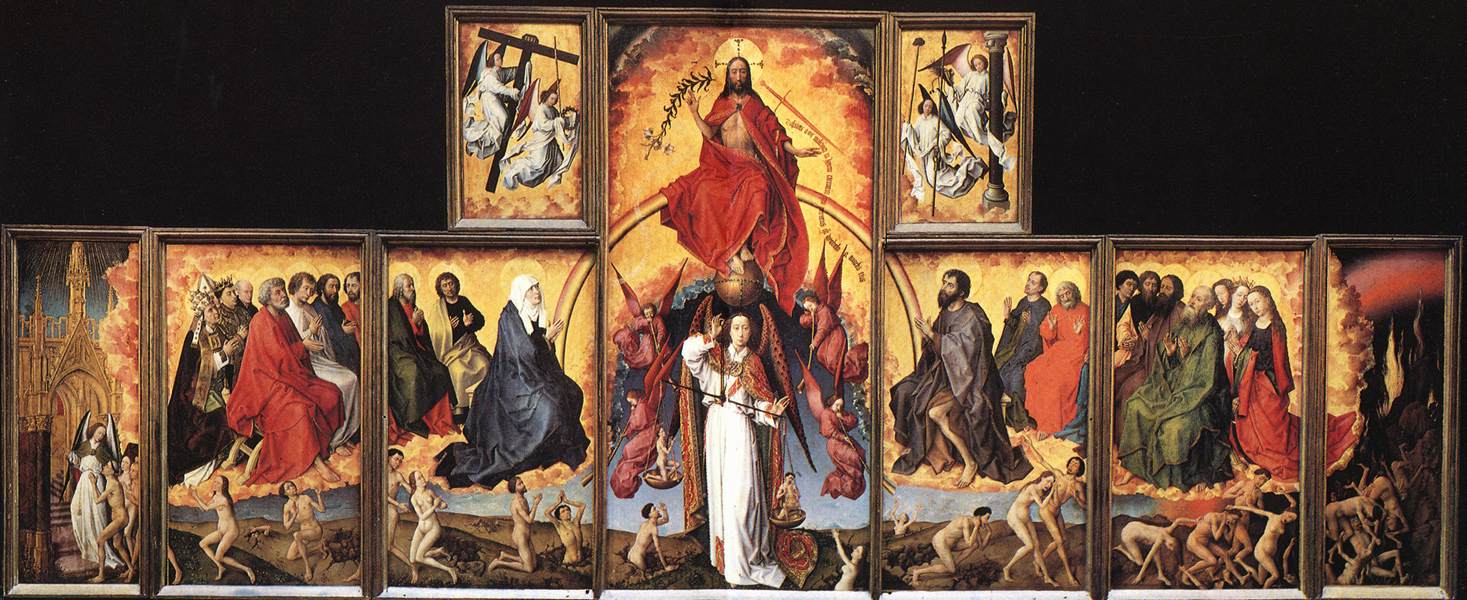
[Art above: “The Last Judgment” by Rogier van der Weyden. Just read the article. It’ll make sense.]

Absolutism vs. Relativism: Is there Another Way?


Sorry.  I know this is lame.  But, I was organizing some of the files on my computer and I ran across this proposal I wrote last year to the Journal of Religion and Popular Culture for an article.  It didn’t get accepted, so I never wrote the article.  I thought I’d go ahead and put it up though to see if you all have any thoughts on this topic, or if you’d like to see this article written anyway.  Feel free to leave some comments at the bottom of the post.

In the midst of the culture wars, deep philosophical shifts are challenging old ways of thinking. As a culture of post-modernity encroaches upon ground that was previously held by religion, the presuppositions of all faiths are being challenged by new, competing ideas. Religion charges post-modern culture with Relativism — a tenet that religion claims is unsustainable. This critique is not without validity: no philosophy can stand for long that admits its lack of foundation, and does not recognize a need for such epistemological certainty. The relativizing of post-modernity will surely collapse under a generation of those disillusioned by its inability to deliver that which it has no principle nor authority to deliver.

Continue reading

Some Protestant Leftovers on Scripture & Inerrancy


The other day I posted an article on how Roman Catholics look at Scripture. When I originally wrote it, it was far too long to post online in its entirety. Therefore, I cut out some chunks, that I’d like to post now. They are mainly on how I believe the current landscape is in typical Evangelicalism in America. I know I’m using broad strokes to talk about these things, but I assure you, this mindset is still very strong, especially in the South. Here it is:

Oh, the Bible. It’s the lifeblood of the Church. It’s our backbone. Why? Well, the logic goes like this: there’s a God who’s so far beyond our understanding that we can know nothing of Him unless He reveals it to us. That’s what Christian believe the Bible is–the revelation of God. This may sound fairly simple–and it is, in one sense–but in some areas, this truth of Scripture sometimes brings more confusion and disagreement than clarity and insight. Because, let’s face it, it’s difficult to grasp that the God that is SOOOO beyond our understanding revealed himself through–of all mediums–a book? And what’s more: this book? It’s tough to read many (most?) parts of the Bible and think “this is the revelation of GOD.”

Continue reading

Open Mic: John Yoo, Torture, & Christian Ethics


Yesterday I wrote about how Catholicism views the idea of torture and how a possible response to it and it’s socio-political effects can be found in the Eucharist.  That article was written because the idea of Torture has come front and center in the political discourse once more.  For those not keeping track of the current political climate concerning the previous administration, John Yoo is a law professor at the University of California, Berkeley that was given the charge by the Bush administration and the CIA to define the nature and limits of “enhanced interrogation techniques“. He along with Jay Bybee authored the famous “torture memos” which gave legal justification for the use of waterboarding, sleep deprivation, and other techniques in order to get information from suspected terrorists.

Last year, the Office of Professional Responsibility wrote a report finding the two men guilty of professional misconduct and recommended the Justice Department do a full investigation. Ealier this month, both Bybee and Yoo were officially cleared of all wrongdoing in the eyes of the Department of Justice. Further, the DOJ strongly suggested that no further investigation nor disciplinary action from the bar should be sought. Last week the Department officially closed its investigation. Yesterday, the top ethicist of the Department of Justice said that not only did Yoo and Bybee do nothing criminal, but neither did they even act unethically. (Full summary of the metanarrative of all of this can be found here.)

Continue reading

REVIEW: “Simply Christian” by N.T. Wright


Simply Christian
Bishop N.T. Wright
Zondervan, 2006
Buy Now Here
Pre-Order New Ed. Here

__________

As I revealed in a recent tweet, I believe I’m walking into a new obsession with the author/scholar/pastor N.T. Wright. Surprising to many, I’m sure, with me being a seminarian and all, is the fact that I had never read any Wright before this book. Sure, I’ve known of his existence for years, had seen a few of his YouTube clips, and skimmed a few of his articles, but I had never read his books. My housemate during the two months or so before seminary began reading through Wright’s entire Christian Origins and the Question of God series (books 1, 2, 3) constituting over 2,100 pages of reading. He couldn’t stop reading, nor stop telling me about how amazing this man was. I nodded and agreed, sure that I would read something at some point. I had no idea what I was missing.

Continue reading

The Bible, Slavery, & Atheists{2b}: Theology & Ethics | Reform & Revive


By the time I finished the next article in the series, it was substantive enough and socially-oriented enough to warrant being posted on my webzine Reform & Revive.  The previous post was on on how secular Philosophy can inform our view of ethics and contribute to the discussion of Slavery, Atheism, and the Bible.  This one is about how Christian theological ethics can uniquely inform our ethics in modern times.  The article covers a LOT of ground and is the longest one I’ve written yet in this series.  Hopefully that’s not a turn off.  This article has more of my thought concerning truth and Biblical interpretation than perhaps any one article I’ve ever written contains.  Here’s the link:

http://reformandrevive.com/2009/12/22/a-theology-of-ethics-contemporary-applications/

It seems in light of my earlier post I’ve decided to pour more of myself into this series, rather than just quickly finishing it off.  Hopefully it’s helpful.

Lastly, I keep getting private emails, texts, and messages from Christians talking about how much they’re enjoying this series, and how helpful it is to them, but hardly any Christians are publicly commenting.  I’m getting tons of comments from my atheist friends, though.  Discrepancy?  I think so.  If you have a thought, please leave it.  It could be really helpful to get more input on this and diversity of thought on this.

Thank you all for your support and encouragement.  It means a lot.

The Bible, Slavery, & Atheists{2a}: Philosophy & Ethics


As I’ve looked at and read the various articulations about this issue put forward by my atheist friends, I’ve noticed a few philosophical assumptions about ethics that are driving many people’s perspective on how the Bible does/should talk about these things. In this post, I’d like to highlight those things and show how they are neither philosophically or theologically correct. By the time I finished writing, it was really long, so, using one of the few benefits of blogging as a medium of discourse, I will put up the second part (concerning the more theological side of this) tomorrow or the next day.
The Philosophy of Ethics

Principles vs. Applications

Even the most cursory look shows that the study of ethics is the study of transcendent principles that govern our morality and behavior. There is an important distinction though made between those transcendent principles and their applications. One can hold to the exact same set of principles, but apply them differently at different times/cultures. It is simplistic and reductionistic to think that anyone’s “ethics” will be applied in the exact same way every time. No ethicist secular or otherwise treats ethics in this fashion. I believe that Scripture is consistent throughout in its transcendent principles, though not in their comprehensive applications (below). To navigate applications takes another pair of things the Bible talks at length about: faith and wisdom (more in the next post). Further, I don’t think this principle/application distinction provides any serious ethical challenge to biblical authority. The Bible itself never claims to treat ethics in this reductionistic manner, so to force it upon Scripture is dishonest.

One of my atheist friends mentioned the converts in isolated African tribes where nudity is prevalent, saying that if Christians were consistent, they must insist that they all cover up in order to be Church members in good standing. Except there’s a problem with that: there is no Christian ethic of “non-nudity”. There is a Christian ethic of “modesty” that says that we have the responsibility to adorn God’s beautiful creation of the human body in such a way that it maintains the respect and dignity it deserves. Now, how respect and dignity is shown changes culture to culture, so it takes wisdom to see where the human form is being abused in that culture — and that is not a compromise of Christian ethics. The consistent biblical principle has still been preached, upheld, and lived. If ethics (secular or Christian) were as naively structured as is necessary for some of these atheist criticisms to make sense, then the entire field of ethics would be unnecessary and non existent, because we could have a computer program that could make all the black-and-white moral decisions for us.

Continue reading

The Bible, Slavery, & Atheism: Part 1b


this is real (I did it myself)

The next post is pretty much done, but I wanted to send out this quick note before moving on. The previous post revealed a lot of things that I neglected to make clear. My fault. Sorry.

First and foremost, the last post was not meant to settle the question on slavery and the Bible. I just wanted to get out what the Bible actually says about it. The most I wanted to accomplish toward addressing the issue was to let people see a clear trajectory within Scripture wherein no part is inherently contradictory to the parts before or after it, no more than a seed is contradictory in nature or form to a fully blossomed flower. I also wanted to give a sense of the complexity of the issue. In every passage that lies out even the most comprehensive sets of morality and ethics for the Israelite people, you never see slavery there. It was never an action that was consistently seen as something moral. It’s not a freedom that the Israelites are free to use whenever they desire; it’s used sporadically, meaning that there must be something else going on beyond some explicit commentary by God on the moral nature of slavery. The New Testament is clear that the crucifixion of Christ was something that was foreordained and ultimately brought about by God, but this neither expunges the moral responsibility of the people that actually did it, nor says that God is all about crucifixion and thinks it is “morally neutral” or “ethically okay”. He clearly thinks it is wrong and evil, and yet He clearly ordained it, allowed it, and used it to bring about his promised redemption to the world.

Continue reading

Beauty: The Complete Series


screen-captureIn 2009 I did a seminar at my old church, Epiphany Fellowship, on the topic of Beauty. I spent about nine months doing research, reading, talking, and thinking before offering it to the community. I then separated my overall talk into the series of blog posts you’ll see below. A year later, I updated the main manuscript with some expanded thoughts. Those blog posts represent the material before the update.

On this page you’ll find the audio from the talk and the updated manuscript,, as well as a special appendix I put together offering a complete breakdown of every word in both Greek and Hebrew that the English Standard Version of the Bible translates as “beauty” or “beautiful”, broken down by frequency.  Along with those words (and all their forms), I’ve offered the most literal definition of each so you can easily see the huge range of meanings that the Biblical words for “beauty” carry. I hope it’s helpful. You don’t need any knowledge of Greek or Hebrew to understand it or get something from it.

Series Table of Contents

Resources for this series:

[photo by David Schrott]

The Outline for the Entire Series:

Resources for this series:

[photo by David Schrott]