Our infinitely compassionate (and delegating) God | Exodus 3.7-8


Then the Lord said, “I have observed the misery of my people who are in Egypt; I have heard their cry on account of their taskmasters. Indeed, I know their sufferings, and I have come down to deliver them from the Egyptians, and to bring them up out of that land to a good and broad land, a land flowing with milk and honey….
Exodus 3.7-8

Notice the verbs hear that God uses to describe how he relates to his people. He observes, hears, knows, and comes down. How intimate, tender, and powerful. Also, it’s a little funny that he says that he has come down to save if his people right as he’s commissioning Moses to do it for him.

See other Marginalia here. Read more about the series here.

Ancient Miracles, Skepticism, & Historicity | Mark 2.12


And he stood up, and immediately took the mat and went out before all of them; so that they were all amazed and glorified God, saying, “We have never seen anything like this!”
Mark 2.12

Even ancient people knew magic tricks. This was utterly different than anything else they’d ever seen or even thought was possible. This point is especially interesting considering the things they believe God had done in history in the past. Even though they “believed” the things happened, it wasn’t until they were face to face with the New Creation that they really saw the things this God could do.

Similarly to today, I wonder if there’s a subtle, unconscious “wink-wink” about how seriously we take some of these things. In their case, I actually think it was right, however, as those miraculous things in their stories were to be seen more as symbols and shadows that would point forward to an “actual” manifestation in Christ–not as historically-essential events. And yet, when that Christ was there, it still blew there minds.

See other Marginalia here. Read more about the series here.

Our Exile is for the world’s salvation | Acts 7.6-7


And God spoke in these terms, that his descendants would be resident aliens in a country belonging to others, who would enslave them and mistreat them during four hundred years. “But I will judge the nation that they serve,” said God, “and after that they shall come out and worship me in this place.”
Acts 7.6-7

Our exile/ambassadorship/pilgrim-nature as well as God’s judgment are all for the sake of the ultimate worshipnot condemnation–of the nations and the world!

See other Marginalia here. Read more about the series here.

Random Thoughts on Preaching: The Trinity


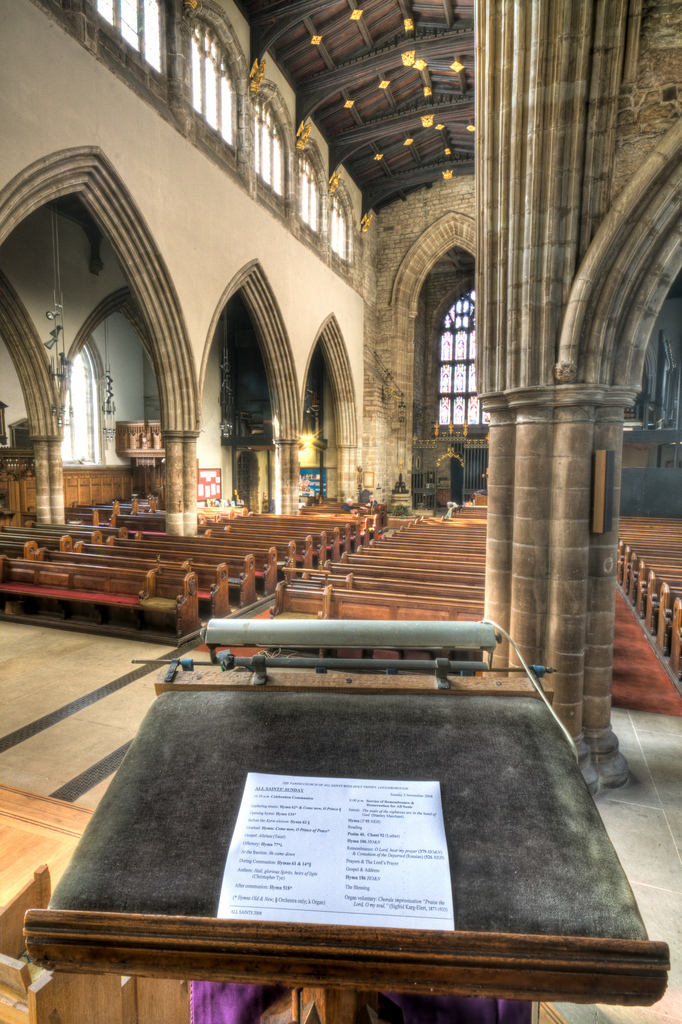
pulpit-church-hdr-bible

First: Our worship is a participation, mediated by the Spirit, in Christ’s Communion with the Father.

In this Trinitarian picture of worship, where does preaching fit in? Well, there is an eternal “conversation” happening among all the members of the Trinity. The divine words of Creation are presented as an “overflow” of this divine conversation. So to me, preaching is a Spirit-“infused” (and humanly articulated) mediation of the words between the Father, the Son, and the Holy Spirit.

Because the Spirit enables our union with Jesus, and because Jesus is joined to the Father, we find ourselves mystically and intimately in union with the whole Trinitarian God Himself. And so, preaching is–in a sense and at its best–an articulation and “listening in” on this eternal “trialogue” within the Godhead.

The world having been created through and for the Son means that the Father’s words to the Son are now his words to and for us. And this Word that is spoken to the Son by the Father is the Gospel. When it is offered to humans, this eternal, mysterious articulation of the Gospel in the Godhead is always mediated and contextualized in order to be received and perceived by the hearer. This is why the Bible is the way it is.
Continue reading

We worship Christ and…. the Resurrection? | Acts 17 & 24


Also some Epicurean and Stoic philosophers debated with him. Some said, “What does this babbler want to say?” Others said, “He seems to be a proclaimer of foreign divinities.” (This was because he was telling the good news about Jesus and the resurrection.)
Acts 17:18

One of the funniest moments in Acts. Notice they accuse him of preaching foreign “divinities” (plural). The Greek word for Resurrection is Anastasis. Paul has rolled in preaching “ton Iesous kai thn Anastasin”, or “the Jesus and the Resurrection”. The Philosophers think that Paul is preaching about two gods: “Jesus” and his wife, “Resurrection”.

I have a hope in God—a hope that they themselves also accept—that there will be a resurrection of both the righteous and the unrighteous. Therefore I do my best always to have a clear conscience toward God and all people.
Acts 24:15-16

Paul is obsessed with the resurrection. Well technically, Luke is. If you see the charge against Paul earlier, it was that he was preaching Christ and the Resurrection. They thought he was teaching two gods. Apparently, he must have been talking about the Resurrection so passionately. Almost as passionately as Christ.

They did not accuse him of preaching Jesus and the Cross, Jesus and the Tomb, Jesus and the Jews, Jesus and Grace through Faith, or even Jesus and the New Creation! It was Jesus and the Resurrection. The Resurrection is Paul’s way out of trouble. It’s his way of telling his story. Of causing divisions between himself and some Jews, and to show his solidarity with others. It’s everything to who Paul is and what he’s come to do.

See other Marginalia here. Read more about the series here.

The King’s Authority: more Christian lessons from Esther | Esther 8.7-8


When King Ahasuerus said to Queen Esther and to the Jew Mordecai, “See, I have given Esther the house of Haman, and they have hanged him on the gallows, because he plotted to lay hands on the Jews. You may write as you please with regard to the Jews, in the name of the king, and seal it with the king’s ring; for an edict written in the name of the king and sealed with the king’s ring cannot be revoked.”
Esther 8.7-8

Oh the beauty here. Look at this. This is the king who had conquered the enemy of God’s people, sitting down and lending his authority to the very people that he was previously in a contract of anger and condemnation towards. He lends them his very authority and gives them the responsibility and freedom–based on what they know of the world and culture around them–to proclaim the good news to their people with the king’s authority. Sound familiar? This is what we do as Christians, and we strive to do that faithfully.

See other Marginalia here. Read more about the series here.

God’s Sovereignty, Moses’ Will | Exodus 3.4


When the Lord saw that he had turned aside to see, God called to him out of the bush, “Moses, Moses!” And he said, “Here I am.”
Exodus 3.4

What an interesting interplay between God’s Sovereignty and human will. The angel, or an expression of God, calls out to Moses and then waits for his response. The text then makes a point to say that it was only after God saw Moses obey the call and come to him that he begins speaking his promises and showing his identity to Moses. God here shows patience, and waits for Moses.

See other Marginalia here. Read more about the series here.

Mark Driscoll: Now just another fundie, but it still hurts


TT_May_Driscoll

Let not those who hope in you be put to
shame through me, O lord God of Hosts;
let not those who seek you be brought to
dishonor through me, O God of Israel.
Psalm 51

I have written before how much I enjoy my own ignorance of the Christian blogosphere. Things happen in evangelical corners of the world, that I have no idea about. I am happy to know more about the Ukrainian crisis than whatever crisis some mega church or celebrity pastor is going through.

And yet, somehow (usually Facebook), I always seem to keep up with whatever is going on with Mark Driscoll. He has lots of critics, and I am certainly one of them, and many of them seem to be grasping at whatever they can to “bring him down”. There seem to be so many Driscoll obsessions out there, be it plagiarism, making fun of “effeminate” church leaders, extreme church discipline, messy staff turnovers, un-credited ghost writing, or buying his way onto best seller lists. (If you care about those “scandals”, just Google them.)

I have big problems with how a lot of folks criticize Driscoll and the glee they seem to feel in each new thing we all find out. Lore Ferguson has the best and most beautiful articulation I’ve read of the unhelpful ways people levy these criticisms his way.

Continue reading

God & Job | Job 1.8


The Lord said to Satan, “Have you considered my servant Job? There is no one like him on the earth, a blameless and upright man who fears God and turns away from evil.”
Job 1.8

We so often forget that this whole thing was God’s idea, and he initiated it. He is the first one to drop Job’s name and suggest this scheme to Satan.

See other Marginalia here. Read more about the series here.

Responding to the Covenant | Genesis 35.9-13


God appeared to Jacob again when he came from Paddan-aram, and he blessed him. God said to him, “Your name is Jacob; no longer shall you be called Jacob, but Israel shall be your name.” So he was called Israel. God said to him, “I am God Almighty: be fruitful and multiply; a nation and a company of nations shall come from you, and kings shall spring from you. The land that I gave to Abraham and Isaac I will give to you, and I will give the land to your offspring after you.” Then God went up from him at the place where he had spoken with him.
Genesis 35.9-13

Here is God renewing the Abraham covenant with Jacob. Notice that this is not a new covenant, but a passing of the mantle of stewardship on to Jacob. This is the same covenant we are under, except this mantle of stewardship has gone to, and stayed with, Jesus himself.

See other Marginalia here. Read more about the series here.

Wrestling with God: History & Theology | Genesis 32.24-32


Jacob was left alone; and a man wrestled with him until daybreak. When the man saw that he did not prevail against Jacob, he struck him on the hip socket; and Jacob’s hip was put out of joint as he wrestled with him. Then he said, “Let me go, for the day is breaking.” But Jacob said, “I will not let you go, unless you bless me.” So he said to him, “What is your name?” And he said, “Jacob.” Then the man said, “You shall no longer be called Jacob, but Israel, for you have striven with God and with humans, and have prevailed.” Then Jacob asked him, “Please tell me your name.” But he said, “Why is it that you ask my name?” And there he blessed him. So Jacob called the place Peniel, saying, “For I have seen God face to face, and yet my life is preserved.” The sun rose upon him as he passed Penuel, limping because of his hip. Therefore to this day the Israelites do not eat the thigh muscle that is on the hip socket, because he struck Jacob on the hip socket at the thigh muscle.
Genesis 32:24-32

Two strands of thinking here:

Critical-Historical: Where the heck did this story come from?  It’s got to be a later interpolation (it has no connection whatsoever to the surrounding verses and is never mentioned again in the OT), but from what?  That last verse implies that the story came about simply to explain the dietary habits of Israelites. But really, why appeal to such an odd, powerful and incredibly profound story for such a simple message?

Biblical-Theological: Holy crap, what a concentrated text of such meaning. He “wrestles” with God, but it’s in the midst of his greatest stress and travail. It testifies to us how our greatest struggles in life are often wrestlings with God himself. We get a new name, we bear life-long scars, and it affects our ancestors for years to come.

See other Marginalia here. Read more about the series here.

The Worship of Job; the Blame of God | Job 1.20-22


Then Job arose, tore his robe, shaved his head, and fell on the ground and worshiped. He said, “Naked I came from my mother’s womb, and naked shall I return there; the Lord gave, and theLord has taken away; blessed be the name of the Lord.”

In all this Job did not sin or charge God with wrongdoing.
Job 1.20-22

I mentioned this verse earlier in my post on a theology of angels. It’s one of the most concentrated, powerful, packed lines of Scripture in the Bible. Job suffers and he worships. He ascribes to God the actions of Satan and the text explicitly says he does not sin in doing so. He fully inhabits his mourning and it is sincere and it is real. And yet, just as sincere as is his mourning, his worship is as well.

See other Marginalia here. Read more about the series here.

A quick note on why everything you think about angels might be wrong | Exodus 3.2


There the angel of the Lord appeared to him in a flame of fire out of a bush; he looked, and the bush was blazing, yet it was not consumed.
Exodus 3.2

It seems that in other parts of Scripture–both Old and New Testaments–the writers seem to think that this is God himself showing up in the bush. Heck, this account itself makes that claim. So, I’m wonder if angels aren’t so much heavenly beings with their own individual personalities, but rather incarnations (pun intended) of “parts” of God. Maybe certain attributes, perhaps? And so, maybe it is the case that all the stories about angels and heavenly hosts and battles really are more symbolic of general spiritual forces rather than individual beings with their own personalities and such. Maybe they are not “representatives” of God, but are just God in certain forms. Perhaps they are like pre-incarnations? I think we need a new vocabulary to talk about this. Either way, this text clearly says “the angel of the Lord appeared” and then the rest of the story says it’s YHWH himself.

If you want an even more provocative thought. Recall Job, when the “angel Satan” does a bunch of stuff to Job? Well, Job goes on to say that the Lord has done those things to him, and both times he does this, the text clearly says, “Job did not sin with his lips or ascribe wrong to God.” “Satan” does something, Job says God did it. The Bible says Job is right.

Lastly, as a disclaimer on these Marginalia posts. These are my stream of conscious thoughts as I read Scripture. They are not fully-formed doctrinal positions. I think it beneficial not to shield people from even the craziest left-field questions that pop up in one’s mind, but to invite them into the thinking process.

See other Marginalia here. Read more about the series here.

God’s Camp is Our Camp | Genesis 32:1


Jacob went on his way and the angels of God met him; and when Jacob saw them he said, “This is God’s camp!” So he called that place Mahanaim.
Genesis 32:1

Jacob experiences God here, says that this is God’s camp, and yet the name he gives it means “two camps”. I love this idea. The camps that are God’s are also ours. We have an “ownership” of sorts in God’s presence. His presence “belongs” to his people. It also speaks of devotion. Where He camps, we camp. The good news of the covenant? In Jesus, the whole world is God’s “camp”. Therefore, the whole world is our inheritance.

See other Marginalia here. Read more about the series here.