Some Protestant Saint-Praying Clarifications & Responses


Wow. Last week’s post about praying to saints really brought out more passion in people than I thought it would. Both here on the blog and on Facebook, here were some clarifying comments I left. By the way, this was the best comment on that post that challenged my thinking. I hope this helps.

First, here is my final, quick summary clarification of my position and why Evangelicals need not be freaked out about all this. If you read nothing else on this post, let it be this:

I really wish there was a different and better word than “prayer” for this. I agree that what most of us Protestants think of when we think of prayer really should only be directed at God.

Further, I’m simply advocating for this to be one more optional means of grace a Christian can participate in, depending on how they are wired. This shouldn’t take away from anyone’s participation in union with Christ or praying to him anymore than Bible memorization, fasting, listening to sacred music, or reading a devotional book does.

Everything critics have said they think should only be reserved for God, I absolutely agree with. I am certainly not suggesting we turn our affections, praise, adoration, or even our hearts towards those that have died. I just think we can talk to them, and they can intercede for us to God. I don’t think they talk back, that we experience their presence, or that they magically impart any more of God’s favor than asking a friend to pray with us would.

As Paul said, our outer selves are wasting away, while inwardly we’re being renewed day by day. Those that have died are, in a very real sense, just as “alive” as we are now, albeit absent from the body.

Therefore, all I think is (1) they can see and know what’s going on down here, and (2) they talk to God.

If those two things are true, then I don’t see the inherent evil, harm, or soul-destroying error it might be to simply “talk” to those that have gone before–not “commune with”, “worship”, or any of the other dimensions of “Godward prayer”. Just sending up some prayer requests to the part of the Body of Christ that is absent from the body, but present with the Lord.

What’s the harm in that?
Continue reading

The Best Communion Prayer my Church has ever had


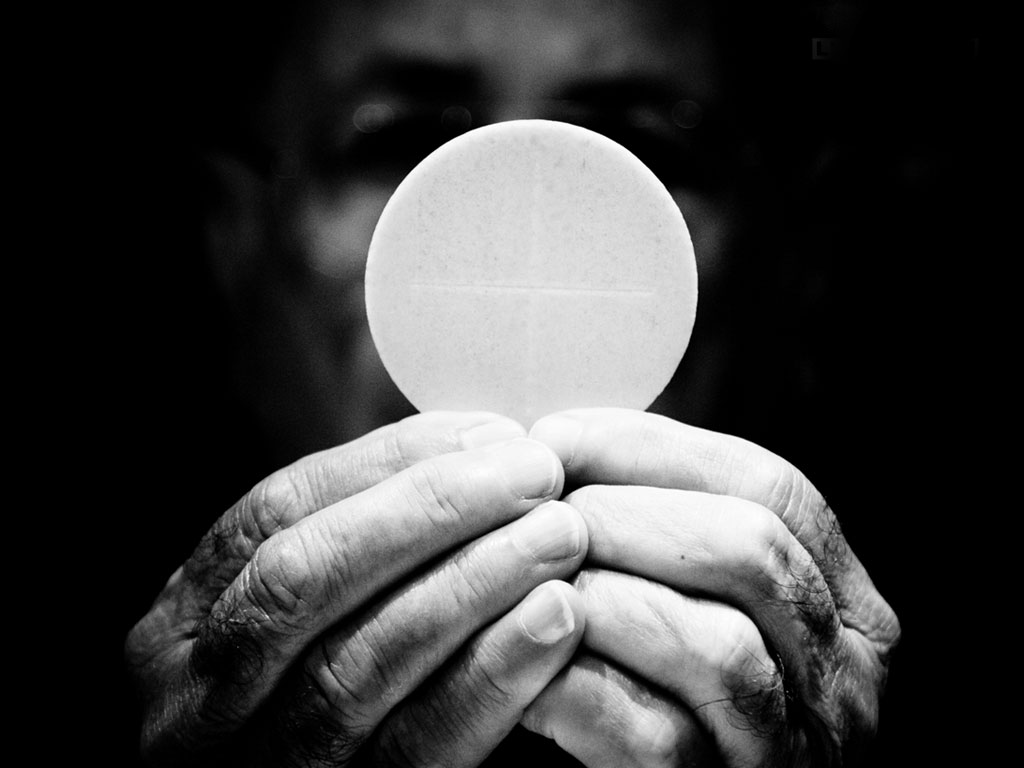
eucharist-bw-waferFather, your table proclaims to us your undying love for us. This table tells us that you do not simply endure our presence. This table tells us that you delight in being with us. You have invited us to feast in your presence.

So we have come to eat and drink deeply of your love for us. May we interpret our lives through this table. May we understand that we are a people with whom you are well pleased. May this reality energize us as we move into our world. May we live out our lives as your deeply loved, anointed children. Fill us with joy as’we labor for you in this world. Amen.

Liberti Church, 10/20/13

Good Morning (prayer)! [photo sermon]


ultimo-coffee-cortado

Each week, WordPress has a Weekly Photo Challenge, where they give a theme and invite people to highlight photography representing that theme, accompanied by a few meditations on it. OccasionallyI try and write a “photo sermon” or meditation based on those themes, accompanied by a photo of mine . This week’s theme is “Good Morning“.

* * * * *

In one of those oddities of tire human condition, I love sleep, and yet I avoid it like the plague. I have a terrible sleep schedule. My sleep pattern is a microcosm of my lack of discipline in many parts of life, and maybe even an extremely low level of self-harm, where my body and heart wouldn’t really know what to do if it were consistently well-rested. There’s something about a constant weight of tiredness that—maybe—makes one feel “productive”, even as it steals productivity away from you.

This is a lie. I know. I’m working on it in therapy.

In some Christian circles, people claim “life verses” for themselves; bits of the Bible that they feel speak to them so deeply that the words amount to a blanket summary, call, encouragement, guiding principle, or telos to their life. People usually pick a “life verse” that speaks to what they want their life to be or how they want God to work in their lives.

Continue reading

Postscript: J. I. Packer’s Helpful Evaluation of Praying in Tongues [QUOTE]


ji-packerI just have one more thing to post in this little series on my charismatic sensibilities. Yesterday, when writing about praying in tongues, I quoted from this long piece that J. I. Packer (the spry man to the left) wrote evaluating the charismatic movement as a whole. It’s a heavy article, but if you get to his conclusions, they are very interesting.

Packer is a Reformed Anglican, and believes that the “sign” gifts (the “extra-crazy” works of the Holy Spirit) have now ceased and were only used for a time to “get the church going” as it were. (If it weren’t clear, I think this designation of “sign gifts” is incredibly arbitrary and I think you have to twist the Bible backwards to prove that these things simply stopped at some point in time. I think they are still very much with us, however neglected they may be.)

But still, he is incredibly gracious to the charismatic movement and sees it as a legitimate expression of God’s people seeking a greater communion with him, and even believes that they need to teach the old Reformed fuddy-duddies (is that how you spell that?) a thing or two. I found his comments particularly on tongues especially delightful, and I thought it would be a fitting post-script to these posts I’ve been writing on my own charismatic side. The paragraph breaks in this quote are my own, for ease of reading. Continue reading

Charismatic Confessions, pt. 3: Praying in Tongues for Everyone!


flickr-sculpture-worship-kiss

{abstract: “Praying in tongues” is not really a “gift”, but rather a way in which God makes Himself known, and we commune with Him. Therefore, I believe it’s open to all of us, not just those with a “gift”. It is a sacramental, physical participation in the “real presence” of God praying within you. It may very well be random and not a “real heavenly language”, but nevertheless, God is sacramentally mediated to us in it. I conclude by offering some brief practical encouragements.}

Last week, I started writing some posts in response to a New York Times piece about research concerning the practice of talking in tongues. I wrote about how this piece reminded me of my own charismatic side and how I’ve been neglecting it. I then talked about my views concerning the use of tongues in a corporate Sunday church context. Today, I want to give people a realistic and (hopefully) sensible framework for understanding the private use of praying in tongues.

Continue reading

Confessions of a Lapsed Charismatic, pt. 1


Grace-words-mouth-poetry-psalms

{summary: Though rooted in a Reformed tradition that usually spurns this, I am very much a theological charismatic. I believe in the full, contemporary exercise of the Holy Spirit through his Church, including all of the manifestations this has had throughout Church History. And yet, though I “believe” these things, over the past few years, they’ve played a smaller and smaller part in my life. In this piece, I reflect on that.}

UPDATES: Part 2 is up, where I go through a brief history of tongues in a corporate church context. I’ve also posted Part 3, where I focus in on the why and how of individual praying in tongues.

Several days ago, the New York Times had a wonderful Op-Ed piece called “Why We Talk in Tongues“, by a researcher who is exploring this phenomenon. (It was also appropriate, as it is still sort-of, but not really, still Pentecost.) The piece seems to have been pretty popular. Playing around with Google Trends a bit, it seems that this article made the topic of talking in tongues more popular than it has been since “Speaking in Tongues” by Justin Bieber popped up on YouTube a few years ago. This article made the topic more popular than even Megan Fox’s revelation that she speaks in tongues (and is still a practicing Pentecostal).

It got some play all over my Facebook feed, and a couple of friends asked for some of my thoughts. That they asked for my opinion was both flattering and dismaying; it reminded me of how little I talk about this part of my spirituality among my church community.

I remember years ago, when I first found my church in Richmond, Virginia, right at the end of my first semester in college. I walked into this special evening service and I immediately knew this was where God wanted me. I joined the church and was exposed to a beautiful display of charismatic theology.

Continue reading

My problem with “quiet times” (some rest for the journey?)


prayer-hands-bible

If you’ve spent any real time in the Church, you probably are well-aware that there are some practical things that “mature Christians” end up doing (or so we hear) to “pursue Christ” and intimacy with God on days other than Sunday. Usually, this is some set of practices, disciplines, and rituals that surround two key things: the Bible and Prayer.

In the Bible Belt, where I’m from, the common term to describe this is the “quiet time”. This can be a devotional that includes a snippet of Bible verses with some meditations and prayers. It could be reading a passage and then journaling about it. It can even be going through an established liturgy of prayer with rotations of Scripture found throughout (here’s my favorite).

Whatever form it takes, it’s usually a subjective engagement (prayer) with the “objective” revealing of God (the Bible). It is usually rooted in the Bible, and even the prayer or journaling is seen as a response to how God reveals Himself in the Scripture. “Quiet times” are, fundamentally speaking, time spent with God in the Bible.

I’m sure the experience is very different in other branches of the Christian family tree, but at least in Evangelicalism (my bread-and-butter), “quiet times” become the go-to litmus test for one’s own spiritual health. If people are going through difficult times, we nudge them towards the Bible more. If we are to feel spiritually vital, healthy and mature, we gain the impression, over time, that it must flow from regular, disciplined quiet times.

But as I have lived through my own pursuit of the elusive “consistent quiet time”, dealt with decades of feelings of spiritual inadequacy, and seemingly had every time of requesting prayer on my behalf be about trying to get the grace to have these quiet times, I have slowly realized there are problems with how we have conceived of the “quiet time”. Come walk with me a little bit.

Continue reading

How We Prove God (a prayer by Karl Barth)


hands-pray-sepia“Dear heavenly Father, we ask you to give us all your Holy Spirit, and to give it continually, that it may awaken, enlighten, encourage, and enable us to dare to take the small and large steps of moving out of comfort with which we can comfort each other and into hope in you. Turn us away toward you! Do not allow us to hide from you! Do not let us do anything without you! Show us how glorious you are and how glorious it is to trust and obey you!

We would ask the same for all people, that the nations and governments may bow to your Word, and that they will be willing to work for justice and peace on earth, that your Word may be understood and taken to heart by all those who are poor, sick, imprisoned, troubled, oppressed, and unbelieving; that through word and deed it may be made known to them; and that it may be perceived by them as the answer to their sighs and cries; that all Christian churches and confessions may learn to recognize it anew and serve it with renewed faithfulness; that its truth may be and remain bright here and now in all of humanity’s error and confusion, until such a time as it shall ultimately enlighten all people and all things.

You are glorified, you who make us free in Jesus Christ, your Son, by confessing and standing on this: that our hope is in you. Amen.”

— from Karl Barth, “Pentecost” in Fifty Prayers

(Note: This was posted as part of a series of back-and-forths between an Atheist friend and myself. These exchanges are now complete. There is a Table of Contents to the discussion now available.)

prayer & meditation for Ascension Day


Grant, we pray, Almighty God, that as we believe your only-begotten Son our Lord Jesus Christ to have ascended into heaven, so we may also in heart and mind there ascend, and with him continually dwell; who lives and reigns with you and the Holy Spirit, one God, for ever and ever. Amen.

(from the the Book of Common Prayer & the site Morning Prayer)

Also read my own meditations on this Holy Day.
Continue reading

{Easter friday} | prayer & readings for Easter Week (2013)


For Easter Week: reading schedule/reflections.

prayer.

Almighty Father, who gave your only Son to die for our sins and to rise for our justification: Give us grace so to put away the leaven of malice and wickedness, that we may always serve you in pureness of living and truth; through Jesus Christ your Son our Lord, who lives and reigns with you and the Holy Spirit, one God, now and for ever. Amen.
(from the liberti Lent & Easter 2012 prayerbook & the Book of Common Prayer)

Continue reading

{Easter thursday} | prayer & readings for Easter Week (2013)


For Easter Week: reading schedule/reflections.

prayer.

Almighty and everlasting God, who in the Paschal mystery established the new covenant of reconciliation: Grant that all who have been reborn into the fellowship of Christ’s Body may show forth in their lives what they profess by their faith; through Jesus Christ our Lord, who lives and reigns with you and the Holy Spirit, one God, for ever and ever. Amen.
(from the liberti Lent & Easter 2012 prayerbook & the Book of Common Prayer)

Continue reading

{Easter wednesday} | prayer & readings for Easter Week (2013)


For Easter Week: reading schedule/reflections.

prayer.

O God, whose blessed Son made himself known to his disciples in the breaking of bread: Open the eyes of our faith, that we may behold him in all his redeeming work; who lives and reigns with you, in the unity of the Holy Spirit, one God, now and for ever. Amen.
(from the liberti Lent & Easter 2012 prayerbook & the Book of Common Prayer)

Continue reading

{Easter tuesday} | prayer & readings for Easter Week (2013)


For Easter Week: reading schedule/reflections.

prayer.

O God, who by the glorious resurrection of your Son Jesus Christ destroyed death and brought life and immortality to light: Grant that we, who have been raised with him, may abide in his presence and rejoice in the hope of eternal glory; through Jesus Christ our Lord, to whom, with you and the Holy Spirit, be dominion and praise for ever and ever. Amen.
(from the liberti Lent & Easter 2012 prayerbook & the Book of Common Prayer)

Continue reading

{Easter monday} | prayer & readings for Easter Week (2013)


For Easter Week: reading schedule/reflections.

prayer.

Grant, we pray, Almighty God, that we who celebrate with awe the Paschal feast may be found worthy to attain to everlasting joys; through Jesus Christ our Lord, who lives and reigns with you and the Holy Spirit, one God, now and for ever. Amen.
(from the liberti Lent & Easter 2012 prayerbook & the Book of Common Prayer)

Continue reading

readings & reflections for Easter Week (2013)


scripture readings for the week.
as the week progresses, check back here and click on the appropriate day for Prayer and Scripture text for that day

(from the liberti Lent & Easter 2013 prayerbook & the Book of Common Prayer)
Continue reading