Please Oppose SOPA & PIPA in Congress. Here’s why & how.


UPDATE: I wrote a follow-up piece to this protest that might be worth your time if you care about this issue.

As many people know (especially in the circles that read this blog), today is the official “blackout day” for many sites in protest of two proposed bills before Congress: the Stop Online Piracy Act (SOPA) and the Protect IP Act (PIPA). They are each supposed to be attempts to address the problems of piracy and copyright infringement on the web.

First, let’s be clear. Most of the people opposing these bills are not trying to protect piracy and illegal activities. These are problems, to be sure. Those opposing these bills are merely saying that there are much better and much more specific ways to do this. The bills, as currently written are so broad in their scope and definitions, that most any website, and most every individual who currently casually uses the internet will at some point be guilty of the felonies spoken to in this bill. I am not exaggerating. I am not talking in extremes to scare people. (It almost makes one think the bills were intentionally written that way. They are also weighed down with a lot of political corruption.)

This is serious. Why?

Supporters of the bill are painting those that oppose it as merely reacting to the general idea of the bills rather than the “substance” of them. This is false. You may have heard that that the sponsors of the bill recently struck the “DNS blocking” provisions from the bills. This is not even close to the scariest part of the legislation. It is the very substance of it that is the scariest. I would really beg each of you to read the following few articles to get educated on the specifics of these bills, what’s wrong with them, and what to do something about it.

What to do?

Sign Petitions

Write your Representatives in Congress

If you go to the Wikipedia (English) homepage, for just today, you’ll see it’s blacked out in protest of the bills. If you input your zip code, you can find your representatives in Congress and convenient links to email or call them. Below, you will find the email I wrote to my Representatives and Senators (my senators’ emails are currently down due to heavy traffic. I’m hoping that’s a good sign). Feel free to use it as a template if you like. If you get this when Wikipedia’s tool is not available, you can also find your representatives at the House website and the Senate website. Please act!
Continue reading


Advent, Evolution, & Absolution


It’s Advent. A time where we especially orient ourselves towards rejoicing and celebrating the fact that God did not remain far off and merely create a “legal” or “dogmatic” satisfaction for the plight of his creation and creatures. Rather, he broke into it and came into his creation and among his creatures. In this year’s Advent series, we’re exploring how, in this Coming, Jesus took on our creaturely form, care-taking functioncomprehensive fallenness, and communal formation.

First, God took physical, human, creaturely form. In the study I did–and subsequent lecture I gave–on Beauty a couple of years ago, I defined “Beauty” as the attribute of something that expressed complexity simply. Is not this God-in-human-flesh (theologically referred to as the Incarnation) the most beautiful of all miracles to take place? The Infinitely Complex God inhabits the simplest of human forms: a child.
Continue reading

a Jesuit Priest on Evolution. Enjoy.


Is evolution a theory, a system or a hypothesis? It is much more: it is a general condition to which all theories, all hypotheses, as systems must bow and which they must satisfy henceforth if they are to be thinkable and true. Evolution is a light illuminating all facts, a curve that all lines must follow… There is an absolute direction of growth, to which both our duty and our happiness demand that we should conform. It is human function to complete cosmic evolution…. Christ is realized in evolution.

Pierre Teilhard de Chardin, Jesuit Priest and trained paleontologist in “The Phenomenon of Man“, ca. 1930s

I’ll be writing more about this in my Advent reflection on Monday. [Read reflection 1]

Weekly Must-Reads {08.30.11}


Admittedly, this week’s Must-Reads are a bit random, but I think you all will enjoy them. There are no consistent themes this time around, just a little hodge-podge of humor, politics, theology, etc.. As usual, feel free to add your own links for myself and others to read in the comments section, as well as comment on these articles.

__________

Things Organized Neatly

This site is starting to make its rounds amongst our crew here in Philly. We’re obsessed, but it’s so worth it. I’ve taken some of the pictures and have them rotating as my laptop background to reflect my interest in bookswritingcoffee and breakfasthistorymy favorite board gamedressing nicelybeing coolfacial hair, and shaving.

God, Math & the Multiverse | the Veritas Forum

I haven’t actually watched/listened to it yet, but it should be pretty phenomenal. Thanks for the link, Colin.

Continue reading

Weekly Must-Reads {08.11.11} | reasonable Christianity edition (in honor of John Stott)


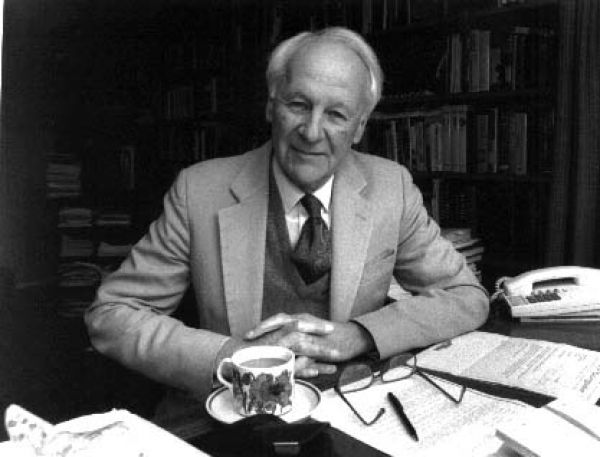
This week, I wanted to focus on extremely “reasonable” expressions and discussion surrounding Christianity: it’s heroes, it’s application, and how to live it out. This is in honor of a great man we lost recently. A couple of weeks ago, John Stott, a great and fairly unassuming hero of the Church, died. He is very much responsible for the shaping of a Christianity that is both just and intelligent. Even though he did not preach nor speak regularly, and mostly wrote academic books, it is he that laid the theological foundation that has only now finally trickled down to the masses of young and “restless” Christians today–whether we know his name or not. It is the shoulder of this giant of the faith upon which we all now stand. Let us not forget that. I have provided some links to that end.

___________

John Stott Has Died | Christianity Today

This is Stott’s obituary in Christianity Today. Read up on his life and read some of the homages linked to in this article. He was an amazing man.

Evangelicals Without Blowhards | NYTimes.com Opinion

This is by Bill Kristof, a weekly contributor to the blogs at NYT. He is not a Christian, and yet he devotes this article in honor of John Stott–his work, his influence, and the presence of millions of Evangelicals that are continuing his work today by caring about justice in this world.

Continue reading

Weekly Must-Reads {06.20.11} | a New York Times Op-Ed miscellany


This week, as I compiled my favorite reads for the week, I realized nearly all of them were from the New York Times. I found these on different days, at different times, and had no idea that I kept bookmarking the same site over and over again. But still, all of them are very different and I encourage you to peruse, read, ponder, and post your thoughts!

__________

Instead of Student Loans, Investing in Futures | NYTimes.com

Ever since the financial crisis hit, I’ve been so intrigued by other economic models for getting things done. This article follows one idea when it comes to funding higher education. And it really seems to work. I also love that this particular idea was not dreamt up by nor financed by the government.

Continue reading

science and the evolution of the science of evolution


Over at Scot McKnight’s blog, Jesus Creed, the resident scientist-who’s-a-Christian (I hate that I can’t just write “Christian Scientist”), RJS (I have no idea what his full name is, and I couldn’t find it), recently posted a brief post about the ongoing dilemma of a fossil called Tiktaalik rosea, the dating of which and the evolutionary place in which it exists is still in flux. After recounting some of the changing conclusions about this fossil, RJS asks:

Is this kind of give and take an evidence for weakness in the evolutionary hypothesis?

Is it unexpected waffling or the expected progress of scientific discovery and the refinement of understanding?

Continue reading

On Darwinism vs. Design (a response to the Richmond Center for Christian Study) {pt.2}


Yesterday, I posted the first part of a reply to Chris Daniel, Executive Director of the Richmond Center for Christian Study, who wrote an article titled The Origin of Life: Darwinism vs. Design. Here is part 2.

Chris, you are right to attack Darwinism as a philosophy or worldview; just like it is also appropriate to attack humanism, hedonism, racism, sexism, bibliolatry, and “systematic theology-ism”. Any system that builds its existence and definition around a created thing rather than the Person of God Himself ought to be attacked and shown to be the inadequate system it is.

But just because those “isms” above shouldn’t define our worldviews, it does’t mean that there isn’t truth and goodness even in the the things they are tempted to define themselves by: humanity has worth, pleasure is good, races are beautiful, genders are different, the Bible is the primary revelation of God (we are not a people of the Book, but a people of the Word that is testified to by the Book), and systematic theology can be helpful as we interpret and apply the Scriptures.

And Darwinism as a philosophy is an improper elevation of a seemingly true process.

Continue reading

On Darwinism vs. Design (a response to the Richmond Center for Christian Study) {pt.1}


[Update: Part 2 has been posted]

Chris Daniel, Executive Director of the Richmond Center for Christian Study posted this article titled The Origin of Life: Darwinism vs. Design. In it, he unpacks why he thinks agreement with evolution is an incorrect posture for Christians and how “Intelligent Design” is the superior and clearer stance to take.

I consider Chris a friend. He led the Reformed University Fellowship at VCU when I went there and our campus ministries worked together on several occasions. He is a great man of God, a brilliant teacher, and an articulate apologist for the Christian faith.

Nevertheless, my feelings on this topic are no secret, and my heart has broken frequently over these discussion (and has become angered some times). As I started writing out a little comment on the post on their site, it turned into a full-fledged response, which I’ll break up into two posts today and tomorrow. Please refer to his article for any references I make that seem to have no context. Here’s part 1 of my response. Part 2 is here: Continue reading

Good News: Blogging is Dying!


According to a new study by the Pew Research Center, as discussed in The New York Times yesterday, blogging is declining among those age groups that originally led to its popularity.  Apparently, between 2006 to 2009 blogging activity among those between the ages of 12 and 17 feel by half.  Even among my own age group, the 18-to-33-year olds, blogging activity has dropped by 2% in the past couple of years.  Considering that almost 505,000 post were published just today and just on the WordPress blogging platform, 2% can add up to a lot of posts.

The article goes on to say that these younger bloggers have moved on to using Twitter to share things they find interesting and Facebook to share their “original” thoughts with the world.  Using a blog has just become “another step” in communicating ourselves that these kids find unnecessary and unappealing.
Continue reading

Weekly Must-Reads {01.09.11}


Last week I experimented with a little feature on my new favorite bookmarking service, Diigo, where it would automatically write up a weekly blog post containing all my bookmarks for the week and the comments I posted and quotes I highlighted.  Well, I went in blind and the post last week was a little messy.  So, this week, I took some time to clean it up a bit.  This week’s articles range the gamut from abortion to blogging.  If you click the links, they will take you to a special annotated version of the page where you can even see the little sticky notes I left.  Please read any of these articles that interest you and please–if you could–let me know what you think down in the comments.  Thanks.

U.S. teenager tortured in Kuwait and barred re-entry into the U.S. – Glenn Greenwald – Salon.com

I really don’t think the Founders wanted us to be terrified of our government.  Just think of it: you as an American citizen–with no legal record of any kind–could be studying abroad and have this happen to you.  This guy had NO indication that he could end up here.  This is like some crazy movie.  I’m actually scared of my country.

Continue reading

Weekly Must-Reads {01.02.11}


  • This is so cool. The findings in this field evoke so much wonder, awe, and worship within me. So much joy in Christ comes from these studies by these scientists. Thank you, Christ, for your book of revelation known as Nature!

    tags: share evolution science

    MONEY QUOTE: For the necessary interbreeding to have happened, Dr Paabo’s new species would thus have to have been spread over a vast area of Asia. Yet it has left no previously identified traces.

  • Continue reading

When Great Minds & Stubborn Hearts Collide: on Al Mohler & Karl Giberson


Ah, this is a tough one to write. As some on the blogo-rounds have been quick to jump on the coat tails of, Al Mohler, the president of Southern Baptist Theological Seminary and Karl Giberson, the Vice-President of the BioLogos Foundation, have been in a bit of a tizzy for the past couple of months. Mohler is a very conservative Evangelical whom Time proclaimed as the most influential Evangelical intellectual in America of couple of years ago. Giberson is also a Baptist, but has devoted much of his time, writings, and energies to showing how Darwinian Evolution is not inherently antithetical to a Christian worldview. Mohler, as can be expected, disagrees. This little debate has reached a climax in the past couple of days. For a full account of what’s been written in this exchange, I have a full timeline at the bottom of this post.

Hopefully in the next few days I can actually lend some (hopefully) helpful thoughts on the actual argument taking place, but today I just wanted to step back and lament a little.

Continue reading

“Is Twitter Really Killing Us?” – Patrol Mag


Do we form Social Networks or do Social Networks form us?

That’s the fundamental question raised by Peggy Ornstein’s recent article “I Tweet, Therefore I Am” in The New York Times recently.  It’s also the question I want to address in my recent article in Patrol Magazine.  So, whether you’re on Twitter, Facebook, or no Social Network at all, I promise the article has something for you, our culture, and the world in which we find ourselves.  Leave comments!  Here’s the link:

“Is Twitter Really Killing Us?” – Patrol Mag

You can read all my articles for Patrol Magazine here.

“Information Overload, Social Darwinism, Linguistics, & Nuclear Forensics”-Patrol


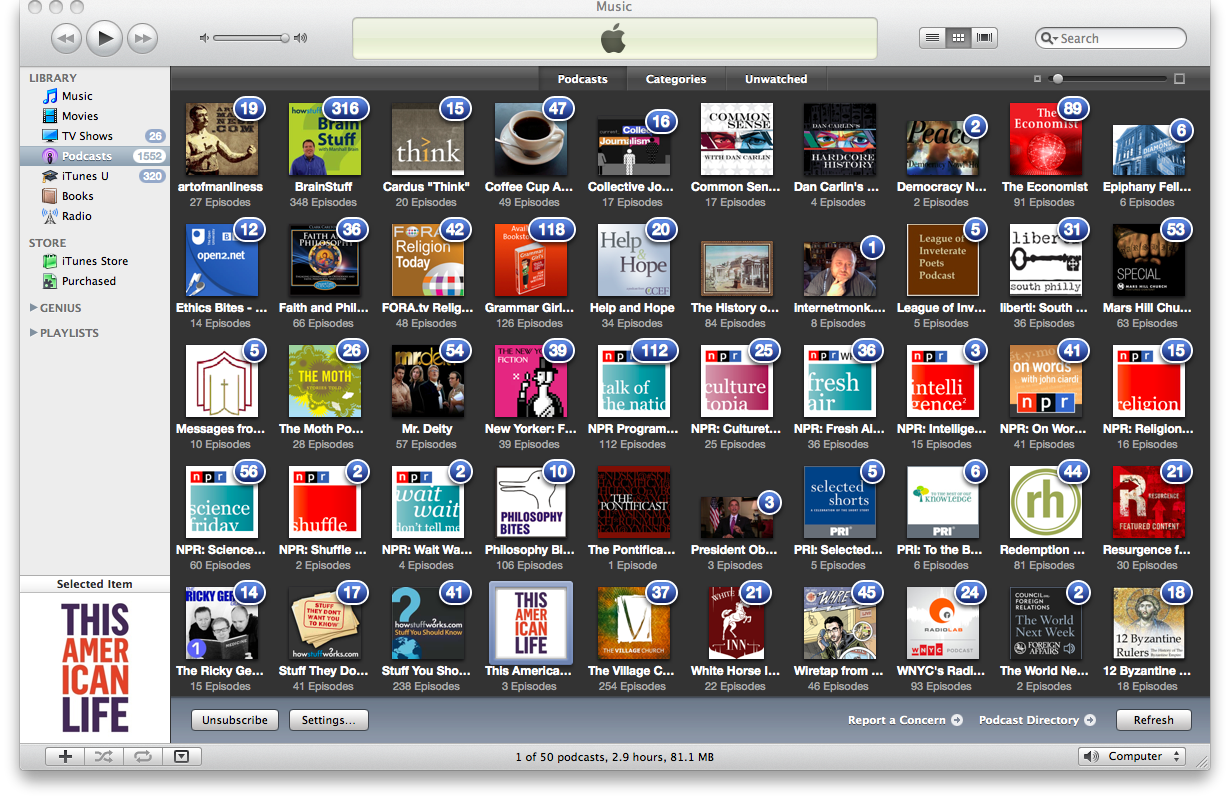
Look at that picture above.  Click on it to make it bigger.  That’s my iTunes.  As you can see, I listen to a LOT of podcasts.  And no, this isn’t just a  narcissistic  moment  to seem smart.  You see all those blue numbers above each podcast?  Well, those are just the episodes I haven’t listened to.  Also notice the 320 iTunesU lectures that have also been neglected.

And so begins my newest article in Patrol Magazine.  It’s about our culture’s (and my own) addiction to information consumption, how we should think about it, and where our hope is that something good may come of it.  I know, it’s some light reading, right?  Here’s the link:

“Information Overload, Social Darwinism, Linguistics, & Nuclear Forensics”

For all my previous articles at Patrol, click here.