I’m terrified of becoming a Pastor


paul-art-wingThis seminary semester, I’m taking classes on both Preaching and the Emotional/Spiritual/Psychological Identity of Pastors. So yeah, get used to seeing more posts like this on the blog. This week, in my “Pastor class” we did readings and had a lecture on “vocational hazards” and discerning one’s “call” to ministry. We were asked about what challenges and encourages us most about this possibility of being “called” to serve the Church in pastoring. Here were my thoughts. 
The biggest fear going into this course–and reinforced in the lecture–is the whole question of whether it is my “False Self” that is called, rather than my True Self. I have spent much of my life following Spurgeon’s (I think) advice that if you feel called to ministry at all, try to do everything else in your life you possibly could do. If you still end up in ministry, then congratulations, you were called.

Continue reading

For the times you want to be strong, but aren’t | 1 Corinthians 1.27-31


But God chose what is foolish in the world to shame the wise; God chose what is weak in the world to shame the strong; God chose what is low and despised in the world, things that are not, to reduce to nothing things that are, so that no one might boast in the presence of God. He is the source of your life in Christ Jesus, who became for us wisdom from God, and righteousness and sanctification and redemption, in order that, as it is written, “Let the one who boasts, boast in the Lord.”
1 Corinthians 1.27-31

Oh how encouraging this is in those moments that I feel most inadequate intellectually and spiritually.

See other Marginalia here. Read more about the series here.

Paul: Diverse Theology, Singular Mission | 1 Corinthians 1.10-11


Now I appeal to you, brothers and sisters, by the name of our Lord Jesus Christ, that all of you be in agreement and that there be no divisions among you, but that you be united in the same mind and the same purpose. For it has been reported to me by Chloe’s people that there are quarrels among you, my brothers and sisters.
1 Corinthians 1.10-11

Notice here that Paul does not say they need to be one in doctrine or theology. Rather, he says mind and purpose. They should have the same goals for the church. They should have the same sense of mission. They should all be moving in the same direction.

They should also be of one mind. This can mean lots of things, but the sense that I get is that it’s closely related to the purpose. They are singularly focused on what is essential and have proper weight and proper priority given to the proper things. Looking at the different allegiances that Paul goes on to criticize within the Church, there does seem to be a lot of doctrinal and theological diversity in this church. Paul, in a sense, seems overjoyed about this. He has a problem, rather, with their disjointed sense of purpose and mission. So, doctrinal diversity is good. Loss of mission is bad.

See other Marginalia here. Read more about the series here.

#Marginalia Weekly Round-Up #4 [3/17-23/14]


Marginalia is a section of this blog dedicated to (mostly) short reflections, meditations, questions, and difficulties I have while going through my Bible reading plan. I’m still trying to figure out the best pace at which to post these, so be patient with me. To aid in helping people engage with these posts, every weekend I post a round-up of all of Marginalia posts that appeared during that week. This list is in biblical canonical order.

Genesis

Responding to the Covenant | Genesis 17:10

God & Sarah: one of the most beautiful verses in the Bible | Genesis 21.1

The Echoes of History &  Abraham| Genesis 24.22-23

And the story moves from Abraham to Isaac… | selections from Genesis 26

God’s Camp is Our Camp | Genesis 32:1

Wrestling with God: History & Theology | Genesis 32.24-32

Responding to the Covenant | Genesis 35.9-13

Exodus

Moses the Levite? | Exodus 2:12

Moses the Shepherd | Exodus 3.1

A quick note on why everything you think about angels might be wrong | Exodus 3.2

Continue reading

Luke on the New Perspective on Paul | Acts 15:1,8-11


Then certain individuals came down from Judea and were teaching the brothers, “Unless you are circumcised according to the custom of Moses, you cannot be saved.”…
Acts 15.1

This is a great summary of the argument for the New Perspective on Paul. The key is the line about Moses. It’s not about works righteousness, but ethnic identity.

And God, who knows the human heart, testified to them by giving them the Holy Spirit, just as he did to us; and in cleansing their hearts by faith he has made no distinction between them and us. Now therefore why are you putting God to the test by placing on the neck of the disciples a yoke that neither our ancestors nor we have been able to bear? On the contrary, we believe that we will be saved through the grace of the Lord Jesus, just as they will.”
Acts 15:8-11

Another quick NPP note. Notice here that Peter is not contrasting salvation by yoke versus salvation by grace, but that grace will also save them just as the Jews believed it saved them.

See other Marginalia here.Read more about the series here.

We are descendants of the Covenant| Acts 3.24-26


And all the prophets, as many as have spoken, from Samuel and those after him, also predicted these days. You are the descendants of the prophets and of the covenant that God gave to your ancestors, saying to Abraham, ‘And in your descendants all the families of the earth shall be blessed.’ When God raised up his servant, he sent him first to you, to bless you by turning each of you from your wicked ways.”
Acts 28.23-31

In this, we see that we, the New Covenant People of God, are still members of the covenant that’s been in effect the whole time: the Abrahamic Covenant. It is not done away with; only brought under a new administration: that of Christ.

See other Marginalia here. Read more about the series here.

The God of Chance & Randomness | Genesis 13.14-18


The Lord said to Abram, after Lot had separated from him, “Raise your eyes now, and look from the place where you are, northward and southward and eastward and westward; for all the land that you see I will give to you and to your offspring forever. I will make your offspring like the dust of the earth; so that if one can count the dust of the earth, your offspring also can be counted. Rise up, walk through the length and the breadth of the land, for I will give it to you.” So Abram moved his tent, and came and settled by the oaks of Mamre, which are at Hebron; and there he built an altar to the Lord.

Genesis 13:14-18

I find it really interesting that this promise comes after Abram more or less left this land allotment to chance and Lot’s choice. He let Lot choose what land he wanted, and then God pretty much says to Abram “everything else Lot didn’t choose is yours!” This becomes the Promised Land for the people of God. And it was essentially leftovers. Oh the tension between Providence and Human Action!

See other Marginalia here. Read more about the series here.

Covenantal Confusion (on my part) | Genesis 6:18


But[, Noah,] I will establish my covenant with you; and you shall come into the ark, you, your sons, your wife, and your sons’ wives with you.

Genesis 6:18

I really don’t get how the idea of Covenant fits into the narrative flow here. Is this covenant “different” than the Abrahamic one? How so? What happened to it? How do we know that the Abrahamic covenant isn’t just a new administration of the Noahic one?

See other Marginalia here. Read more about the series here.

Paul’s ministry thesis & maybe Theophilus’ identity? | Acts 28.23-31


After they had set a day to meet with him, they came to him at his lodgings in great numbers. From morning until evening he explained the matter to them, testifying to the kingdom of God and trying to convince them about Jesus both from the law of Moses and from the prophets. Some were convinced by what he had said, while others refused to believe. So they disagreed with each other; and as they were leaving, Paul made one further statement: “The Holy Spirit was right in saying to your ancestors through the prophet Isaiah,

‘Go to this people and say,
You will indeed listen, but never understand,
and you will indeed look, but never perceive.
For this people’s heart has grown dull,
and their ears are hard of hearing,
and they have shut their eyes;
so that they might not look with their eyes,
and listen with their ears,
and understand with their heart and turn—
and I would heal them.’

Let it be known to you then that this salvation of God has been sent to the Gentiles; they will listen.”

He lived there two whole years at his own expense and welcomed all who came to him,31 proclaiming the kingdom of God and teaching about the Lord Jesus Christ with all boldness and without hindrance.
Acts 28.23-31

What a thesis statement for all of Paul’s ministry and the books of Luke: the hard-heartedness of the Jews and the inclusion of the Gentiles. Perhaps this was a main reason why Luke wrote both of these books to the mysterious Theophilus. Maybe he wrote these to offer assurance to this Gentile man (as evidenced by his Roman name) of his inclusion in the mission and salvation of God.

On a side note, it’s odd that this statement of the Gentile inclusion in the family of God (throughout Paul’s preaching) rests primarily on the a story of the preaching ministry of Paul. It’s well-known that Luke draws literary parallels between Jesus in the Gospel of Luke and Paul in Acts. But since this was being written to Theophilus, and these writings about Paul seem to rest on an implied authority and trust that it seems Theophilus would have had in Paul (if he said it, then it must be true), then could this be a hint that Theophilus met Paul at some point or even that Paul was the one that converted him?

Just a thought. A pure, conjectural thought.

See other Marginalia here. Read more about the series here.

Why go to church? Well, why get married? [QUOTE]


If someone asks me what is the use of going to church, what good does it do me, what do I get out of it, how do I answer these questions?

It is as though someone asks me what the use is of getting married, what good does it do me. If I answered such questions by saying, “Well, it is very useful to get married! You have someone to do the housework, the shopping, cook the meals, etc.,” it would clearly be a false view of marriage. No woman wants to be merely a housekeeper, kept because of her utility!

There is only one supreme reason for getting married—for love’s sake, for the other’s sake, for mutual love, self- giving, a longing for intimate communion, and sharing of everything.

So in Christian worship, we worship God for God’s sake; we come to Christ for Christ’s sake, motivated by love. An awareness of God’s holy love for us, revealed in Jesus Christ, awakens in us a longing for intimate communion—to know the love of the Father and to participate in the life and ministry of Christ.

Worship in the Bible is always presented to us as flowing from an awareness of who God is and what he has done: “I am the God of Abraham, Isaac and Jacob . . . I have loved you and redeemed you . . . I will be your God and you will be my people. Therefore, this is how you will worship me.”

As we have seen, worship in the Bible is an ordinance of grace, a covenantal form of response to the God of grace, prescribed by God himself. This is supremely true of the New Testament understanding of worship, as the gift of participating through the Spirit in the incarnate Son’s communion with the Father and his mission from the Father to the world, in a life of wonderful communion.

— from James B. Torrance’s beautiful book Worship, Communion, and the Triune God of Grace (paragraph breaks added for clarity)

Women at the Cross | Matthew 27:55-56


Now when the centurion and those with him, who were keeping watch over Jesus, saw the earthquake and what took place, they were terrified and said, “Truly this man was God’s Son!”

Many women were also there, looking on from a distance; they had followed Jesus from Galilee and had provided for him. Among them were Mary Magdalene, and Mary the mother of James and Joseph, and the mother of the sons of Zebedee.
Matthew 27:55-54

It’s really interesting to me that Matthew adds this little addendum to the end of the account. Why point out the women that were there? Is the assumption that all the men have scattered, and so Matthew had to show his sources for this story?

See other Marginalia here. Read more about the series here.

Introducing Marginalia: a new part of this blog


schrott-bibles-paul-coffee

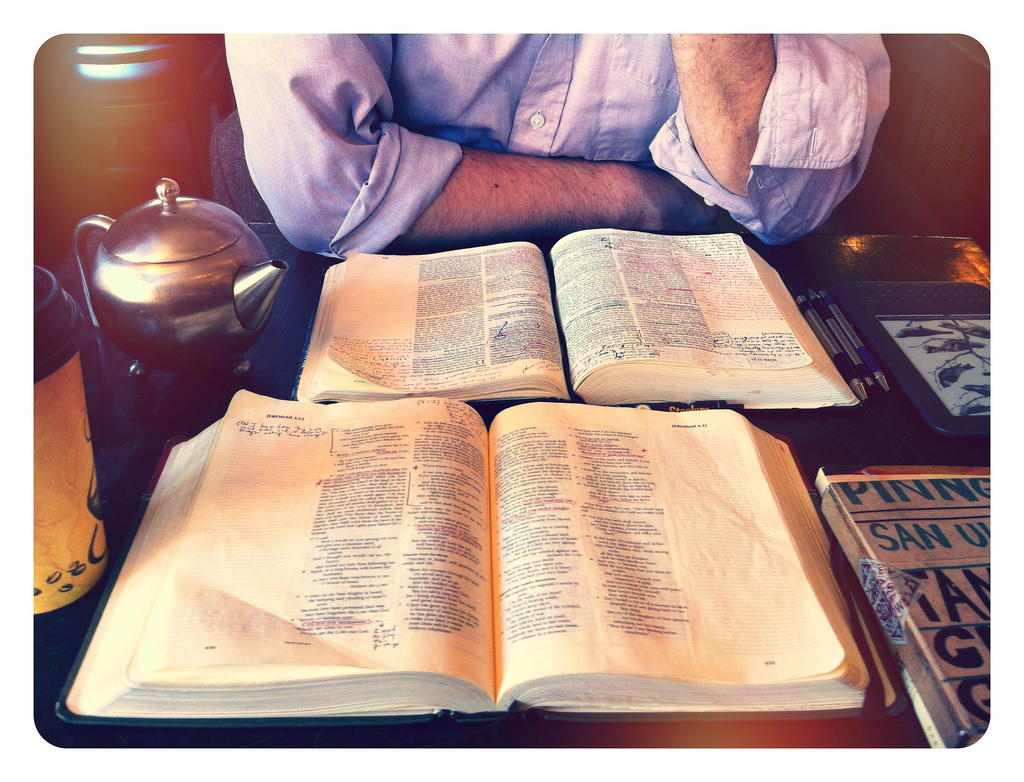
I’ll be honest. It’s been years since I’ve been able to find a way to regularly read the Bible that sticks and works for me. To be frank, readings plans usually don’t work for me because I get bored. Depending on the plan, you’re either stuck in the same book for long stretches of time or you’re jumping around so much that you lose the sense of the whole.
This year, I think I’ve started a regimen that is clicking: the M’Cheyne Bible reading plan. At any given time, I’m going through four completely different part of Scripture and for me, this is keeping me really engaged. As I’ve gone on through the plan these past couple of months, I started highlighting and writing up little notes on random verses here and there. Lots of themAnd I’d like to share them with you.

So today, I’m introducing a new little part of this blog called Marginalia, where I’ll be posting these short little meditations on Scripture as I go through this plan.
Continue reading

Abraham’s son Ishmael was part of Covenant! | Genesis 17.23-27


This is my covenant, which you shall keep, between me and you and your offspring after you: Every male among you shall be circumcised… and it shall be a sign of the covenant between me and you…. Both the slave born in your house and the one bought with your money must be circumcised. So shall my covenant be in your flesh an everlasting covenant. Any uncircumcised male who is not circumcised in the flesh of his foreskin shall be cut off from his people; he has broken my covenant.”… As for Ishmael, I have heard you; I will bless him and make him fruitful and exceedingly numerous; he shall be the father of twelve princes, and I will make him a great nation. But my covenant I will establish with Isaac, whom Sarah shall bear to you at this season next year.”…. Then Abraham took his son Ishmael and all the slaves born in his house or bought with his money, every male among the men of Abraham’s house, and he circumcised the flesh of their foreskins that very day, as God had said to him…. And his son Ishmael was thirteen years old when he was circumcised in the flesh of his foreskin. That very day Abraham and his son Ishmael were circumcised; and all the men of his house, slaves born in the house and those bought with money from a foreigner, were circumcised with him.
Genesis 17.23-27

Yes, God said that Ishmael would not be the primary bearer and “administrator” of the covenant, but he still bears its marks. Reminds me of a reading from Lesslie Newbigin where he talks about how through our election and Covenantal relationship with God, Salvation is extended to all the nations. “Election” isn’t about blessing; it’s about responsibility to extend the Blessing to others.

Other peoples (even those not in the elect people of God) participate in and receive the full benefits of being part of the Covenant. To be elect is to extend these Covenantal blessings to all nations (as we see here with Abraham). To be marked as God’s is to be placed on mission.

Ishmael was still joined to the covenant! Praise God for his gratuitous grace!

See other Marginalia here. Read more about the series here.

This is why Genesis was written (and Ken Ham doesn’t see it)


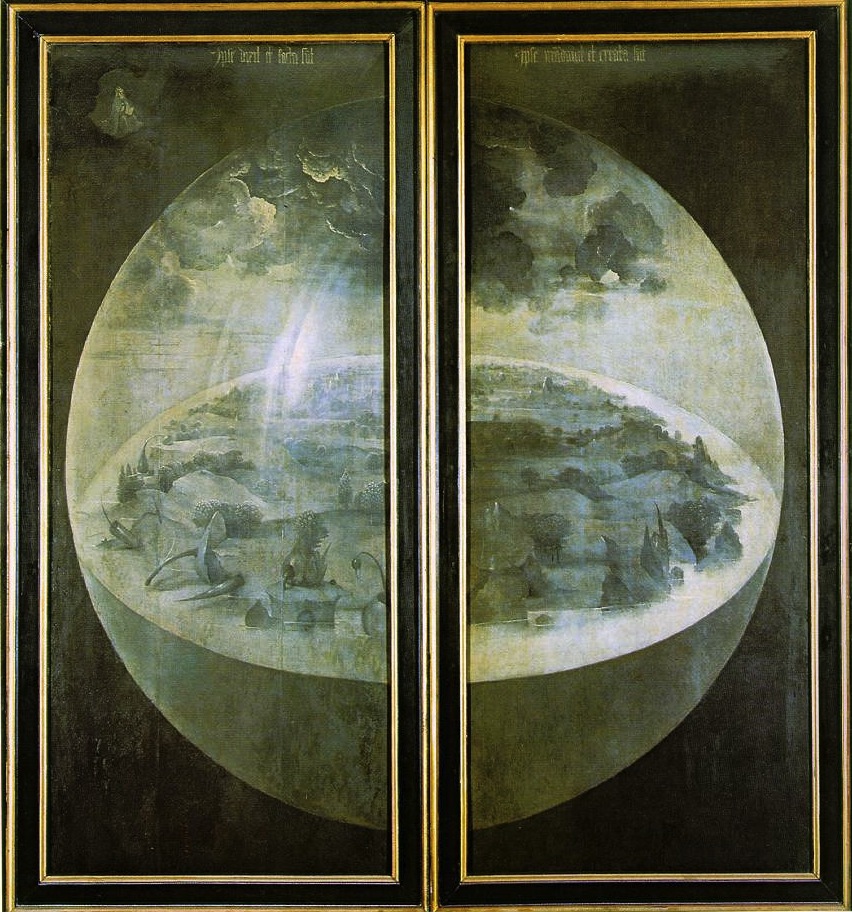
Bosch-Garden-Earthly-Delights-Outer-Wings-Creation-WorldIf my Facebook feed is representative of the general population at all, then I can confidently say that most of you have heard about the debate between Ken Ham and Bill Nye about creationism and evolution.

On this blog, I try not to get too much into issues of great contention in the church family when I don’t think it’s necessary, especially when I think it would unnecessarily prevent someone from reading this blog with a free conscience, or just mess with their head too much. But this is the one issue that I have felt the freedom to be blunt, bold, consistent, and loud about my opinion. So, I don’t have too much to add to everyone else out there that was more or less lamenting this debate more than celebrating it. Maybe I’ll have some thoughts next week coming at it from a different angle, but we’ll see.

Today, I wanted to share with you a video from the in-person portion of my Hebrew class a couple of weeks ago. To get an A in the class I have to translate, memorize, and recite a section of the Genesis 1 in the Hebrew. To help us with that, my professor made a video of him reciting it and acting out the recitation in front of us.
Continue reading

A Sacrament Primer (and some questions I still have)


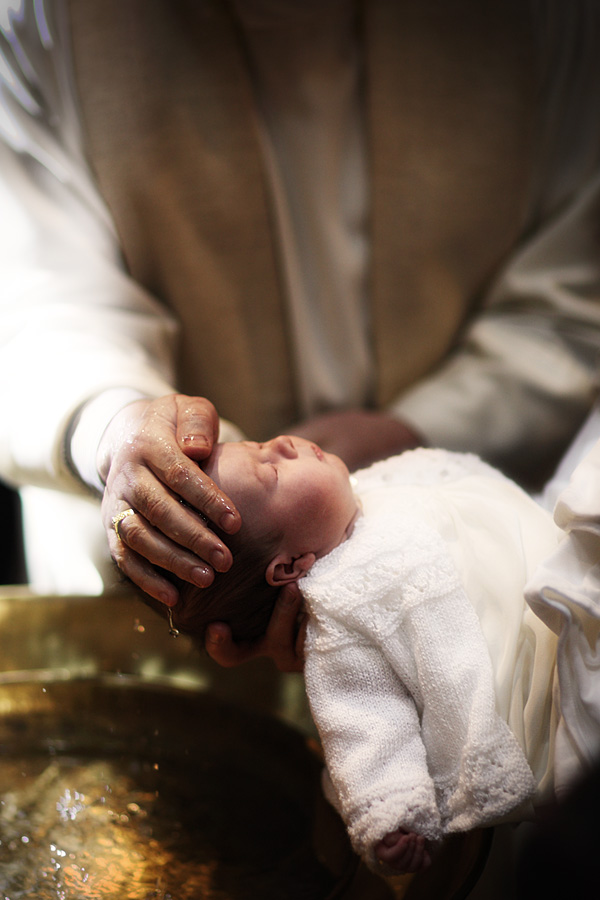
infant-baptism-water-7

For my worship and liturgy class, we had to write up a little thing explaining how we would explain the Sacraments to an everyday person. We were also supposed to throw up some questions that we might still have about them. Here are is mine.

In the beginning of the Bible, we see God create what amounts to a “temple-world”. He wants to dwell in this temple, with his people, and make it his home. He ordains priests to care for it but they fail. So God puts in motion a plan and story to rebuild this world and re-prepare it for his dwelling.

The focal point of this story and our entire faith is Jesus Christ. He is God among us having come dressed in humanity. The Gospel of John says he literally “templed” among us, using our created humanity as something he was pleased to dwell in.

This is the Gospel; it is our life and strength as Christians.
Continue reading