A Brief History of Secular Discernment & Decision-Making


fall-river-philly-kelly

This is a post in our series on the Christian Practice of Discernment. 

Struggles around decision-making have existed ever since humans first had a sense that their lives had some sort of telos or purpose. Eventually, humans came to an understanding that each decision directly bears on the events and “story” that will come after it. And so they started thinking through principles that could guide this process. Later, Christians would contribute greatly to this discussion.

But before we can start exploring how the Bible and Christianity engages with decision-making and Discernment, we need to see how else it has been engaged throughout history. Today, we’ll look at a “secular”(*) history of decision-making and Discernment. Our next post will look through Church History.
Continue reading

Discernment: Making Decisions Christianly & Why It Matters


paul-city-bwMore so than other practices, Discernment is not something we try to do to enrich our lives or draw closer to God. Rather, it is a basic function of our storied existence, driven by our own internal narratives. Because of this, we necessarily find ourselves in positions where decisions great and small need to be made.

Unlike most other practices of the Christian faith, the question here is not whether or not we will practice Discernment, but rather how well we will do it, and how intentionally we will cultivate it. The challenge is not so much to articulate a vision for Discernment so much as to find out what truly Christian Discernment looks like.

series intro

That is why I chose Discernment for a research paper I wrote for my seminary program this semester. It’s essential to human life and being. This is also why I want to share many of the lessons I learned along the way of writing this paper and putting into practice. And so today I’m starting a new blog series exploring this Christian practice of decision-making, also called Discernment.
Continue reading

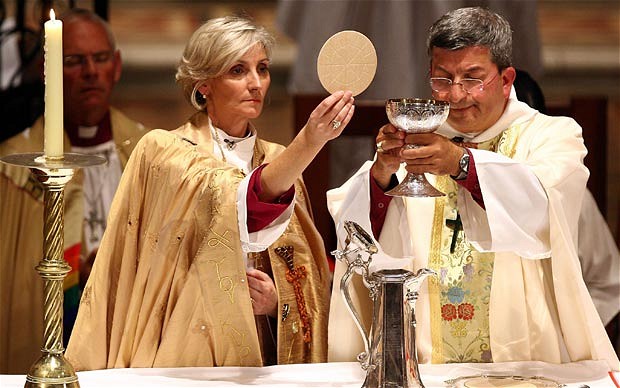
So, some women were ordained last week and…it wasn’t that exciting.


female-woman-bishop-anglican-communion

This is a post in our on-going series on Women in the Church.

The past week of my life was filled pretty heavily with church stuff. First, my church hosted our denominational meeting for those churches in our church family that are in cities. They talked about new developments in my seminary program, gave updates on the health of current church plants, adopted the 2014 budget, and ordained and commissioned new pastors to serve in churches across the country. It was a day and half filled with theology jokes, family talks, overdue introductions, and post-meeting sessions of cocktails and cigars on the front steps of the church.

Second, as I mentioned last week, my church spent yesterday celebrating it’s maturation from a “church plant” (a church that still relies on other churches for most of its support and leadership) to a full-blown self-sustaining, self-leading church. My parents came in town, the music was loud, the sermon was great, and we had a large block party after the service with a moon bounce, chili cook-off, and homebrew contest (the bourbon barrel stout won, by the way. It was called “The Nord’s Wrath”).

It was great, and it will be a block of days I will not soon forget.

Continue reading

On Not Following the Christian Blogosphere (a plea)


paul-blog-coffee

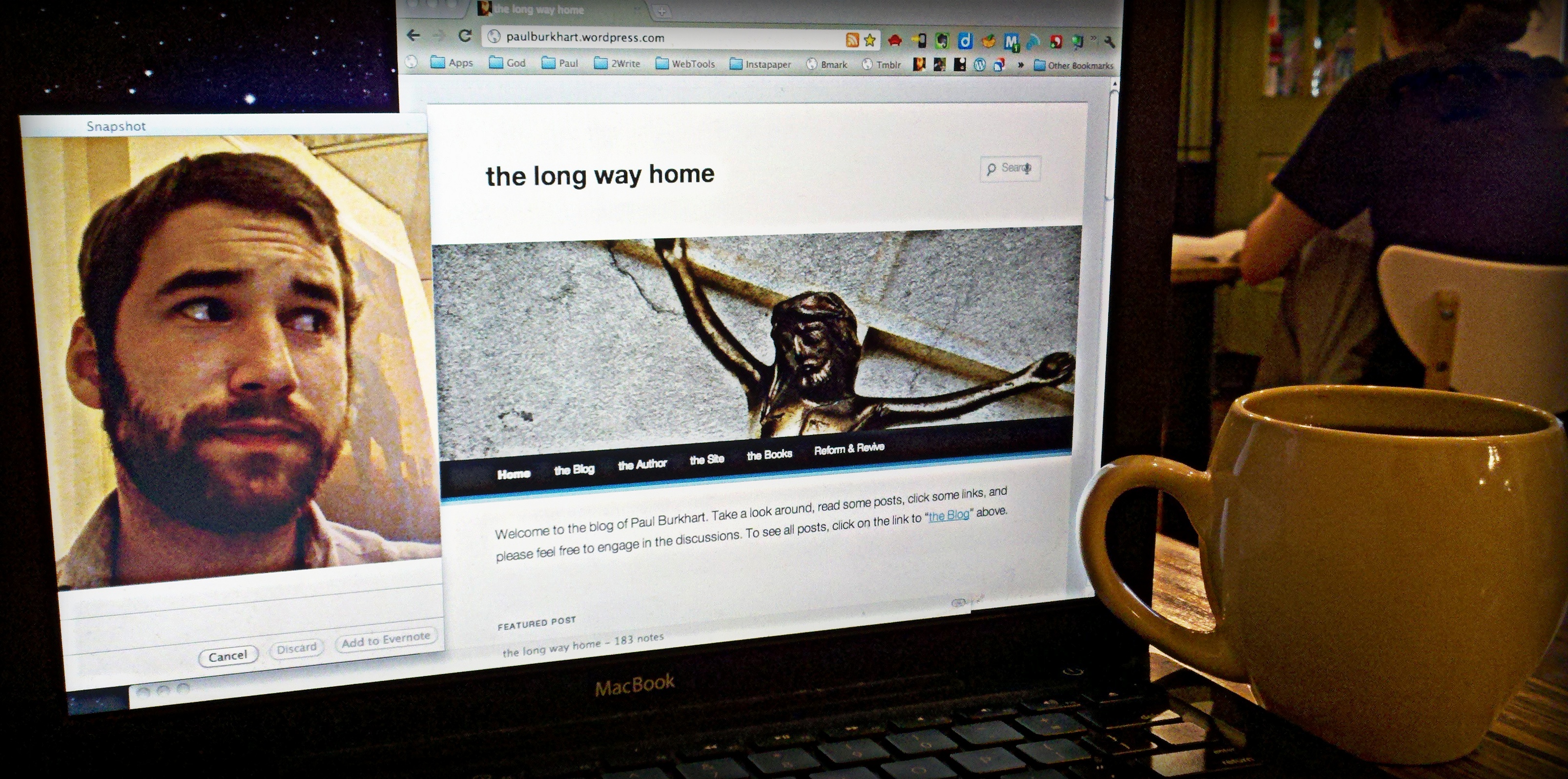
I pride myself on thinking that a large percentage of the readers of this blog have no idea of this odd subculture/alternate universe that is the “Christian blogosphere”. So for those that don’t know: there is a very large labyrinth of (largely evangelical) blogs and conferences and podcasts and websites that are dedicated to talking about “the” “Christian view” on any manner of things that (1) really don’t affect much of people’s real lives or (2) seem kind of weird to have a “Christian view” of.

It’s not simply talking about things from a Christian perspective (like this blog), but rather doing so with a particular reactive, evangelical, tribal “flavor”. I’m sure I fall into that at times here, but I’m not proud of it and I try to act against it.

the dangers of the Christian blogosphere

There are two primary things about the nature of these sites that more easily lend themselves to human weakness, I feel.
Continue reading

Are you cool enough to raise kids in the city?


Halloween-RittenhouseFor my “Urban Christian” class, we’ve been looking into family life in urban areas. I was asked to comment on the challenges and benefits to raising kids in the city. Because it’s almost Halloween, I decided to use this incredibly cute picture as well.

Let’s face it, if you’re not already raising kids in the city (and probably even if you are), the idea of doing so can be terrifying. But, thinking about it, I wonder if this has less to do with the nature of cities themselves, and more to do with the lack of precedent many of us have when thinking through raising kids in the city.

This leads to two dynamics: fear of the unknown, and so concerns about safety, money, education, and child “corruption” by the wider culture arise because of the limited exposure most of us have to anyone that has done this before and come out the other side. This leads us to have to rely on stereotypes and caricatures of the city to inform our fears and concerns.
Continue reading

Karl Barth: Our Freedom, Our Home, & God’s Directing [AMAZING QUOTES]


karl_barth crop

I’m writing this long paper on the ancient Christian Practice of Discernment. In my research, I pulled out some Karl Barth, my favorite theologian (hands down), and got to soak in the beauty of these words, and I wanted to share them. Now, for people that don’t read “real” and “proper” theology, this is it. It’s circular, it repeats itself, and it’s unnecessarily complicated and unclear. I know. I get that. But I promise, if you can spend a few minutes, quiet yourself, and focus, I promise the pay-off is huge. This guy stands as a tower over all of modern theology and deserves more attention than he gets. I’ve done slight edits to some of the wording and paragraph breaks for clarity. Enjoy.

* * * * * * * *

God’s direction is an all-powerful decision, His own divine act of lordship. By this means, too, God vindicates His honor and maintains His glory. By this means, too, He exercises authority….

God’s direction is the directing of humans into the freedom of His children. It is this which has taken place in Jesus Christ no less uniquely than the once-for-all fulfillment of the divine sentence on all humanity. In suffering in our stead the death of the old nature, and bringing in by His resurrection the life of the new, He has made room for the being of all humanity to be at peace with God.

On the basis of what we are and is not by virtue of the divine sentence passed and revealed in Jesus Christ… we have no other place but this—the kingdom in which God can be at peace with us and us at peace with God. Jesus Christ…is the all-powerful direction of God to us to occupy this place, to live in this kingdom. If we are told in Him who we are and are not, we are also told in Him where we belong, where we have to be and live.

Continue reading

I wrote a paper on the ending of the Gospel of Mark. And here it is.


Lindisfarne Gospels -- MarkI usually never post items like this on the blog. But hey, it’s Friday. Below you’ll find a brief academic paper I wrote exploring different scholarly views on the ending to the Gospel of Mark. I’ve written devotionally on that ending before, but this gave me a chance to explore more of the scholarship behind it.

As a general rule, I don’t think people should put up blog posts that have a Works Cited page attached (haha). Such posts usually go against everything the blog medium stands for: brevity, clarity, and accessibility.

But as I researched this topic, I found it difficult to find similar, short, web-accessible writings and bibliographies like this so, in the interest of academic exploration, I’m putting the paper up here for all the future Googlers that might be able to use this, and for those of you that might care about some of the scholarly opinion concerning Marks’ incredibly odd ending. Enjoy. (You can also find this document on Scribd.)

___________________________

BL537 Paper #1: The Ending of Mark

For centuries, the Gospel of Mark more or less sat dormant, gathering the dust of Church interest. It was a broken Gospel, after all. It was a crude, geographically confused, narratively-challenged, more-or-less bastardized version of The Gospel of Matthew. And what of that ending?
Continue reading

How to wear your theological offensiveness (conservative, liberal, & atheist)


Francisco_de_Goya_y_Lucientes_-_Duelo_a_garrotazos-small

Reading through Luke, I was struck by a dimension to Luke’s portrayal of Jesus I hadn’t noticed before. I also think, in these times where more people are able to have more platforms to speak their mind on issues, it’s an important dimension to take into account.

In Luke chapter 4, we see Jesus officially kick off his public ministry. He does this by standing up at his hometown synagogue, reading some verses from Isaiah and saying that these words are fulfilled in his arrival. He then adds commentary on this, highlighting how Israel has fallen out of God’s favor and so this fulfillment won’t come to them. This enrages the people and they try and kill him right there by throwing him off a cliff (yeah, it’s kind of funny). But he gets away.

Jesus offended these people deeply. He spoke what he believed to be true about God and the world, and they didn’t like it. And yet, people spoke offensive words in the ancient world all the time. There were many Messianic figures, and yet their words didn’t “stick” like Jesus’ did. His words ended up not simply gathering people that agreed with him, but actually changing minds, even while offending those that would be offended.

How did he do this? How can we do this with our own theological (or a-theological) beliefs? How should we wear our beliefs that might be very offensive to others?
Continue reading

I have found the Holy Grail against women in leadership, and I am ruined


Countering-the-Claims-of-Evangelical-Feminism-Grudem-Wayne-9781590525180This is a post in an on-going series on Women in the Church.

A while ago, I stumbled on a clearance copy of the book Countering the Claims of Evangelical Feminism by Wayne Grudem. Now, for those that don’t know, Grudem is one of those super-influential evangelical theologians that doesn’t get a lot of play in the wider culture. He’s not going to make any headlines like Mark Driscoll, and he’s not going say anything too outside the conservative box, like Rob Bell. He’s a quiet intellectual who writes and influences a lot.

Through college, I had a bunch of friends obsessed with his “Big Blue Book”, Systematic Theology, which is an accessible, clear introduction to what became the “New Calvinism” fad. In short, he’s sort of a Calvinistic Baptist that believes the Holy Spirit is still doing more outlandish sorts of things.

And yet, if you look at all of his publications, the vast majority of them are simply various versions and editions of just these two books (well, admittedly, the book I’m writing about today is an abbreviated version of this book). It’s quite easy to see that Grudem has devoted his life primarily to two things: Systematic Theology and Gender Roles in the Church. A lot of the arguments you’ll hear from complementarians–those that do not think Women should be allowed to exercise authority in Church or Home contexts–come straight from Grudem.

And so, in the interest of being fair in my Women and the Church series, I picked this book up to hear “the other side”. The book goes through 45 of (what Grudem feels are) the absolute best Egalitarian arguments. He lays out the individual argument, usually printing a paragraph-length quote from someone who has expressed that opinion. And then he offers responses (usually about 1 to 4) for each of these points. Each chapter is 2 to 5 pages long.

I went into the book with only minor curiosity, because I was raised with his perspective, was completely inundated with it in college, and pretty much felt I knew most of the arguments he would throw out there.

Well I was wrong.
Continue reading

AMAZING Interview and Q&A about Women in the Church


haddad-mimi-rhe-egalitarian-womenWell, I think it’s time to restart our on-going series on Women in Ministry, don’t you?

While researching a particular argument for limiting Womens’ role in the Church, I stumbled on this interview and Q&A on Rachel Held Evans’ blog. It is a conversation with Mimi Haddad, President of Christians for Biblical Equality. And it is wonderful.

This whole disagreement about Women in the Church can produce a lot of noise that’s difficult to sift through. Too often, people on both sides end up retreating back to their respective sides and both fulfilling a lot of stereotypes while lobbing that accusation at the other side. This ends up entrenching the conversation even more deeply and intractably. The conservatives end up speaking sort of demeaningly about women (even unintentionally) and accusing egalitarians of not believing the Bible, all while egalitarians end up resorting to radical and simplistic feminist-sounding rants and calling all conservatives misogynists.

Haddad’s interview is wonderful because it moves against this. She is gracious, though firm in her convictions, and maintains the big picture of the discussion rather than getting lost in the rabbit-hole of interpreting individual proof-texts. She speaks in such a conversational, disarming, and winsome way. She brings up common-sense and clear-headed perspectives that are such a breath of fresh air for someone who sits for too long trying to pick apart individual texts. You can tell she loves the Church and the Bible and wants to honor them both well.

It also reinvigorated me to continue this discussion. There is still much more to be said, and as I have the privilege of being part of a church that will be ordaining its first female elder next month (the first church of this kind I’ve been a part of!), these issues are especially pertinent to those around me and the discussions we’re having.

And so, in the weeks to come, see this space fill back up with this discussion. Many of the things I want to write about will be building upon many of the ideas found in this interview and Q&A. So, if you want a big picture preview of what’s come, check it out. Really, I can’t recommend it enough.

Heidelberg (Hyper-)Calvinism? | (a celebration)


morlock-hands-cradling-stone-head

Q. What is your only comfort in life and in death?
A. That I am not my own, but belong—body and soul, in life and in death—to my faithful Savior, Jesus Christ. He has fully paid for all my sins with his precious blood, and has set me free from the tyranny of the devil. He also watches over me in such a way that not a hair can fall from my head without the will of my Father in heaven; in fact, all things must work together for my salvation. Because I belong to him, Christ, by his Holy Spirit, assures me of eternal life and makes me wholeheartedly willing and ready from now on to live for him.

So begins the Heidelberg Catechism, a 16th-century document written under extraordinary circumstances. Long story short, after the counter Reformation, different “princes” over different regions were allowed to declare what “denomination” their region would be. The problem for Frederick III? His region was split pretty evenly between Lutherans and Calvinists. And so, he brought together some people from different traditions, and had them write a document they all agreed upon. The Heidelberg was born.

This document is one of the main doctrinal statements of my denomination, the Reformed Church in America (RCA), and my church. I’ve read little bits and pieces of it in the past, but I recently sat down and read the whole thing. And I was pretty surprised.
Continue reading

On a Theology of “Non-Place” & Being the Suburb of God


suburbs-flickr

Yesterday’s post on how I’m wrestling through a Theology of the City really seemed to have struck a chord. Here on the blog, there was an interesting discussion about how to theologically view the suburbs. We asked many questions, but landed at few answers. And so, I thought I’d continue the discussion by posting the essence of these conversations on the blog and seeing if we can’t keep the conversation going.

To further offer context, I’ve also added a video I had to record as an introduction to my “Urban Christian” seminary class. In it, I offer a little background on where I’m coming from in this discussion and how I came to question my own subtle sense of urban elitism. The angle also makes my hands look massive, so you can enjoy that as well. Feel free to read these exchanges, and jump in, offering your own comments to move this discussion along!

_______________________________

Jacob Haynes wrote:
Continue reading

I’m starting to wonder about this whole Urban Christianity thing…


rooftop-philly-2

Let’s file this one under: Things I Never Thought I’d Say.

First, some realities.

America, almost since its founding, has had an Agrarian ideal spliced into its DNA that has thought more highly of the vision of the independent rural farmer–building himself up from nothing and sustaining his family by the work of his brow–over and above the idea of the dirty urban manufacturer, competing with others for the few jobs that are there.

Further, it’s pretty clear that during White Flight in the mid-1900s, whites took the association of “good, religious folk” with them to the suburbs (along with the support and attention of governments), leaving the cities to be seen as the cesspools of sin that deserved to rot away.

Along with this, the American Church (especially so, but this is definitely global) has tended to neglect cities, enjoying the safe numbers and comfort of the suburbs. In my opinion, this has helped ravage American faith, causing it to take on the aspects of the surrounding suburban culture, making it often isolating, consumerist, capitalistic, intellectual, based on convenience, behavior-driven, and not rooted to any sort of historical tradition or depth. (This does not extend to individuals per se, and it is a broad generalization, but it’s one that I think statistics would show is generally true.)

Continue reading

What is Discipleship? A Definition.


discipleship-silhouette

For one of my spiritual formation classes, I had the privilege of reading Deitrich Bonhoeffer’s Life Together and Henri Nouwen’s In the Name of Jesustwo incredible books. Last night, after having read these books, we were then asked to offer our own one sentence definition of Discipleship, and then spend some time expounding on the definition. Here was my contribution. Feel free to add your own definitions below.

______________________________

Discipleship: The cultivation of an inner and outer life–with both ourselves and others–that is marked by a humble reliance on the work, words, life, and leading of Christ and His Spirit.

The thing that struck me most about these readings as it pertains to discipleship was the weird paradox of one’s inner- and outer-lives. In both Nouwen and Bonhoeffer, there is such an emphasis that our hearts’ goal should be nothing less than the heart of Christ Himself and our reliance upon it. And yet, the primary access point to this Heart is found in the simple, mundane bodily actions we take upon ourselves with regularity.

The way in is from without, I suppose.

Especially for those of us in seminary and who minister in a Church context, isolation in these endeavors can be such an easy temptation. I don’t even pastor a church, and yet as a deacon leading a home group or class or the Sunday liturgy, I feel that damnable desire just to be liked, and not be seen for who I really am.
Continue reading