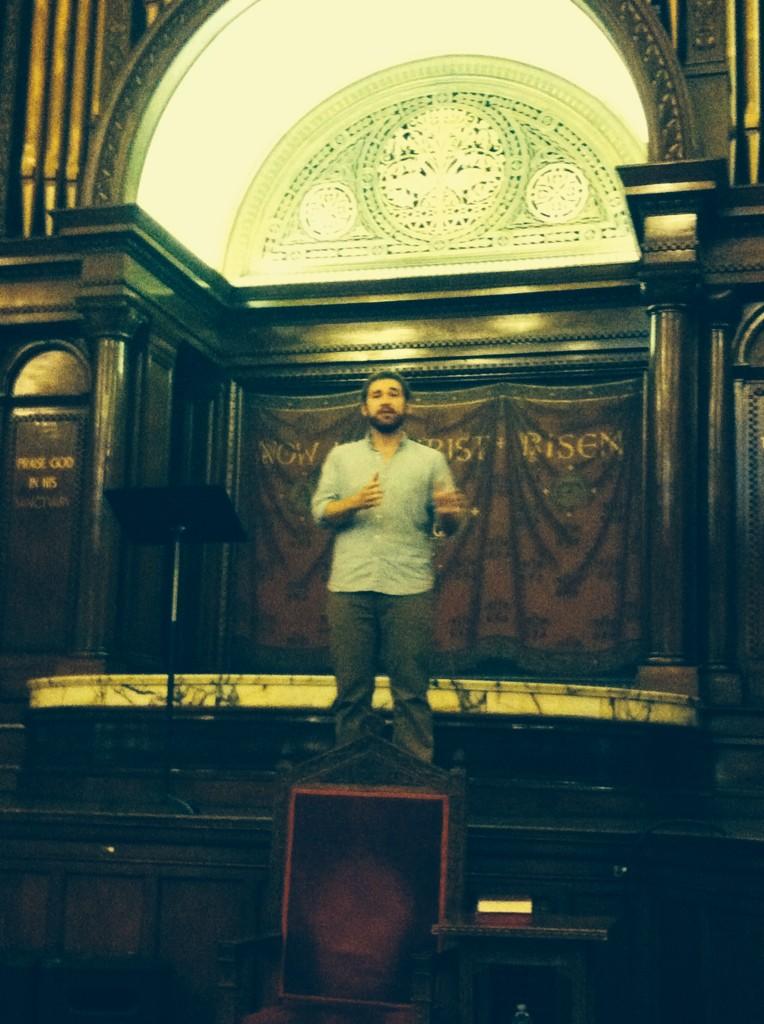
My church let me preach another sermon. Here it is.


Tanner-the-anunciation-mary

Believe it or not, even after preaching my first real sermon ever, my church let me preach again. All jokes aside, I had the honor of preaching this past Sunday as part of our Advent series.

The text is Luke 1:26-38, the moment in the life of Jesus known as The Annunciation, when the angel Gabriel tells Mary that she will give birth to Jesus. Cameos in the sermon include Mary, Friedrich Nietzsche, Karl Barth, the podcast Serial, racism, white privilege, and the story of everything. Here’s the audio:

You can also download it here, or subscribe to our podcast here.
Continue reading

My first Sunday Morning Sermon. I’d like to share it with you.


paul-liberti-sermon-preachingSure, I’ve done some lectures, taught some classes, led a home group, and preached a sermon in a seminary class, but I’ve long believed that there was something truly sacred and “other” about preaching to a church family in a gathered worship service. And it’s something I had never done.

I’ve always been an over-zealous guy, and very wise leaders have pulled the leash on me, telling me to just sit and watch for a while, until the time was right to put me in front. This has continued through my life at my church in Philly, as they’ve slowly discipled me and loosened the leash bit by bit in service to our people.

Well this past week I had the honor of preaching my first Sunday morning sermon to my church family. It felt good and I myself experienced such a grace and blessing in preparing for it and offering it to my brothers and sisters. And so, I’d like to share it with all of you as well.

It’s the final sermon in our series “Finding Freedom” that went through the Ten Commandments. The text is Matthew 7:13-29, the very end of the Sermon on the Mount. Here’s the audio:

You can also download it here, or subscribe to our podcast here.
Continue reading

Spiritual maturity has little to do with doctrine | 1 Corinthians 3.1-3


And so, brothers and sisters, I could not speak to you as spiritual people, but rather as people of the flesh, as infants in Christ. I fed you with milk, not solid food, for you were not ready for solid food. Even now you are still not ready, for you are still of the flesh. For as long as there is jealousy and quarreling among you, are you not of the flesh, and behaving according to human inclinations?
1 Corinthians 3.1-3

Firstly: Oh. Snap. Knowing the issues this church deals with, that’s got to be so insulting to them in the highest degree. “You are not spiritually mature.” But notice what makes them immature: not doctrine. Paul says time and time again throughout this letter: they’ve got wisdom and doctrine. And yet they are “infants”. Why? Jealousy. Wow.

Think: Do we think that we are “spiritually immature” when we’re “simply” jealous? What of other emotional, heart things? Do we use those things to judge our “spiritual maturity”? Or do we look more to doctrinal knowledge, what podcasts we listen to, what books we read, or how good our “quiet times” are?

See other Marginalia here. Read more about the series here.

The Sermon’s Essence & Power | 1 Corinthians 2.1-5


When I came to you, brothers and sisters, I did not come proclaiming the mystery of God to you in lofty words or wisdom. For I decided to know nothing among you except Jesus Christ, and him crucified. And I came to you in weakness and in fear and in much trembling. My speech and my proclamation were not with plausible words of wisdom, but with a demonstration of the Spirit and of power, so that your faith might rest not on human wisdom but on the power of God.
1 Corinthians 2.1-5

This encourages me so much in preaching. No matter the exegesis, eloquence, or whatever, we preach Christ and him crucified, and that makes a good sermon. We also live a life in accordance with that outside of the sermon and it supports our preaching as well. Just as in the nature of God Himself, our words and our deeds cannot be separated from one another.

See other Marginalia here. Read more about the series here.

Should Protestantism Still Be a Thing?


Roger-Smith-cc-rosary-bible

For years now, I have described my place in the Christian family as a “Protesting Catholic“. I love Catholicism (and Orthodoxy. I’m so sorry you are so frequently left out of these discussions–I’m as guilty of doing this as any). I love the entire Church family, in fact, and I can’t think of a tradition from which I have not benefited greatly from it nuancing, sharpening, refining, or deepening my theological thinking in some way.

A friend posted this interview with Stanley Hauerwas, on his new book on the “end times”. It’s a brief interview with some nice quotes and sentiments from the elder public theologian, but this set of lines particularly caught my eye:

My suggestion [that Protestantism may be coming to an end] is meant to be a reminder that Protestantism is a reform movement. When it becomes an end in itself it becomes unintelligible to itself. Protestants who don’t long for Christian unity are not Protestant. There is also the ongoing problem that Catholics have responded to the Protestant critique in a way that the Protestant critique no longer makes much sense. Accordingly, the question is: why do we continue to be kept apart?

I wholeheartedly agree with Hauerwas about the heart of Protestantism and how it should long for unity and, eventually and hopefully, end. So why is Protestantism still a thing I embrace? Why am I not fleeing to Rome, to our Mother Church? Let me offer a few words.

Continue reading

Jonah: a Children’s Story of Verbs


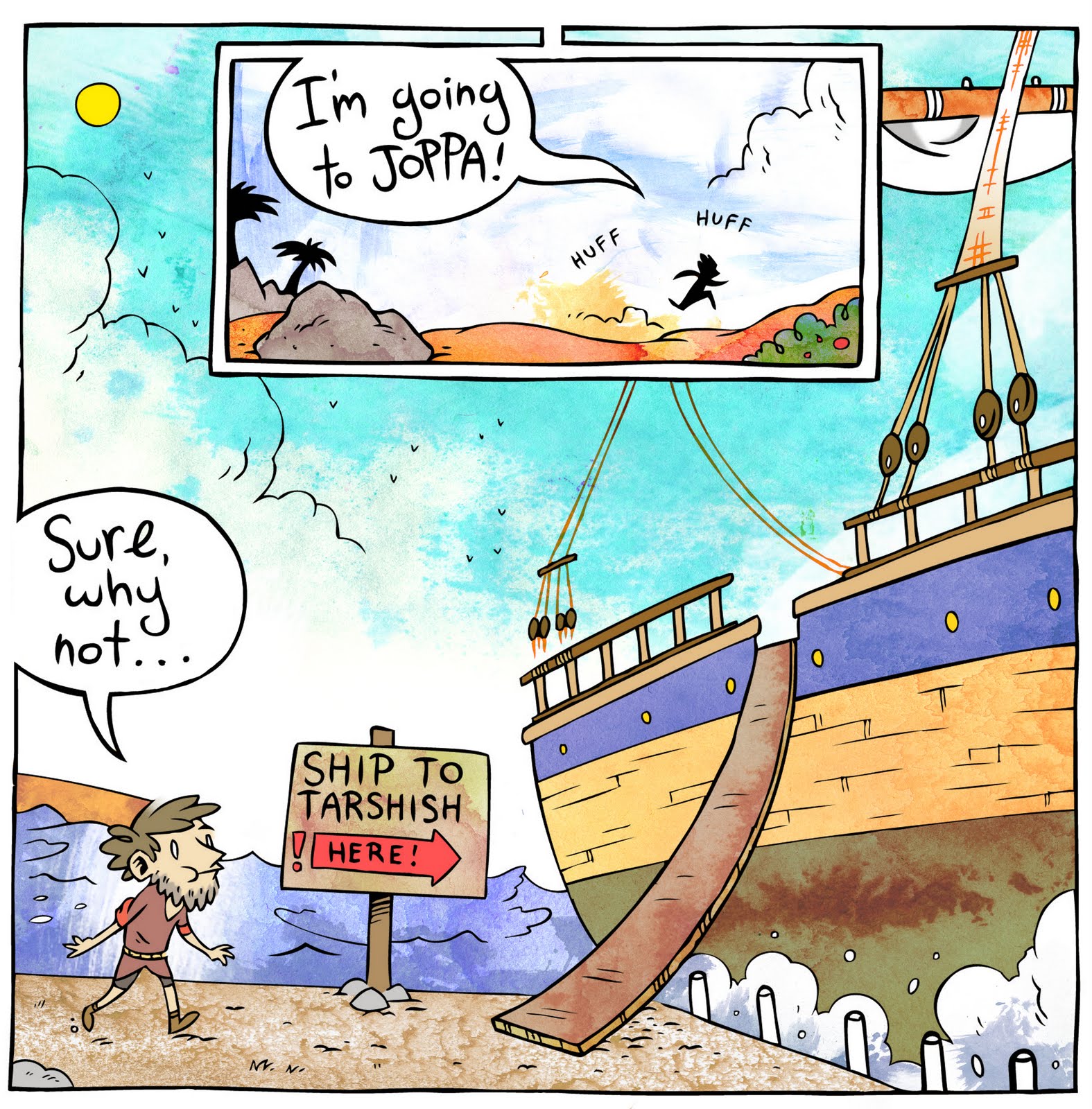
Jonah-boat-comicMy Hebrew class has moved from learning grammar to the actual process of translation and interpretation. To do this, we’re going through the book of Jonah. Our first interpretive assignment was to look at all the Jonah-related verbs in the first six verses and draw some theological conclusions. Here was my contribution.

But first, my incredibly literal and somewhat stilted translation of the opening verses [Jonah 1.1-6], including all the odd word order and idioms of Hebrew:

(1) And the word of the LORD was to Jonah son of Amittai, in order to say, (2) “Rise, go to Ninevah, the large city, and cry out against her because their evil arose to my face.” (3)And Jonah rose in order to flee in the direction of Tarshish from the toward-facing faces [Hebrew idiom for “Presence”] of the LORD and went down to Joppa and he reached a ship going to Tarshish and he gave its fare and went down in it in order to enter with them to Tarshish away from the toward-facing faces of the Lord. (4) And the LORD hurled a large wind upon the sea and it manifested as a large storm among the sea and the ship thought to shatter towards itself. (5) And the sailors were afraid and they cried out, man to his God, and they were made to throw the receptacles which were in the ship into the sea away from them towards making themselves small and Jonah had gone down into the rear of the vessel and had laid down and slept heavily. (6) And the chief sailor came to him and said to him, “Why are you sleeping? Arise! Cry out towards your gods! Perhaps the god of you will bear us in mind and we will not perish.”

And now for some lessons we can draw…
Continue reading

Fundamentalist vs. Pentecostals vs. the Cross | 1 Corinthians 1.27-31


For the message about the cross is foolishness to those who are perishing, but to us who are being saved it is the power of God. For it is written,

“I will destroy the wisdom of the wise,
    and the discernment of the discerning I will thwart.”

Where is the one who is wise? Where is the scribe? Where is the debater of this age? Has not God made foolish the wisdom of the world? For since, in the wisdom of God, the world did not know God through wisdom, God decided, through the foolishness of our proclamation, to save those who believe. For Jews demand signs and Greeks desire wisdom, but we proclaim Christ crucified, a stumbling block to Jews and foolishness to Gentiles, but to those who are the called, both Jews and Greeks, Christ the power of God and the wisdom of God. For God’s foolishness is wiser than human wisdom, and God’s weakness is stronger than human strength.
1 Corinthians 1.27-31

So good. And also really appropriate for this age. The fundamentalists want knowledge and certainty, and the Pentecostals want experience and signs. But we preach Christ crucified.

See other Marginalia here. Read more about the series here.

When & How to Criticize Other People’s Pastors | 1 Corinthians 4.2-5


Moreover, it is required of stewards that they be found trustworthy. But with me it is a very small thing that I should be judged by you or by any human court. I do not even judge myself. I am not aware of anything against myself, but I am not thereby acquitted. It is the Lord who judges me. Therefore do not pronounce judgment before the time, before the Lord comes, who will bring to light the things now hidden in darkness and will disclose the purposes of the heart. Then each one will receive commendation from God.
1 Corinthians 4.2-5

What does this mean? At least right now, my instinct is to take it like this: outside of clear sin issues, we should not divide and judge other Church leaders (nor effusively favor them). If you can’t find clear sin issues in their lives, churches, or teaching, then don’t demean their doctrine, style, gifting, or missional emphases. In the same way, though, even if there are no clear sin issues going on, don’t exalt them because of their doctrine, style, gifting, or Missional emphasis.

If a church doesn’t fit for you, fine. Go in peace to love and serve the Lord. But don’t bad-mouth, criticize, gossip, complain, or be overly-sensitive and judgmental at them. To both conservatives and liberals, neither of us should criticize other members of the family, no matter how kooky they are–not even for what we feel is “bad” teaching. “Sinful” teaching, however is another issue. Clear historical heresy, teaching that abuses and harms the dignity of humanity, and things like prosperity preaching are examples of things that should be judged harshly and criticized.

See other Marginalia here. Read more about the series here.

For the times you want to be strong, but aren’t | 1 Corinthians 1.27-31


But God chose what is foolish in the world to shame the wise; God chose what is weak in the world to shame the strong; God chose what is low and despised in the world, things that are not, to reduce to nothing things that are, so that no one might boast in the presence of God. He is the source of your life in Christ Jesus, who became for us wisdom from God, and righteousness and sanctification and redemption, in order that, as it is written, “Let the one who boasts, boast in the Lord.”
1 Corinthians 1.27-31

Oh how encouraging this is in those moments that I feel most inadequate intellectually and spiritually.

See other Marginalia here. Read more about the series here.

Really. What is this “Mystery” Paul is talking about? | 1 Corinthians 2.6-8


Yet among the mature we do speak wisdom, though it is not a wisdom of this age or of the rulers of this age, who are doomed to perish. But we speak God’s wisdom, secret and hidden, which God decreed before the ages for our glory. None of the rulers of this age understood this; for if they had, they would not have crucified the Lord of glory.
1 Corinthians 2.6-8

What an odd set of lines. I’ll be brutally honest. I get that “the mystery” is the inclusion of the Gentiles but in hindsight, it doesn’t seem that mysterious. From the beginning, God has promised a multitude of peoples would be counted among his people. Perhaps, the mystery was not merely the inclusion of the Gentiles as we commonly express it, but rather the way in which they are connected to God’s people? Maybe the “mystery” is more that it is no longer by becoming an ethnic group, but rather by both Jew and Gentile becoming something different and wholly other from what they have been.

See other Marginalia here. Read more about the series here.

Paul: Diverse Theology, Singular Mission | 1 Corinthians 1.10-11


Now I appeal to you, brothers and sisters, by the name of our Lord Jesus Christ, that all of you be in agreement and that there be no divisions among you, but that you be united in the same mind and the same purpose. For it has been reported to me by Chloe’s people that there are quarrels among you, my brothers and sisters.
1 Corinthians 1.10-11

Notice here that Paul does not say they need to be one in doctrine or theology. Rather, he says mind and purpose. They should have the same goals for the church. They should have the same sense of mission. They should all be moving in the same direction.

They should also be of one mind. This can mean lots of things, but the sense that I get is that it’s closely related to the purpose. They are singularly focused on what is essential and have proper weight and proper priority given to the proper things. Looking at the different allegiances that Paul goes on to criticize within the Church, there does seem to be a lot of doctrinal and theological diversity in this church. Paul, in a sense, seems overjoyed about this. He has a problem, rather, with their disjointed sense of purpose and mission. So, doctrinal diversity is good. Loss of mission is bad.

See other Marginalia here. Read more about the series here.

Weekly Must-Reads {2.12.14} | Creation, Masturbation, & Communism


guy-newspaper-reading

Well, it’s been a good long while since I’ve posted a Reading List for you all to enjoy–too long, in fact. These were some of my favorite things I read this week. What were some of yours?

__________

In defense of creationists | The Week
Michael Brendan Dougherty

I referenced this at the end of my post yesterday, but this is a stunningly beautiful piece that wrestles with humanizing those that frustrate us the most in the Christian family. A must-read for sure.

Escaping the Prison of the Self: C.S. Lewis on Masturbation | First Things
Wesley Hill

Don’t overlook this piece too quickly. It is an incredibly powerful piece that speaks to how all of us–married, single, gay, straight–engage our sexuality in this world. It showed me how having celibate unmarried people in the world is necessary for healthy marriages, as well as how masturbation ruins even good friendships.

Continue reading

A Sacrament Primer (and some questions I still have)


infant-baptism-water-7

For my worship and liturgy class, we had to write up a little thing explaining how we would explain the Sacraments to an everyday person. We were also supposed to throw up some questions that we might still have about them. Here are is mine.

In the beginning of the Bible, we see God create what amounts to a “temple-world”. He wants to dwell in this temple, with his people, and make it his home. He ordains priests to care for it but they fail. So God puts in motion a plan and story to rebuild this world and re-prepare it for his dwelling.

The focal point of this story and our entire faith is Jesus Christ. He is God among us having come dressed in humanity. The Gospel of John says he literally “templed” among us, using our created humanity as something he was pleased to dwell in.

This is the Gospel; it is our life and strength as Christians.
Continue reading

That elusive Rest of all rests…


oldrich-kulhanek-untitled2At my job, I have this client (nowadays they’re called “participants”) who’s unlike any other I’ve known. He’s got some sort of complicated cocktail of mental health issues going on. Whatever they are, they’ve come together to create the most agitated, anxious, hyper, manic, rapid-thinking individual I’ve ever seen.

He’s the kind of guy whose own thoughts race a million miles an hour in addition to the other voices in his head doing so as well. He craves attention and simply has to be the center of it at all times; the more people around, the more dramatic and performative he becomes. He acts out like a child in any way to get the attention he craves, all while his inside hums and buzzes with a constant anxiety.

He can easily talk non-stop for hours with random things setting off new associations and new lines of thought and one topic flowing into another topic that seems unrelated, save for a color, a location, or even a word in common with the prior one. The first time I met him, his thoughts became so fast and so loud, he started screaming and clawing at his head just to get them to quiet down.

He evokes little sympathy from those around him, including myself. He seems to thrive on the fact that he can so affect people–even if it’s in a negative, irritating way.

Continue reading