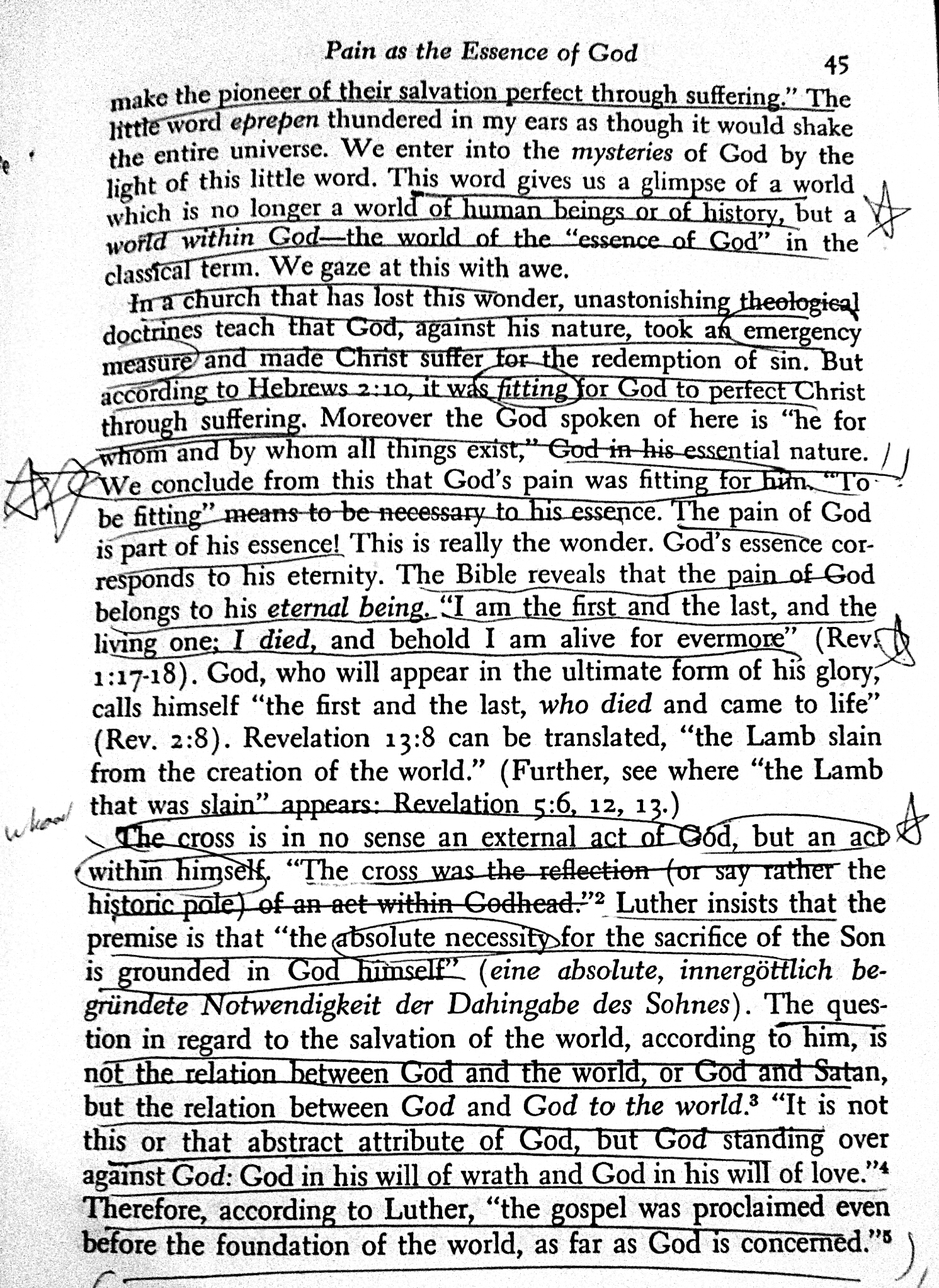
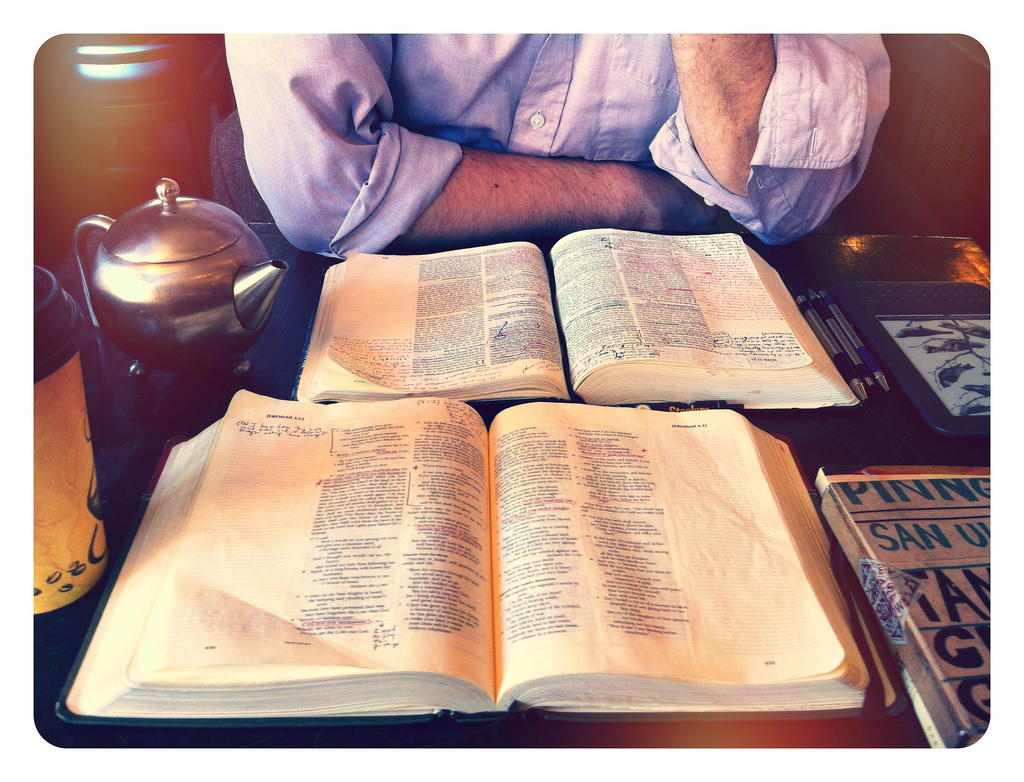
From Kazoh Kitamori’s Theology of the Pain of God.
Get it.
And yeah, those are my markings. Welcome to my brain on a page.
From Kazoh Kitamori’s Theology of the Pain of God.
Get it.
And yeah, those are my markings. Welcome to my brain on a page.
“The task of witnessing to the gospel is to vitalize the astonishing fact of the gospel. The message “the Son of God has died” is indeed most astonishing…. God has died! If this does not startle us, what will? The church must keep this astonishment alive. The church ceases to exist when she loses this astonishment. Theology, the precise understanding of the gospel, must be seized by this astonishment more than anyone else. It is said that philosophy begins with wonder; so theology begins with wonder. The wonder of philosophy pales before the wonder of theology. The person astonished by the tidings “God has died” can no longer be astonished at anything else.”
Kazoh Kitamori, Theology of the Pain of God
… it has increasingly become my conviction that the primary task of theology must be concerned with ‘substance’ and ‘content’ rather than mere ‘system’ of thought. The splendor of the content of the gospel makes everything else lose color.
–Kazoh Kitamori, Theology of the Pain of God
 For the next week-and-a-half more, I find myself in Holland, Michigan. I’m here for an in-person intensive in my otherwise distance seminary program. It’s two weeks of Hebrew for over 5 hours a day and two other classes in the afternoon and evenings.
I’ve been here since Sunday and it really has been amazing. There was tons of snow here causing travel hiccups for a lot of people, though I came in just before the worst of it. I’m staying with some guys from the program in a house right on Lake Matacawa (see picture above).
I still don’t know how to relate to these sorts of times. Going into it, I expected it to be a time appealing to my introverted self; mainly sitting and staying to myself (and happily so), keeping my nose in books. I wasn’t looking forward to taking this much time off from work, and I wondered why these classes couldn’t continue being online. I didn’t need to know these other people in the program. Why was I being forced to spend time with them in person?
Instead, it’s been hard to get a moment to myself (and–surprisingly–happily so). These guys I’m staying with are all amazing men, and the classes have been learning experiences unlike anything I’ve seen before. I get to have conversations that are so refreshing compared to my previous seminary experiences. Yes, the talks are still all about those things most normal people don’t (and shouldn’t) spend much time in thought over (theories of lapsarianism, the mutability of God, the influence of Western philosophical models on classical theology, etc.).
And yet, these talks have been marked by two big differences from their prior college and seminary iterations. First, few of these talks have stayed there in the ether for their entire duration. Eventually they get to talks about how it affects how we do ministry, serve others, how we communicate these ideas in helpful ways, and how we can peaceably coexist with others that disagree with us on any particular niche issue. It has challenged my pastoral sensibilities and has really connected high theology with the mundane in really beautiful ways.
And that leads to the second thing. In my particular program, there is so much diversity in opinion on even major parts of theology and church life. This school is a denominational school with lots of beliefs about lots of things–and they don’t hide it–they’re anything but wishy-washy on doctrinal issues. And yet, those that are here have such a beautiful sense of what’s essential and not. To see the most theologically conservative members of our group joking around with and living life with those that would be considered some of the most rebellious “liberal” theologians in the Church today truly is a beautiful thing.
So many of our theological conversations have simply been exploring what one another thinks, why they think it, what led them there, and how it affects their lives. It’s not debate or argument. Just sharing and, in a sense, playing in the playground of theology.
And when theology becomes that–not a battle ground with God as our theological General, but a playground with our loving Father watching on, kissing boo-boos, and bandaging scraped knees–theology becomes an exercise in freedom, worship, beauty, and invitation unlike anything the rest of the world has to offer.
Would that all of our brothers and sisters felt the same way.
 For my Gospel, Culture, and Church course this past week, we had to read the opening chapter of this book on the Church as mission, rather than seeing the Church as something that does mission. We also had to read some mind-blowing pages from Hans Kung’s epic work The Church. It got me thinking a lot about what precisely the “church” is and how it is that thing. I just wanted to share some disjointed thoughts today.
Throughout the readings, the (perhaps over-used) term “Being in Becoming” kept coming to mind. (For my more philosophically-trained friends, forgive me if I’m simplifying this term too much; My main exposure to this has been cursory, in the context of the Trinitarian theology of Karl Barth and how he describes God).
In others words, the Church’s very Being is in its efforts to more faithfully “Become” what it is. It is not and cannot become a static entity into which we invite people. As we are caught up in the missional plan of the missional God, it propels forward into places where the old notions of Christendom and privilege are not relevant and are shown to be the anemic frameworks they are.
Continue reading
Reading through Luke, I was struck by a dimension to Luke’s portrayal of Jesus I hadn’t noticed before. I also think, in these times where more people are able to have more platforms to speak their mind on issues, it’s an important dimension to take into account.
In Luke chapter 4, we see Jesus officially kick off his public ministry. He does this by standing up at his hometown synagogue, reading some verses from Isaiah and saying that these words are fulfilled in his arrival. He then adds commentary on this, highlighting how Israel has fallen out of God’s favor and so this fulfillment won’t come to them. This enrages the people and they try and kill him right there by throwing him off a cliff (yeah, it’s kind of funny). But he gets away.
Jesus offended these people deeply. He spoke what he believed to be true about God and the world, and they didn’t like it. And yet, people spoke offensive words in the ancient world all the time. There were many Messianic figures, and yet their words didn’t “stick” like Jesus’ did. His words ended up not simply gathering people that agreed with him, but actually changing minds, even while offending those that would be offended.
How did he do this? How can we do this with our own theological (or a-theological) beliefs? How should we wear our beliefs that might be very offensive to others?
Continue reading

Q. What is your only comfort in life and in death?
A. That I am not my own, but belong—body and soul, in life and in death—to my faithful Savior, Jesus Christ. He has fully paid for all my sins with his precious blood, and has set me free from the tyranny of the devil. He also watches over me in such a way that not a hair can fall from my head without the will of my Father in heaven; in fact, all things must work together for my salvation. Because I belong to him, Christ, by his Holy Spirit, assures me of eternal life and makes me wholeheartedly willing and ready from now on to live for him.
So begins the Heidelberg Catechism, a 16th-century document written under extraordinary circumstances. Long story short, after the counter Reformation, different “princes” over different regions were allowed to declare what “denomination” their region would be. The problem for Frederick III? His region was split pretty evenly between Lutherans and Calvinists. And so, he brought together some people from different traditions, and had them write a document they all agreed upon. The Heidelberg was born.
This document is one of the main doctrinal statements of my denomination, the Reformed Church in America (RCA), and my church. I’ve read little bits and pieces of it in the past, but I recently sat down and read the whole thing. And I was pretty surprised.
Continue reading
Yesterday’s post on how I’m wrestling through a Theology of the City really seemed to have struck a chord. Here on the blog, there was an interesting discussion about how to theologically view the suburbs. We asked many questions, but landed at few answers. And so, I thought I’d continue the discussion by posting the essence of these conversations on the blog and seeing if we can’t keep the conversation going.
To further offer context, I’ve also added a video I had to record as an introduction to my “Urban Christian” seminary class. In it, I offer a little background on where I’m coming from in this discussion and how I came to question my own subtle sense of urban elitism. The angle also makes my hands look massive, so you can enjoy that as well. Feel free to read these exchanges, and jump in, offering your own comments to move this discussion along!
_______________________________
Jacob Haynes wrote:
Continue reading

Let’s file this one under: Things I Never Thought I’d Say.
First, some realities.
America, almost since its founding, has had an Agrarian ideal spliced into its DNA that has thought more highly of the vision of the independent rural farmer–building himself up from nothing and sustaining his family by the work of his brow–over and above the idea of the dirty urban manufacturer, competing with others for the few jobs that are there.
Further, it’s pretty clear that during White Flight in the mid-1900s, whites took the association of “good, religious folk” with them to the suburbs (along with the support and attention of governments), leaving the cities to be seen as the cesspools of sin that deserved to rot away.
Along with this, the American Church (especially so, but this is definitely global) has tended to neglect cities, enjoying the safe numbers and comfort of the suburbs. In my opinion, this has helped ravage American faith, causing it to take on the aspects of the surrounding suburban culture, making it often isolating, consumerist, capitalistic, intellectual, based on convenience, behavior-driven, and not rooted to any sort of historical tradition or depth. (This does not extend to individuals per se, and it is a broad generalization, but it’s one that I think statistics would show is generally true.)
 Below, you’ll find a random assortment of 30 completely disjointed musings on Hell. Each paragraph is its own statement, in no particular order. This is not meant to be a discussion of where I currently land on this issue. I’d love to just get your thoughts. Respond as you like, below.
(1) In the past 10 to 15 years, the American Church saw a new emphasis on Idolatry as the foundation of sinfulness, rather than “Law-breaking”. I’m starting to see a new re-emphasis on Law-Breaking and Hell as punishment for this. And yet, the “Law” is always connected to God’s Image and Character, and so Law-Breaking is living by a wrong law, or image, and therefore is idolatry. We have an analogy for how a Judge responds to breaking the law, and this leads to the popular view of Hell since Medieval times. But what is the analogy for the response to transgressing an image?
(2) Can any Universalist tell me what the point of missions or Evangelism is in this life, if their perspective is true?
Continue reading
 I’m trying to get an early start on reading my seminary books (which I’m still trying to purchase–thank you so much to all who have helped out!). I’m currently enjoying Mark Gornik’s To Live in Peace: Biblical Faith & the Changing Inner City. I’ve read similar books before, and expected more of the same, but this really is a much higher level-analysis of urban policy than I thought it would be. He is writing from the context of the inner city community of Sandtown, in West Baltimore. I’m really liking it and encourage you to check it out yourself.
I wanted to devote my entire post today to a series of excerpts from his section going through the historical and theological roots of urban and racial difficulties. In light of recent comments–especially by conservatives–demonizing those who live at this level and at these places in the world (or demonizing the government policies that serve them), I found this appropriate in offering us some perspective.
On a side note, for newer readers: I do not ascribe to a particular party and I actively speak out against both of the main ones wherever I see injustice, hypocrisy, and absurdity. This just happens to be an area of policy where Republicans are far more guilty. Here are the excerpts (the bold-faced lines are my emphases). Continue reading
(Note: These exchanges are now complete. There is a Table of Contents to the discussion now available.)
We continue our response to Daniel Bastian’s blistering critique of religious belief. Part 1 tried to respond to what seems to be Daniel’s basic understanding of the world, reason, and spirituality. Part 2 focused entirely on his use of scientific claims and findings to discredit (at least the need for) religiosity. Yesterday, Daniel responded to Part 2 (here was my response). Today, we narrow in on his views of the Bible, miracles, and history.
A Simplistic Bible
(Disclosure: a lot of this is cut-and-paste from various comments here and on Facebook. Also, I’ve taught a few classes that have a more detailed discussion of a theology of Scripture. Those can be found here, here, and here.)
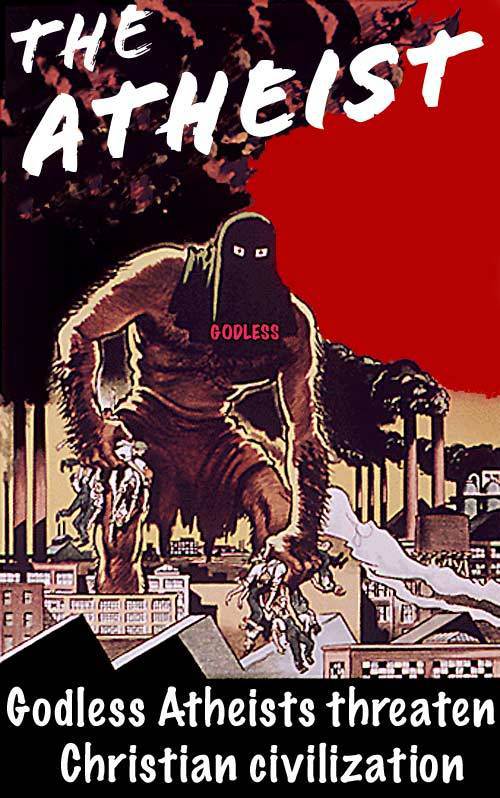
The points about the Bible in Daniel’s post were especially difficult to read. In fact, they were my inspiration for my post last week talking about how Christianity can shape the types of Atheistic beliefs people come to. My frustration came from the fact that, since Daniel originally wrote this (a while ago), I’ve watched him engage with and express respect for others that offer substantive critiques to what he ended up re-posting last week.
In his points, he expresses a view of the Bible that is mechanical, wooden, systematic, simplistic, and puts expectations on the text that it doesn’t even place on itself. It seems like he is only responding to the modernist, fundamentalist view of the Bible (what I called a “Straw Bible”), and I know his thinking is far more nuanced than that–I couldn’t understand why he still perpetuated this. But nevertheless, he did, so I’ll address it as it’s posted.
Continue reading
 (Note: These exchanges are now complete. There is a Table of Contents to the discussion now available.)
“I walk outside my house, I look around, and it doesn’t seem apparent to me that there is a God. I just don’t feel it. It doesn’t seem to be the natural conclusion of reality when I live life and look around. I see the world, and the existence of God doesn’t feel like a natural conclusion one could draw.”
I stare down into my coffee, catching the corner of my pastor’s glasses in the dark reflection.
“Well”, he says, “I know it doesn’t fix how you feel, but in the grand scope of human history, and even the global humanity living today, that opinion you just expressed is in the extreme, extreme minority. Most people living in the past and now have found looked at the world and have not been able to come to any conclusion other than their being a God.”
Crap. He was right. What I thought was such an objective engagement with the world around me, was (of course) still the product of the cultural forces from which I drink deeply. History and developmental psychology have shown us that religiousness is the default mode of the human heart.
We are by nature religious. It takes other, external forces to push back against that and move us away from it. And this fact is no apologetic for religion. It’s neither a point “for” or “against” religion. We are also by nature selfish and willing to do whatever it takes to be the fittest and survive. We try not to give into this natural drive and through education and conditioning try to move away from it.
As I am currently registering for my seminary classes, I thought I’d post this “theological statement” I had to write as part of my application materials. Some friends of mine had thought it would be interesting to read what I wrote, so here it is.
Seeing as I was writing to a seminary staff audience, there might be some references that aren’t commonly understood. I’ll link to times I’ve written about some items, but otherwise, any terminology or ideas that aren’t explained are a simple Wikipedia (or Theopedia–yes, it’s a real thing) search away. Continue reading
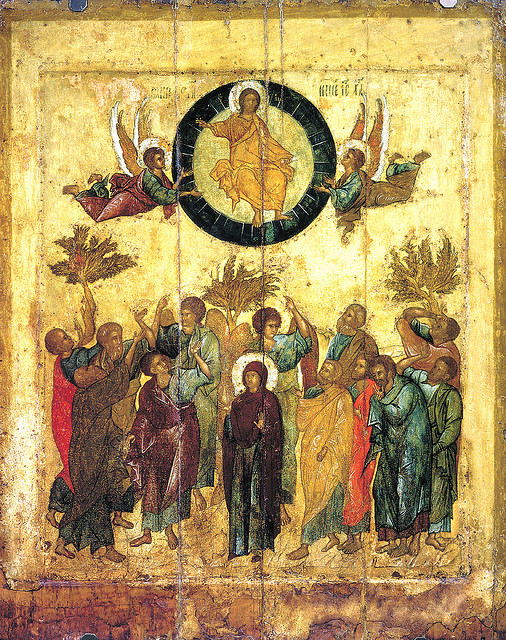 Today in the Christian church calendar is Ascension Day, the day we celebrate Christ ascending into heaven 40 days after his resurrection and now sits at “the right hand of God the Father.” (You can read a prayer and poem I posted earlier for this Holy Day)
The Useless Ascension
The idea of “Ascension” doesn’t seem to get a lot of play nowadays in the Church. This, in spite of the fact that it is an essential part of all the Church’s earliest doctrinal formulations, and the subject of the most-quoted Old Testament verse in the New Testament:
The Lord says to my lord, “Sit at my right hand until I make your enemies your footstool.”
Compared to other, non-creedal things like Hell, homosexuality, and “attacks on biblical authority”, the Ascension isn’t really talked about. Maybe this is because the Ascension isn’t really a “doctrine”–it’s an “event” and a “declaration”.
And we western Christians love our systematic “doctrines” that we can pick apart as nauseam and/or figure out how we can “apply it to our lives” in such a way that we can feel like we’re “good Christians.” But honestly, the Ascension doesn’t have many direct applications for today.
Continue reading
 the long way home