Wright, the Neo-Reformed, & Unity in the Church (If you read one thing all day, let it be this)


easterDon’t worry, the title is not referring to this very blog post you are reading right now.  It’s actually referring to this article at Christianity Today by Brett McCracken:

Wrightians & the Neo-Reformed: ‘All One in Christ Jesus – A dispatch from Together for the Gospel and Wheaton’s Theology Conference with N.T. Wright

The article compares and contrasts the general ethos of two very different conferences that occurred very close to the same time.  One conference was the Together for the Gospel Conference and Wheaton College’s Theology Conference with N.T. Wright.

Continue reading

A Great Deal from the Westminster Bookstore


Just wanted to drop a quick note to let everyone about a great deal I saw at WTSBooks.com. I’ve long said that Westminster Theological Seminary’s Bookstore is the best bookstore I know of.  Between classes, it where we’d go to have fun.  It was like a candy store for all those theologically-inclined individuals.  They’re dirt-cheap (more often than not cheaper than Amazon) and usually have some good deal going on.  And this one is no exception.  Two brand new books.  $14.49.  Here’s the link:

You Can Change/ What Is The Gospel (Two Pack)- WTSBooks.com

I’m most excited about this first book, You Can Change: God’s Transforming Power for Our Sinful Behavior and Negative Emotions by Tim Chester.  A little while back I read a book he wrote with Steve Timmis, Total Church: A Radical Reshaping Around Gospel and Community.  That book changed my entire perspective on the Church, the Gospel, preaching, and simply living life as a Christian.  It put many of the pieces together in my mind concerning the Church and spirituality and their place in society.  I became convinced that these guys “get it”.  They have such a full understanding of the Gospel in a corporate context, so I’m so pumped to see Chester’s thoughts on the Gospel on an individual level.  Here’s the trailer for the book:

Continue reading

Catholics on Scripture and Inerrancy


Oh, the Bible. It’s the lifeblood of the Church. It’s our backbone. But there’s so much we don’t get, and the culture both within and without the Protestant Church hasn’t helped. In its response to the Enlightenment, Evangelicals adopted the ground rules and assumptions that undergird modernism, namely, that Truth must be something that has a one-to-one correlation to things in created reality (as opposed to Ultimate Reality–God Himself), therefore making science and history the only vehicles for this Truth. This has caused so many problems with the rest of the world when talking about a little doctrine: Inerrancy which means, at its simplest level, that the Bible contains no “errors”. What does that mean?

Catholics can help us answer this.

I fear that Evangelicalism is becoming increasingly irrelevant to the current discussion on nearly every front because of these improper assumptions about Scripture. Catholics, though, were having these discussions in the Middle Ages! They have largely already dealt with the things that we Protestant are only now encountering issues with. This gave them a foundation that let them maintain intellectual and biblical credibility in light of the Enlightenment and now modernism. Here’s what they say about Scripture in the Catholic Catechism:

Continue reading

Open Mic: John Yoo, Torture, & Christian Ethics


Yesterday I wrote about how Catholicism views the idea of torture and how a possible response to it and it’s socio-political effects can be found in the Eucharist.  That article was written because the idea of Torture has come front and center in the political discourse once more.  For those not keeping track of the current political climate concerning the previous administration, John Yoo is a law professor at the University of California, Berkeley that was given the charge by the Bush administration and the CIA to define the nature and limits of “enhanced interrogation techniques“. He along with Jay Bybee authored the famous “torture memos” which gave legal justification for the use of waterboarding, sleep deprivation, and other techniques in order to get information from suspected terrorists.

Last year, the Office of Professional Responsibility wrote a report finding the two men guilty of professional misconduct and recommended the Justice Department do a full investigation. Ealier this month, both Bybee and Yoo were officially cleared of all wrongdoing in the eyes of the Department of Justice. Further, the DOJ strongly suggested that no further investigation nor disciplinary action from the bar should be sought. Last week the Department officially closed its investigation. Yesterday, the top ethicist of the Department of Justice said that not only did Yoo and Bybee do nothing criminal, but neither did they even act unethically. (Full summary of the metanarrative of all of this can be found here.)

Continue reading

Catholicism on Torture, the State, & the Eucharist


I know, I know — this seems like a weird topic to inaugurate this series. Today, in my ongoing series “Catholics Aren’t Crazy” I wanted to put up a post on a Catholic view of Scripture, inspiration, and inerrancy. They have some amazing things to say on these topics that Evangelicals could do really well to embrace. But alas, current events have changed that plan. Tomorrow I’m posting up a potentially controversial article here on a Christian view of Torture. I’m writing it in light of the recent developments, publications, and interviews concerning the legal and ethical exoneration of the “Torture Memo” authors, John Yoo and Jay Bybee. In my research I stumbled upon the following wonderful article by Andrew Sullivan of The Atlantic, posted on his blog on Ash Wednesday:

“May the Judgment Not Be Too Heavy Upon Us” — The Daily Dish

The article concerns Marc Thiessen, former speech writer for President Bush. Thiessen is on a tour of every news outlet it seems (I’ve seen him on like four different ones just this past week) to promote his brand new book, Courting Disaster, the point of which is pretty much as follows: Our “enhanced interrogation” techniques were moral, effective, and NOT torture; and President Obama has ended them, thereby “inviting the next attack” and putting everyone in America at risk of being slaughtered by Islamic extremists.

Continue reading

Catholics Aren’t Crazy (New Series)


As some of you may have noticed, weekends are pretty quiet here on the blog. In an ideal world, I would post every day during the week and then take weekends off (as I’m not too sure people are surfing much on the weekends. Am I wrong?).  Anyway, I want to try something.  Beginning yesterday, I’m trying to start a little tradition where on Saturdays I’ll post a more personal, meditative post and Sundays I’ll do the series I’m kicking off today.

I was raised in the Bible Belt as a Southern Baptist where there is absolutely no diversity in Christian denominations: there are only Baptists and Catholics — nothing else. This was, at least, my exposure growing up in Dallas, Texas. Throughout my years as a “good ol’ boy” Southern Baptist, I was regularly taught by my Sunday School teachers that Catholics aren’t actually Christians. Let me unpack this briefly.

Continue reading

Open Mic: A Prolegomena of Transgenderism (pt.ii)


UPDATE: This series is finished. Part 1 can be found here and Part 3 is here.

Yesterday, I started a little miniseries on Transgenderism in response to a question a friend sent me. They were wondering how Christians are supposed to look at this particular issue. I laid out the questions and definitions involved here and asked for feedback (be sure to read all of those comments). Today, I’m talking about a “Prolegomena of Transgenderism”.

Prolegomena” is just a big (but appropriate) word that basically refers to all the things we must keep in mind before trying to answer big questions. For example, in Systematic Theology, Prolegomena is when we lay out the very foundation of our knowledge about the given topics and the presuppositions that will guide us through the rest of the endeavor. That’s what this post is. I want to explore a couple of perspectives that have driven a lot of the answers I’ve seen about this before trying to come to firm conclusions in the next post. So, with all that being said, let’s get started.

Continue reading

REVIEW: “Simply Christian” by N.T. Wright


Simply Christian
Bishop N.T. Wright
Zondervan, 2006
Buy Now Here
Pre-Order New Ed. Here

__________

As I revealed in a recent tweet, I believe I’m walking into a new obsession with the author/scholar/pastor N.T. Wright. Surprising to many, I’m sure, with me being a seminarian and all, is the fact that I had never read any Wright before this book. Sure, I’ve known of his existence for years, had seen a few of his YouTube clips, and skimmed a few of his articles, but I had never read his books. My housemate during the two months or so before seminary began reading through Wright’s entire Christian Origins and the Question of God series (books 1, 2, 3) constituting over 2,100 pages of reading. He couldn’t stop reading, nor stop telling me about how amazing this man was. I nodded and agreed, sure that I would read something at some point. I had no idea what I was missing.

Continue reading

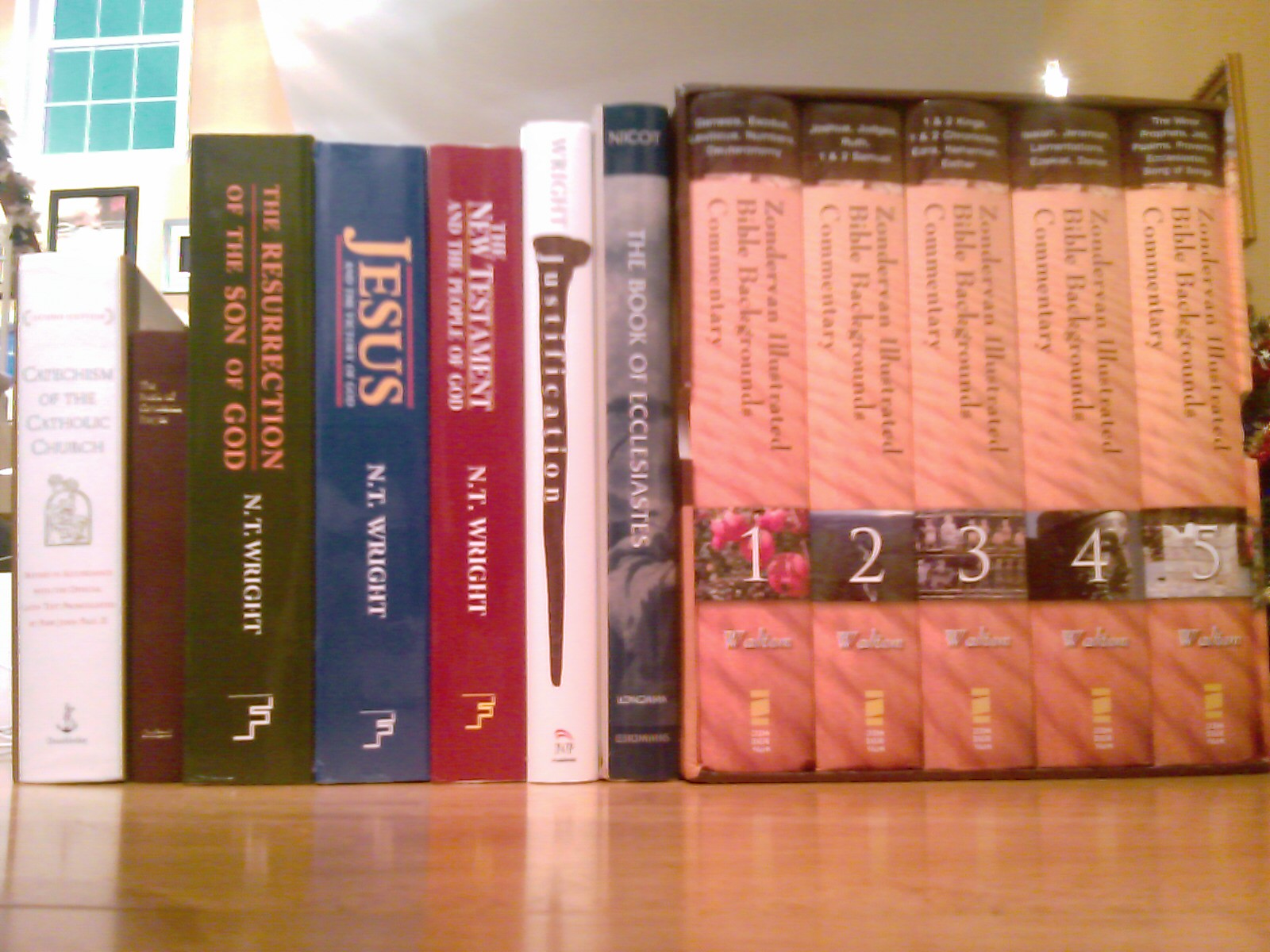
What an Ex-Seminarian gets for Christmas


In order from left-to-right:

weekend update


I wanted to write a quick note to anyone that’s been confused about the lack of writing on all of my sites.

For one reason or another, I’ve decided to do more research on the Slavery, Bible, and Atheism series.  Here’s why: It’s a six part series and so far each part has required two separate posts.  I am mostly done with the second post of Part 2, and for the whole series so far, I have almost 20 pages of content written.  With the stuff I want to say, and the content I wish to cover, I’ve realized that by the end of the series, if I stay on pace, I could have anywhere between 60 and 75 pages worth of material written.  And this doesn’t even include the pages worth of comments I’ve written on comments on Facebook and here on the blog.  So far, all I’ve written has been very “bloggy” in style and language; in other words — completely unworthy of even considering trying to see published.  It’s been very polemical and directly addresses other people and conversations not directly involved in this blog.

Continue reading

The Bible, Slavery, & Atheists{2a}: Philosophy & Ethics


As I’ve looked at and read the various articulations about this issue put forward by my atheist friends, I’ve noticed a few philosophical assumptions about ethics that are driving many people’s perspective on how the Bible does/should talk about these things. In this post, I’d like to highlight those things and show how they are neither philosophically or theologically correct. By the time I finished writing, it was really long, so, using one of the few benefits of blogging as a medium of discourse, I will put up the second part (concerning the more theological side of this) tomorrow or the next day.
The Philosophy of Ethics

Principles vs. Applications

Even the most cursory look shows that the study of ethics is the study of transcendent principles that govern our morality and behavior. There is an important distinction though made between those transcendent principles and their applications. One can hold to the exact same set of principles, but apply them differently at different times/cultures. It is simplistic and reductionistic to think that anyone’s “ethics” will be applied in the exact same way every time. No ethicist secular or otherwise treats ethics in this fashion. I believe that Scripture is consistent throughout in its transcendent principles, though not in their comprehensive applications (below). To navigate applications takes another pair of things the Bible talks at length about: faith and wisdom (more in the next post). Further, I don’t think this principle/application distinction provides any serious ethical challenge to biblical authority. The Bible itself never claims to treat ethics in this reductionistic manner, so to force it upon Scripture is dishonest.

One of my atheist friends mentioned the converts in isolated African tribes where nudity is prevalent, saying that if Christians were consistent, they must insist that they all cover up in order to be Church members in good standing. Except there’s a problem with that: there is no Christian ethic of “non-nudity”. There is a Christian ethic of “modesty” that says that we have the responsibility to adorn God’s beautiful creation of the human body in such a way that it maintains the respect and dignity it deserves. Now, how respect and dignity is shown changes culture to culture, so it takes wisdom to see where the human form is being abused in that culture — and that is not a compromise of Christian ethics. The consistent biblical principle has still been preached, upheld, and lived. If ethics (secular or Christian) were as naively structured as is necessary for some of these atheist criticisms to make sense, then the entire field of ethics would be unnecessary and non existent, because we could have a computer program that could make all the black-and-white moral decisions for us.

Continue reading

The Bible, Slavery, & Atheism: Part 1b


this is real (I did it myself)

The next post is pretty much done, but I wanted to send out this quick note before moving on. The previous post revealed a lot of things that I neglected to make clear. My fault. Sorry.

First and foremost, the last post was not meant to settle the question on slavery and the Bible. I just wanted to get out what the Bible actually says about it. The most I wanted to accomplish toward addressing the issue was to let people see a clear trajectory within Scripture wherein no part is inherently contradictory to the parts before or after it, no more than a seed is contradictory in nature or form to a fully blossomed flower. I also wanted to give a sense of the complexity of the issue. In every passage that lies out even the most comprehensive sets of morality and ethics for the Israelite people, you never see slavery there. It was never an action that was consistently seen as something moral. It’s not a freedom that the Israelites are free to use whenever they desire; it’s used sporadically, meaning that there must be something else going on beyond some explicit commentary by God on the moral nature of slavery. The New Testament is clear that the crucifixion of Christ was something that was foreordained and ultimately brought about by God, but this neither expunges the moral responsibility of the people that actually did it, nor says that God is all about crucifixion and thinks it is “morally neutral” or “ethically okay”. He clearly thinks it is wrong and evil, and yet He clearly ordained it, allowed it, and used it to bring about his promised redemption to the world.

Continue reading

“The Beauty of Theology (an Advent Call)”-GoingToSeminary.com


I just wanted to let all of you know about a new article I recently put up on GoingToSeminary.com.  In light of this advent season, I retooled some of the things I wrote in my Beauty series to encourage those of us getting bogged down in holiday busyness and school finals. I hope the article is used to stir many of you towards the great God that dwelt among us. Read the full thing:

The Beauty of Theology (an Advent Call)

Also, for those interested, my church, Liberti (I go to the South Philly campus) has put together a prayer guide for Advent.  I hope this further helps you in the weeks to come.

Check out the rest of my Going To Seminary posts.

An Open Response to Some Atheist Friends Regarding Slavery & Biblical Ethics (pt. 1)


[First off, this is a long one, and only part 1 of 6, so beware before you start reading.]

On Facebook, there appeared a status by an old atheist friend of mine from undergrad named Larry (supported by another friend Christopher). Here was the thesis of the post:

Regarding moral relativism the christians are hypocritical. They say they believe in a moral objectivity given by god…but how is it then, that they believed slavery was a product of the old days, as it was applicable to the time it was practiced (and sanctioned by the bible) but now condemn it? The bible, last I checked did not change. I think this is a PRIMARY example of moral relativism exhibited by the church and christians. So how can they sit here and tell us that a proof for god is moral objectivity?

In other words, how could the ethics of Christians change over time if the book they supposedly base their ethics upon has not changed? Either the God that inspired the Bible was completely incompetent in his revelation or there was no God revealing anything at all. The note caused a discussion that resulted in almost 90 comments, and I quickly realized that if I were going to respond, it would need to be in a more lengthy manner than a Facebook comment (which is not the most helpful of mediums of debate). So here it is. I’d like to respond to the ideas that came out in the discussions. I want to disagree with them on the basis of five ideas:

Continue reading

My Favorite Song: “Wedding Dress” by Derek Webb


b00008ngas01_ss500_sclzzzzzzz_For those that have read this blog for a while, seeing the name “Derek Webb” AGAIN in the title of one of my posts probably caused you to at least roll your eyes, if not actually letting out a heavy sigh accompanied with an “oh Paul…”.  This is because in about a three month span, I wrote 8 posts all having to do with Derek Webb’s newest album Stockholm Syndrome (here they are: 1, 2, 3, 4, 5, 6, 7, 8).  Admittedly, I kept writing all those mainly because I was boasting record visits to my site because of those articles and I wanted to maintain that.  But eventually it got old, and I went back to my smaller numbers, though those article still rank as my highest visited even still.

Continue reading