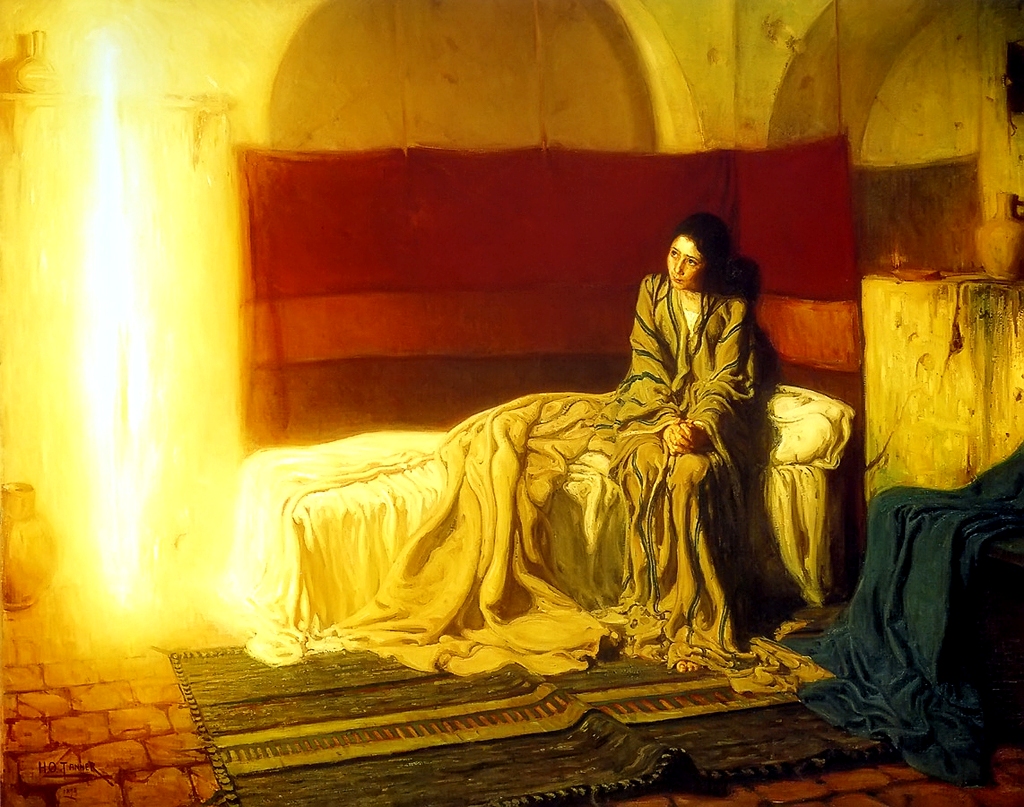
One of the beautiful things about Catholic theology is that it sees story as one of its main interpretive filters. Protestantism, on the other hand, focuses much more on historical context and the text itself.
To modern ears, the Protestant ways sounds great, but there’s one big problem: this is not how most of the biblical writers, Jesus, the apostles, the early church, nor most of church history have ever treated the Bible. They were and have been much “freer” with the text (yes, often to a fault). Catholicism’s rootedness in ancient ways of reading invites them into new dimensions and interpretations.
Take Mary, for example. Catholics see her foretold in the Old Testament just as much as Jesus is. They see her in prophecies and allegorically represented in other women. They see parallels between her and the Ark of the Covenant, the Tabernacle, and the Temple, saying they all carried the Holy of Holies within them, and were revered for it.
There are three biblical offices of authority among God’s people: Prophet, Priest, and King. Christians see Jesus as the fulfillment and highest expression of each of these, but in the Advent event, you can see Mary serving these functions as well. So today, as a Protestant, I want to sit with this and revel in some beauty and divine mystery.
Mary, the High Prophetess
A biblical “prophet” is not someone who tells the future; it is someone who speaks the true words of God with divine authority. They claim a divine origin and “conception” for the Word they “deliver”. And all prophetic words find their truest and most authoritative expression in Jesus himself–the singular, definitive “Word” of God.1,2
If Jesus was the Word of which the former prophets’ words were only a shadow, then Mary herself was the truest and most literal human prophetess: having the True Word of God conceived within her by divine decree, she then faithfully delivered it to the world.
The legitimacy of her Prophetic office is testified by the fact that she delivered the truest and highest Word of God. (It’s also interesting that the only other person in the Advent story explicitly described as a “prophet” is another woman, Anna.3)
Mary was the prophetess that all other prophets were anticipating.
Mary, the High Priestess
Priests served several functions for God’s people. Primarily, they were servants of God, set apart to care for the material and spiritual needs of the people and prepare the ritual sacrifice for their sins. Priests had no land, for God himself would be their inheritance.
Mary is blessed by God, who says he is “with” her, setting her apart for his service and giving her Himself (literally) as her inheritance for her faithfulness. She responds by boldly taking on the title of servant.4 One could see this as Mary’s Priestly ordination.
Mary goes on to birth Christ and, just as the priest would do with the sacrifice, she performs preparation, dedication, and purification rituals on Jesus at the temple.5,6 Years later, Mary watches at the cross, as the final and ultimate sacrifice take place.
Even more literally, Mary cares for the material and spiritual needs of the “body” of Christ, the very body to which we are now joined and by which we are nourished each week at the Communion Table. As a priestess, Mary sets apart, consecrates, and gives out the body of Christ for his people.
Mary, as a priestly servant of the Lord, cared for, nourished, and responded to the needs of the body of Christ.
Mary, the High Queen
Remember, these are “offices”, not in some big, other-worldly cosmic sense, but in a very human practical sense. They are ways that authority is exercised among God’s people.
I’m not saying Mary is a “queen” of Creation itself or reigns as a “queen” for all time–only that there is a type of earthly authority usually exercised in the human office of “King” that is most truly expressed in the life of Mary.
How so? In Jesus, the exercise of royal authority is redefined. It is not lording over subjects, but lowering and emptying oneself on their behalf, bearing responsibility to lead for the good of others.
When Jesus says “not my will but yours be done”7, and when Mary says “Here am I, the servant of the Lord; let it be with me according to your word”8, they are both speaking expressions of authority as Christ has redefined it in Adventing among us.
The earliest known hymn to Jesus, has parallels to Mary’s own song, the Magnificat. In the same way that Jesus empties himself and is therefore highly exalted, Mary empties herself and so is exalted and blessed by generations to come.
Mary shows how true, godly, royal authority is faithfully exercised by human beings–through humble submission and the bearing of weight for the sake of the world.
Paul, the orthodox blogger (I promise)
This is not my “doctrine of Mary”. I’m not saying Mary fulfills these offices in some cosmic sense. These are just some beautiful ideas I could see being true–a silent space in the Mystery of God where there might be some awe.
Just to be clear, I think Mary was an absolute human being: born with a sinful nature, full of doubt and sins, who had other kids, and was not a “co-redemptress” with Christ.
But in saying that, I’m not thinking less of Mary. In fact, the more human one considers her, the more incredible her faithfulness and obedience is, and the more of a model she can be for us to live out those divine offices today.
So may we each look to Mary this Advent season; and in her obedience and faithfulness, let us see how we might deliver God’s word, care for his Body, and exert our God-given authority in ways that resonate with that most blessed of women.
[image credit: “The Annunciation” by Henry O. Tanner]

 the long way home
Love it. Very thought-provoking about someone I’ve never truly thought about before.
LikeLiked by 1 person
I so appreciate this account of the very humble human, yet divinely called to royal priestess Mary is among believers. She is a sanctified, blessed woman indeed! To carry and nurture the Son of Man took faith in God, courage to step out of expectations of the normal, and see Him through no matter what was going on around her! I cannot help but see the parallel of our receiving Jesus as Messiah and Lord and being “born again of the Spirit of God” when our spirit is literally “born again”! And how the Holy Spirit of The Living God is Emanuel, God with us/in us and we need to be nurtured, taught, and fed the Word to mature in the ways of God to walk in the Spirit, by the Spirit. We are entrusted with Him, carrying Him, and the Almighty God is in our Spirit every day! How He must suffer our humanity every single day as Jesus did the disciples… Imagine how we might be cooperating with Heaven, Your Kingdom come Your will be done on earth as it is in Heaven, if we ask Him to help us to understand what Jesus meant when He said “you will do greater things than I”. To God be the Glory.
LikeLiked by 1 person
You write: “Just to be clear, I think Mary was an absolute human being: born with a sinful nature, full of doubt and sins, who had other kids, and was not a “co-redemptress” with Christ.”
Hebrew 9;11 But when Christ came as high priest of the good things that are now already here, he went through the greater and more perfect tabernacle that is not made with human hands, that is to say, is not a part of this creation.
“went through (διὰ) the greater and more perfect tabernacle that is not made with human hands, that is to say, is not a part of this creation.”
Jesus came through Mary. From the very first incarnation of His human atom and cell, He was in Mary.. Hebrew 9, 11 about the Immaculate Conception of Mary.
LikeLike
Sorry, just seeing this. I appreciate your zeal and desire to follow the Scriptures, however, let me offer a few items for your consideration.
– First, I could find no church father in the Ancient Christian Commentary series that interprets this verse this way
– Second, and most significantly, the argument and imagery of sanctuary and tabernacle we see in Hebrews 9 begins all the way back in Hebrews 8:1-2: “we have such a high priest, one who is seated at the right hand of the throne of the Majesty in the heavens, a minister in the sanctuary and the true tabernacle that the Lord, and not any mortal, has set up.” See? The idea is that Jesus’ sacrifice was effective because he metaphorically offered himself as the sacrifice in the Holy of Holies by way of the heavenly tabernacle into the heavenly temple, where the sacrifice of himself was offered.
– Lastly, Ancient Greek doesn’t quite work the way you suggested. Prepositions like “dia” usually have multiple possible translations, usually determined by the ending of the word they modify. In Hebrews, every single time the author uses the word “dia” with the ending used here (the Genitive case, if you’re curious), it means “through” in an INSTRUMENTAL way, not a SPATIAL way. It’s not talking about something Christ literally passed “through” like a birth canal, but the means by which he accomplished something. In this case, he was able to offer himself as a sacrifice in the heavenly Holy of Holies by means of the heavenly tabernacle where the sacrifice took place.
I hope that’s helpful. And thanks for writing.
LikeLike