Visions of Arcadia: the most terrifying art exhibit I’ve ever seen


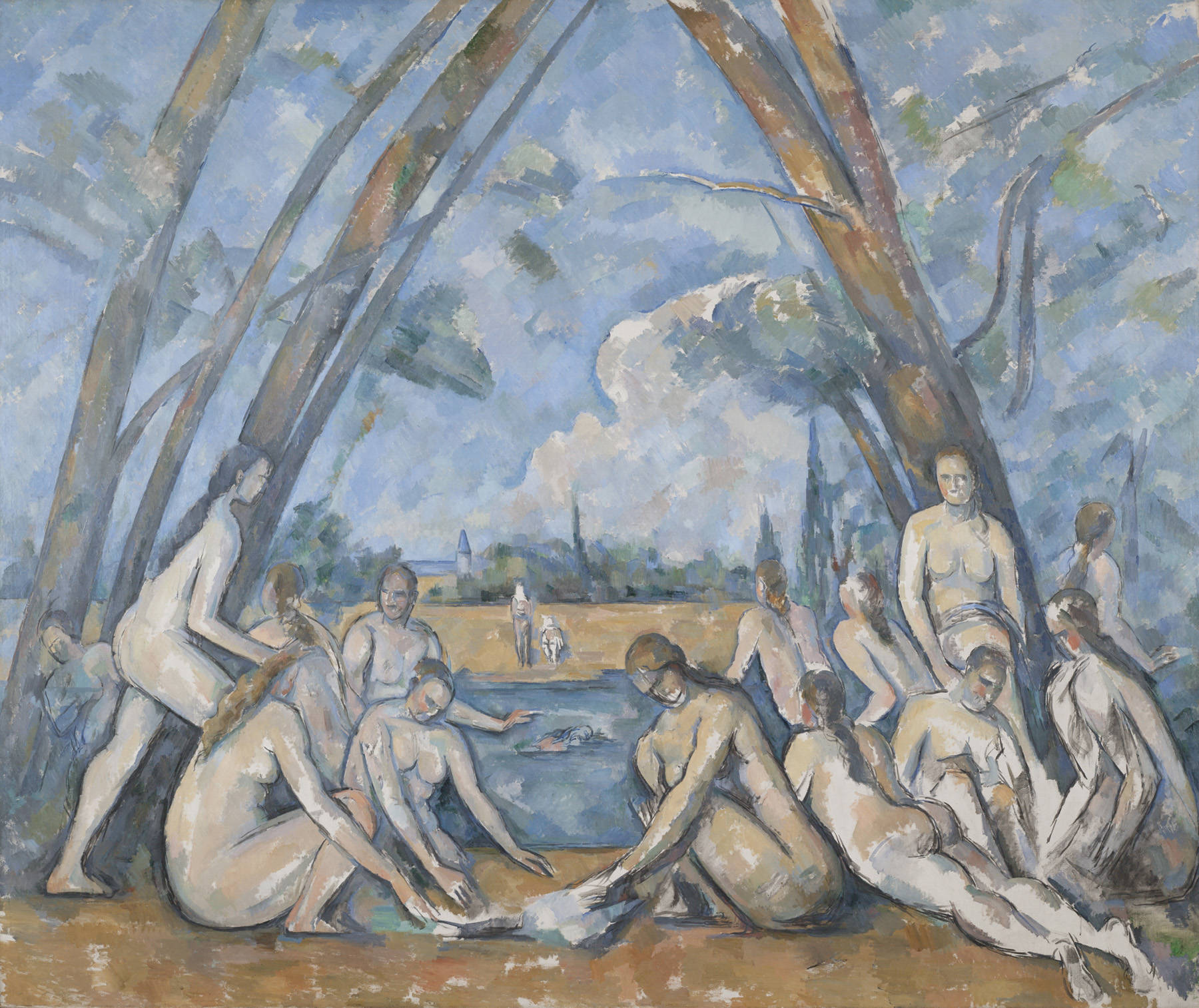
This weekend I had the privilege of seeing the Philadelphia Museum of Art’s new exhibit Gauguin, Cézanne, Matisse: Visions of Arcadia. The exhibit showcases works exploring the idea of “Arcadia“: an idyll pastoral world envisaged in Virgil’s first major poetic work Eclogues where nymphs and fauns dwell alongside Bacchus and Pan; where human dwellers exist in peace, rest, and joy in the natural world.

(To put it simply: you can usually recognize Arcadian themes at work in a piece of art when it has naked people hanging out in nature–usually around rivers.)

This image of Arcadia, having been explored in art epochs in the past, overtook art once more right as modern art was being born, right around the turn of the 20th century. In fact, the exhibit subtly makes the argument that this image of a rural, paradisal ideal is an essential element in modern art’s development. The modernists’ dilemma–the tensions between longing and reality, finding and losing, permanence and transience, human and mythic–all find their embodiment in this Arcadian world.

The exhibit begins with excerpts from Virgil’s poetic treatment of this theme, set beside works that visualized his words. These run along one wall. On the opposing wall of this introductory hallway, there are excerpts from Stéphane Mallarmé’s modernist treatment of Arcadia, L’Apres-midi d’un Faune, accompanied by pen-and-ink drawings from Matisse that visualize his words.

The exhibit is great, but very theoretical. It works subtly and on nuance. It’s not just a bunch of pretty things thrown into a room. Instead it is a thesis–an argument–in visual form. It watches a theme develop from myth to poetry to visual art (and then from Renaissance to modern) and explores how they are all connected and converse with one another. It’s really like no other exhibit to which I’ve ever been. If you get the chance, see it.

But that’s not why I’m writing today.
Continue reading
Class 4: Prophets, pt. 2; Wisdom Books; & Intertestamental Period, pt. 1


This week was the fourth week in the six-week Bible Survey class I’m doing at my church.

We didn’t quite get to the Introduction of the New Testament like I had planned. This class was a bit different than other ones. Rather than focusing on a lot fo content of each book, this week was mostly a “tour” of these sections of the Bible and History, with some “highlights” along the way. The main point was to give people a bigger picture of these things to help them read the Bible themselves.

Just like last week, my notes are very incomplete. Most everything I said is in there, but I definitely want to provide a lot more in the notes than I say–and that hasn’t been filled in for most of the books so far. I will be spending the next two weeks filling that in. Once I’m done, I’ll let you all know. Thanks for your patience.

Lastly, I know I did a very poor job at telling the story of the Intertestamental history. I will try this again and condense it more in the next class. I will be much better prepared then.

This Lecture Covers:

  • Principles to keep in mind to help when reading the Prophetic books
  • Highlights from the Prophetic Books
  • Survey of the content and some of the background of the Wisdom Books of the Old Testament, with a special focus on the content of Job
  • Survey of the History between the Old Testament and New

Download: [Audio] [Notes] Continue reading

notes from last week’s class are finally done!


Earlier this week, I posted the audio and incomplete manuscript for Class 3 for the Bible Survey class I’m doing. Last night, I finally finished polishing up the notes with all the extra information I wasn’t able to say in the class. I hope it’s helpful. This final manuscript comes in at 36 pages long (admittedly, that’s with size 14 font to make it easier to read online, but still), so there is lots of stuff there that wasn’t talked about (especially with Kings, Chronicles, Ezra-Nehemiah, and Esther).

So, check it out below, download it, share it, critique it, and let me know what you think! I’d love to get some feedback on these to know if they’re actually helpful. Enjoy, and thanks for your patience! (and P.S. don’t forget about the Dead Sea Scrolls trip tomorrow.)

What do we make of the atrocities of the Old Testament?


This is a slightly edited version of an excursus I wrote in this week’s notes for the Bible Survey Class I’ve been teaching at my church. Follow that link for more information on the class. Also, I’m well-aware that the second half of this is exactly the “angle” talked about in the venerable Pete Enns’ recent blog post. I wrote this before he posted that, but still, I wanted to put it up on the off-chance this articulation might be helpful to others.

In the books of Numbers and Joshua, God commands the Israelites to commit genocide on many different people, including their women and children. He also commands them to forcibly enslave others. And in still another story, he commands Moses to take the remaining virgins of this particular people of which they disobediently did not kill all, and divide them evenly among the soldiers and the “rest of the Israelites”. We can only imagine what for.

A few quick thoughts:

Continue reading

Class 3: The Historical Books & Prophets, pt. 1


This week was the third week in the six-week Bible Survey class I’m doing at my church.

And yes, we actually covered all the books of the Old Testament from Joshua to Nehemiah, did an intro to the Prophets, and had a brief discussion on the ethical problems with the “Old Testament God” in an hour.

You can find a small article I wrote on those atrocities and “ethical dilemmas” of the Old Testament attached to the end of the Notes below.

At the time of this writing, I’m not quite done with the notes, but I wanted to get the lecture audio to everyone. So, below you will find an incomplete version of the notes. I will upload a revised version later today (or tonight) with everything else filled in. I’ll update this post when that happens, as well as the Scribd doc below.

Also, as I posted about earlier today, as part of this class we will be going to the Dead Sea Scrolls exhibit this Saturday in Philadelphia. There are also discounted tickets available. Check the link, and I hope to see you there!

This Lecture Covers:

  • A discussion of the Deuteronomistic and Priestly Histories of the Old Testament
  • Survey of the content and background of the Historical Books of the Old Testament from Joshua to Nehemiah
  • An general introduction to the Prophets
  • A discussion concerning the atrocities committed in God’s name by the Israelites in Joshua and Numbers

Download: [Audio] [Notes] Continue reading

Join us this Saturday to see the Dead Sea Scrolls!


As part of the Bible Survey Class I’ve been teaching at my church, I’ll be leading a tour of the Dead Sea Scrolls exhibit at The Franklin Institute here in Philadelphia (map).  We will be meeting at 4:30pm this Saturday, July 28th in the main hall just inside the main entrance (you can get into that hall without buying a ticket). I’ll have some introductory words to set up our time, and then we’ll go to the exhibit where we’ll stop a few more times for some added information.

Also, Living Social is selling discounted tickets to the exhibit all this week (the usual evening price is $19.50). So even if you can’t go this week, still buy the tickets and go another time. It’s an amazing exhibit and will be here until mid-October. If you have any questions, feel free to email me at burkhartpm [AT] gmail [DOT] com.

P.S. the trip to the University of Pennsylvania Museum of Archaeology & Anthropology has been moved to a week later than originally scheduled, to the 25th of August.

The Gospel Coalition & Sex as Conquest: it’s still misogyny, however unintended {2}


Yesterday, I talked about a recent brouhaha over some comments by Douglas Wilson and Jared Wilson (no relation) over at The Gospel Coalition about gender and marriage. Jared quoted a book by Douglas where he says, among other things, this:

…the sexual act cannot be made into an egalitarian pleasuring party. A man penetrates, conquers, colonizes, plants. A woman receives, surrenders, accepts.

His (and Jared’s) main point was that they believe there’s an inherent “loving” “authority” exercised by men in marriage, even in the sexual act. Further, this is God’s loving design that Christians are to embrace. They believe that some of our culture’s male addiction to porn and female addiction to S&M bondage fantasies stem from our culture’s rebellion from this “proper”  and “loving” exercise of male authority over women, causing them to turn to “improper” ways of exercising these God-given drives.

Needless to say, they got a lot of flack over this. They insisted time and time again that they are not advocating forcible marital sex or that women should just be treated as passive “receivers” of sex. They defended themselves, attacked their critics, and yet, (inexplicably, to them) critics kept saying these harsh things about them. Yesterday, I wrote about the background of this, the responses, and then wrote some words to Jared Wilson. Please go to that link for that relevant information. Today I want to give more of my specific perspective on this:
Continue reading

The Gospel Coalition & Sex as Conquest: Jared Wilson, you’re better than this {1}


Update: Part 2 is up, engaging with the issue itself and The Gospel Coalition.

Fine… I’ll throw my two cents in.

A few days ago, Jared Wilson, trying to speak to the appeal of the S&M-tinged book 50 Shades of Grey, posted an excerpt from the book Fidelity (which I have read, so I feel I can speak to this) by the always-good-for-a-sound bite Douglas Wilson. Here’s how I’d summarize his ultimate point:

Modern humans have rebelled against God’s good and correct design of male authority and female submission to that authority. But, as people made in the Image of God, we have deep longings for the way God has structured reality to work best. And so, even when we reject God’s gracious version of gender relations, that desire is still there and will thus be corrupted and express itself in things like rape, pornography, and thinking things like 50 Shades of Grey is appealing.

really don’t think either of them would think I am mischaracterizing them here. Both Wilsons involved in this equation clearly intended in their writing to promote what they believe is a beautiful synchronicity between male and female in which both fluorish.

And yet the blogosphere blew up over this.
Continue reading

a homosexuality post-script & conclusion


Most of last week on this blog was spent discussing some recent “conversations” about the Evangelical church’s relationship with the homosexual community. I first addressed conservatives, and then progressives (as well as some thoughts on the “willful persistence in sin” comment I hear from conservatives a lot). This week, we move on. But not yet. In response to some of the ways people have responded to these posts, I felt I needed to write this.

In conclusion to it all…

These posts I’ve written got a lot of circulation around the web (and to those who commented/posted links, I thank you), and so for anyone that runs across them, I want to make something clear:

It might seem odd that I’ve typed far more words and dripped more sarcasm in attacking the more conservative side of this issue, all while ultimately agreeing more with them at the end of the day. In the end, even with all of my many theological and social disagreements, I cast my lot with them, even though I know most of them would not have me.

These posts, hopefully, have been written in the same spirit as Mark Noll’s blistering attack on Evangelical anti-intellectualism, The Scandal of the Evangelical Mind, which he calls “an epistle from a wounded lover”.
Continue reading

For Theology Nerds: a satirical dictionary (don’t miss this!) [casual fri]


Andrew Wilson, over at The Theology Forum has done us a great service my creating this “Brief A–Z of Theological Jargon”, and it is great. Everyone gets some elbows in the ribs. Check it out. You don’t want to miss it. Here are some of my favorites:

Complementarianism 
1. The belief that men and women are complementary.
2. The antiquated and repressive notion that wives should submit to their husbands, and women should not teach or have authority over men.
3. The attempt to disguise (2) by referring to (1).

Egalitarianism 
1. The belief that men and women are equal.
2. The modern and liberating notion that women can do everything a man can, sister, including wearing trousers, leading the home, leading churches and teaching and having authority over men.
3. The assumption that (1) necessitates (2).

Roman Catholicism
The belief that the church is universal, apart from Anglicans, Baptists, Methodists, Presbyterians, Pentecostals, and pretty much everyone except Roman Catholics.

Some critical words for the Left on Gay Reparative Therapy (ii)


Update II: I posted some important final words on these posts.

Yesterday I began giving some of my thoughts on Exodus International‘s recent repudiation of gay “Conversion Therapy” that was supposed to have “cured” gays of their homosexuality. I began by talking about my experience reading the primary text on this type of therapy in college, and then I criticized some of the common thinking of those on the more conservative side of the spectrum when it comes to this topic, especially how Evangelicals have reacted to Exodus International’s President, Alan Chambers. I also wrote some further thoughts responding to some questions about “homosexuals ‘persisting’ in their ‘sin'” (Update: I clarified some thoughts on that post).

But today, I’ve got some words for the Left…
Continue reading

some brief thoughts on “willful persistence in sin” & homosexuality


Update III: I posted some final thoughts on these posts.

Update II: In some commenting I did on facebook, I feel I communicated myself more clearly on a couple of issues than I did on this post. So, below, you’ll find those clearer comments, edited for your consideration.

Update: The second and final part of these posts is up.

In response to my post earlier today on Exodus International’s decision to move away from “conversion therapy” of homosexuals, in which I criticized many more conservative reactions (don’t worry, you progressives will get your due tomorrow, haha). A couple of comments, messages, and such have asked me about that classic Evangelical formulation that homosexuals that “persist in their sin” or “walk in deliberate willful disobedience” cannot be “saved”.  (This idea is based on some parts of 1 John, but that application of those verses has too many interpretive issues to go into here, as I type on my phone. Suffice it to say, though, that it’s a bad application and doesn’t naturally flow from the text).

Anyway, back to the question.

Life is much more complicated than those simplistic categories of “willful”, “deliberate”, and “persistent” (and “sin”, frankly). Being in counseling myself, and being a counselor, this whole “willful disobedience” thing is much grayer than that articulation implies.

What do you do with pastors that are irresponsible in their preaching and “pastoring”, and even in light of SO many other believers telling them they are wrong, disobedient, harmful, and sinfully relating to their people, they “wilfully persist” in that? What about all of us Christians that “willfully persist” in driving even 5 mph above the speed limit? What about the person in the church that never stops gossiping, even in spite of sitting in sermon after sermon on the topic? Or all the southern and midwestern christians that “wilfully persist” in their gluttony?
Continue reading

Exodus International is Right on Gay Reparative Therapy (i)


Update III: I wrote some final thoughts on these posts.

Update II: The second part of this post is up.

Update: I wrote some brief thoughts on a frequent reply I’ve received to this post: “what about gays that are wilfully and persistently disobedient in their sin?” Check it out.

Why on earth am I writing such lose-lose posts as these? I have no idea. Well, here we go.

Last week, Exodus International, one of the biggest and most-well-known Evangelical ministries to homosexuals, came out against what’s called “Reparative Therapy” or “Conversion Therapy”. The New York Times had a big write-up on it (as well as NPR) and an interview with Alan Chambers, the President of Exodus International. And now the whole news cycle is all a-flutter over this. Right when I think the story is dead, I see another headline about “rifts” forming in the Evangelical community and such.

Reading these articles has made me so frustrated with both the Right and the Left in their treatment of this discussion. There’s so much to say, I apologize for the lack of flow or organization that follows.

There are some really important things that seem to be getting lost in this discussion–on both sides.

Continue reading

Class 2: The Rest of the Pentateuch (from Exodus to Deuteronomy)


This week was the second week in the six-week Bible Survey class I’m doing at my church. We went through the rest of the Pentateuch, or more specifically, Exodus through Deuteronomy. I was originally hoping to do all the historical books of the Bible, then I was just hoping to get through Joshua. I did neither. We just got to Deuteronomy. But that will be okay.

In the recording, there’s also a brief discussion we ended up having on the importance of historicty and the Old Testament–a topic that’s only going to more of issue as we move forward in this class. Be sure to listen and get in on the discussion! You can follow the class on the class page above.

**Remember, we have next week off, so the next lecture is on 7/22, with our first field trip on 7/28.**

This Lecture Covers:

  • Review of the foundational ideas of the Bible we talked about last week
  • A more refined response on my part on the doctrine of “Revelation”
  • Survey of the content, background, and application of Exodus through Deuteronomy
  • Discussion concerning the historicity of the Old Testament and its importance

Download: [Audio] [Notes] Continue reading

Class 1: The Bible & it’s Story, OT Intro, & Genesis


This past week, I started the Bible Survey Class I mentioned earlier today. It’s a six-week class going through a theology and history of the Bible and its contents, with an emphasis on these facts helping to build up the spiritual life of Christians. It also goes into a lot of the historical development and issues behind the Bible, so it could also be of interest to non-Christians. You can follow the class on the class page above.

This Lecture Covers:

  • What is the Bible?
  • What is Revelation?
  • The History of Israel
  • The History of the Old Testament
  • Genesis: Contents, Background, and relevance to Christians

Download: [Audio] [Notes]

[audio https://prodigalpaul.com/Bible%20Survey/Bible%20Survey%201-Intro-OT-Genesis.mp3]