Open Mic: The Question of Transgenderism (pt.i)


UPDATE: This series is finished. Part 2 can be found here and Part 3 is here

A couple of days ago, a friend of mine shot me a facebook message asking me for a Christian perspective on, of all things, transgenderism. For many reasons that will be explained later, this will be a topic of increasing pertinence that the Church will have to give a theologically-informed account for at some point. We need to have answers for questions like: “Did God make them that way?”, “Are they just confused?”, “Should we support many people’s desire for surgical alterations?”,”What hope for ‘healing’ can we expect in this life?”,”Is it something that needs to be ‘healed’ in the first place?”, “Is it a sin?”, “What does a Christian with transgender issues look like?”, “Is that even possible?”, among others.

To be honest, I don’t feel like I have a rock solid answer to any of these questions. Every time I feel like I do, I talk to someone and they show me a new dimension I hadn’t seen before. So, I’m very open to ideas, which is why I’m writing this on the blog. I would love everyone’s feedback and opinion as to how one should answer these questions.

Continue reading

John Piper on Porn, Wives, & Marriage


I try not to bash pastors that I know have good intentions.  Those pastors that have demonstrated a desire to be biblically sound and pastorally sensitive, usually get the benefit of the doubt from me, even when I don’t think they are at the moment being biblically sound and pastorally sensitive.  I also know that well-known pastors probably get far more useless and inane criticism from young twenty-somethings that think they know everything (myself included, far more often than I’d like to admit).  But this went a bit too far.  Tonight, John Piper put up the following tweet:

Really?

Continue reading

The Good Motivations of the Heart: God-merica, pt.IIIb [REPOST]


[This is a repost of the last in a 4-part series of articles I wrote about a year-and-a-half ago (here’s Part 1, Part 2, and Part 3) exploring my struggles with the idea of America as a “Christian Nation” and how my Christian faith should influence my politics. Where I ended up is a very helpful place, I believe, for us Christians struggling with these things.  

In the first post, I show how America has many similarities with Ancient Rome that lend itself to helping us in this discussion.  In the second, I discuss the motivations and limits of imposing a Christian worldview on a post-Christian society.  In the third, I laid out the wrong motives that seem to drive most of Evangelicalism’s attempts to take over the country, and their historical and philosophical roots.  In the post below, I pick up right where the third one ends and give a biblical foundation for a possible framework we can use to discern our political action as Christians.

___________________________________

My exploration of motives for Christian involvement in politics began to shift when I realized that the same Paul and Peter that preached a political worldview of simply obeying the laws were the same Paul and Peter that when told by authorities not to preach, they refused to obey.  What’s going on?  Apparently there’s some other principle at work that creates a depth, complexity, and dynamism within this issue: God and His Nature, Christ and His Glory.  More on this in the next post.

Continue reading

REVIEW: “Simply Christian” by N.T. Wright


Simply Christian
Bishop N.T. Wright
Zondervan, 2006
Buy Now Here
Pre-Order New Ed. Here

__________

As I revealed in a recent tweet, I believe I’m walking into a new obsession with the author/scholar/pastor N.T. Wright. Surprising to many, I’m sure, with me being a seminarian and all, is the fact that I had never read any Wright before this book. Sure, I’ve known of his existence for years, had seen a few of his YouTube clips, and skimmed a few of his articles, but I had never read his books. My housemate during the two months or so before seminary began reading through Wright’s entire Christian Origins and the Question of God series (books 1, 2, 3) constituting over 2,100 pages of reading. He couldn’t stop reading, nor stop telling me about how amazing this man was. I nodded and agreed, sure that I would read something at some point. I had no idea what I was missing.

Continue reading

Holy Day Meditations: Jesus Presented at the Temple


The backbone of my morning and evening meditations and prayer has become the Anglican Book of Common Prayer. It has taken me a while to figure out how to use it (with a lot of help from a friend), and I’m still clumsily trying to make my way along, but it is an amazing book. It gives just the right amount of both freedom and structure to give me both guidance and excitement. I’m really enjoying it. Secondly, I am a relatively new member of a church that belongs to the Reformed Church in America. Both of these things has led me to encounter ancient church documents, creeds, and traditions I was never exposed to as a Bible Belt Southern Baptist.

One of those newfound traditions that is really becoming a major part of my life is the Church Calendar. According to the calendar, we are currently in the season of Epiphany, where the church celebrates the travel of the Wise Men to see Jesus, therefore declaring him King and Lord among all the nations, and today is the Church Holy Day on which we celebrate Jesus’ presentation by His parents in the temple (forty days after Christmas) (Luke 2:22-40). As I went through the Daily Lectionary this morning, I found that focusing on this event and meditating on it bore some very real personal fruit that I wished to share.

Continue reading

Some Lord’s Day Meditations on Paul’s Thorn | 2Cor 12:7-11


I’m almost done going through 2 Corinthians, and last night I came across that oh-so-familiar passage of 2 Corinthians 12:7-11:

So to keep me from becoming conceited because of the surpassing greatness of the revelations, a thorn was given me in the flesh, a messenger of Satan to harass me, to keep me from becoming conceited. Three times I pleaded with the Lord about this, that it should leave me. But he said to me, “My grace is sufficient for you, for my power is made perfect in weakness.” Therefore I will boast all the more gladly of my weaknesses, so that the power of Christ may rest upon me. For the sake of Christ, then, I am content with weaknesses, insults, hardships, persecutions, and calamities. For when I am weak, then I am strong.

I thought I’d share some of the things that really spoke to me as I meditated on it:

Continue reading

just a little reminder of my life . . .


I was updating my Author page on this site tonight, and I was reminded once more of this quote that struck me so powerfully by poet Joe Weil.  It’s from a great interview posted on Patrol Magazine a while back.  I wrote about it when I originally first found it almost exactly a year ago.  It’s incredible and describes the nature and substance of my faith like no other set of words I have encountered before or since–coarse language and all.  I hope it speaks to you as well:

“I once described faith as something I got on my shoe and can’t kick or wash off. I’m stuck with it. My poems are the trespasses and blasphemies of a malpracticing Christian, one who can’t stop ogling an attractive leg, or wanting to be first, who is venial, foolish, seldom at peace, horny and lonely, and so far from the kingdom of God that his whole life becomes the theme of that distance, someone knowing he is in deep shit. It’s the perfect place to be, where you can’t fool yourself into thinking you’re on the right track… The only thing I have to offer God is my sins. I am interested in mercy when it appears in places where you would never expect it. I am interested in love that shovels shit against the tide. I am interested in grace… It is better to be annihilated and crushed by God, if you are in love with God, then it is to have no relationship at all. Better God smite you then merely be absent. God does not ‘tolerate’ me. God loves me.”

How do these words strike you?
Dostoevsky on the Tensions of the Christian Life


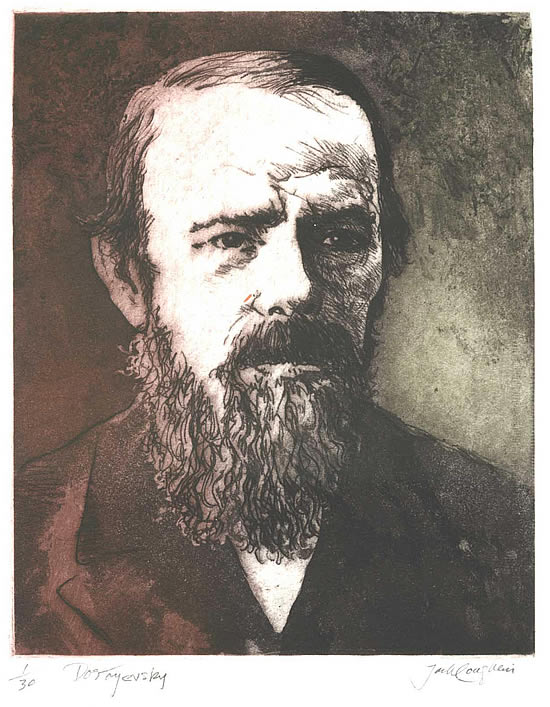
I’m currently reading through The Brothers Karamazov by Fyodor Dostoevsky. Early in the book, there is a scene where the entire Karamzov clan goes to meet with this elder priest to solve some disputes amongst themselves. Of course, being a Russian novel, before they can get to the actual disputes they engage in various forms of political and theological philosophizing for a few chapters. One of the brothers, Ivan, has one of his ideas brought up concerning moral differences between Christians and Non-christians. The elder hears this and immediately identifies it for what it is: an over-intellectualization to help explain away tensions and mysteries existing in Ivan’s heart that he can’t stop wrestling.

As any reader of my writings knows, in the past year or so I have been absolutely taken captive by the truth that Christianity, and therefore the Christian life itself, is fundamentally an exercise in holding tensions and living within mysteries that have no real answer in this life. As Peter Rollins says in the amazing book The Fidelity of Betrayal: “doubt is intimately tied up with faith, because the deep truth of faith gives birth to doubt.” In other words, only the true believer has experienced something in their heart that they can doubt in the first place. Unbelievers don’t doubt, they just don’t believe. But we Christians follow our forefather Jacob whose blessing was to wrestle with God and receive the very name Israel, which means “He wrestles with God”.

Continue reading

Writing in Hope & Angst (a Lament, a Praise)


Okay, now for a personal post. I usually don’t do these, but some encouragement/wisdom from others might help. I don’t know what exactly has been the cause, but the past few weeks have seen my desire to write and effect change rise to a level I’ve previously never known, only to be brought low by information on every side.
If I had to guess, I think my increase in desire and confidence to write has been inflamed by several fronts. First, intellectually, I’ve been experiencing a clarity and creativity of thought concerning books I’ve been wanting to write. Books that have been rolling around in my mind for about a year finally have some shape, structure, and direction. Also, I’ve been feeling more confident in my ability to think and subsequently express those thoughts in writing. This little slavery and atheism series I’ve been doing has been giving me a chance to flex some muscles I didn’t know were there. This has led to lots of affirmation and encouragement from others concerning my writing prospects. This has put writing in the front and center of my mind.

But, anxieties and insecurities ensue, both from within and without . . .

Continue reading

Consider Sponsoring a Child with Compassion


[This is also posted at the Come and See blog]

This is what a friend at another Liberti campus recently sent this out.  She’s been asked by a ministry called Compassion to look for a sponsor for a 9-year old Ethiopian named Dinku Dejene.  His birthday is August 21; he lives with his stepfather, mother, and sibling; and his favorite activities are soccer, running, and hide-and-seek.  (Click here for his full-size Compassion card.)

Meredith writes:

“The goal is to find a person to sponsor him on a committed, monthly basis for $38 per month by December 31. The children Compassion serves receive (among other things): the opportunity to hear the gospel and learn about Jesus; regular Christian training; educational opportunities and help; health care, hygiene training and supplementary food if necessary; a caring and safe Christian environment to grow in self-confidence and social skills; and personal attention, guidance and love.

Continue reading

What an Ex-Seminarian gets for Christmas


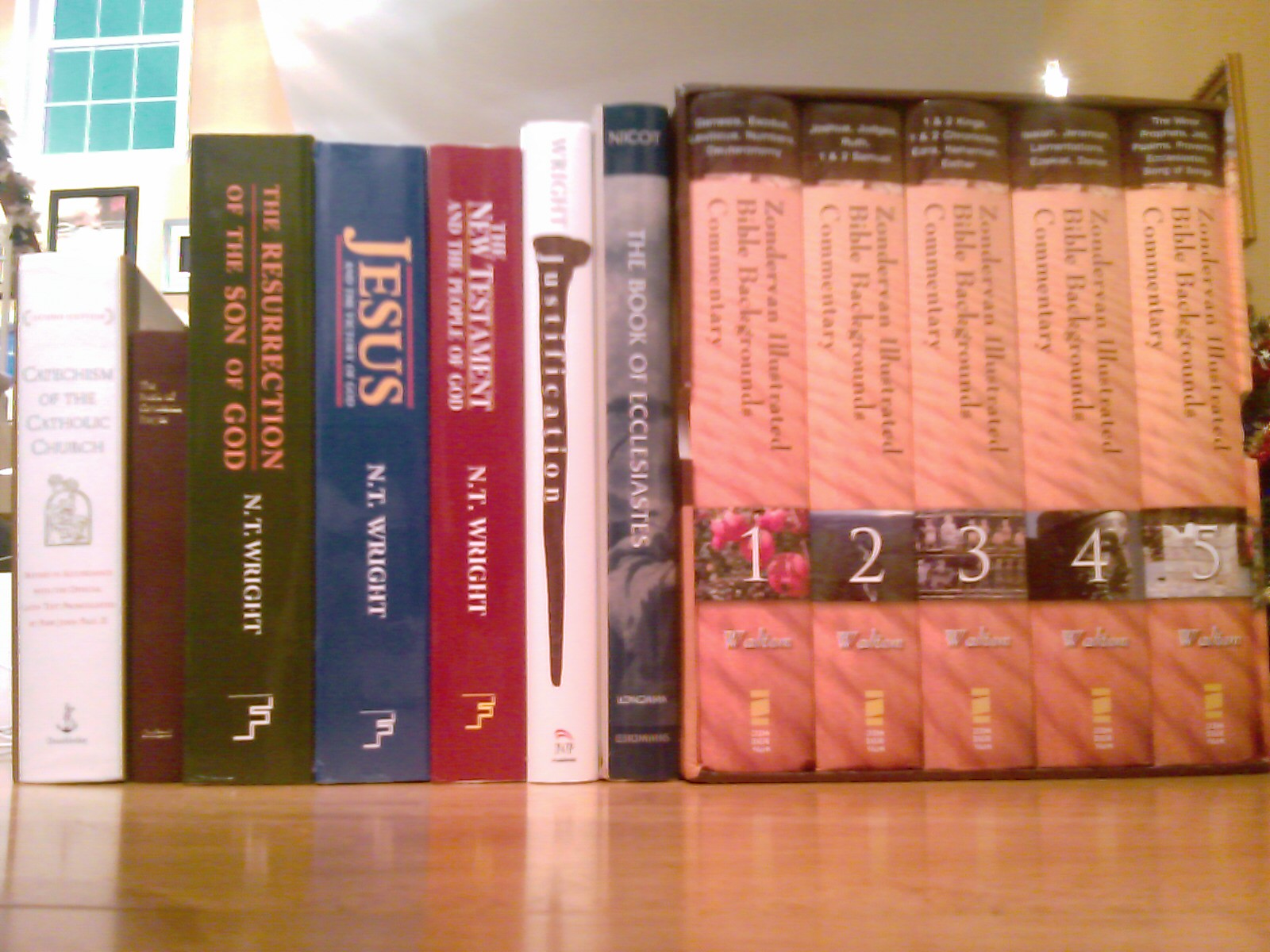
In order from left-to-right:

“O Sovereign, Come” (an original Advent hymn)


On this beautiful White Christmas (at least where I’m at), for those precious few of you that will make it online today, I wanted to put up a hymn I wrote a about a year ago.  I pray this encourages you and creates anticipation for the Advent that is to come. Merry Christmas.

O Sovereign, Come

Our chains behind us, our sin before us
showing all our crippling need.
Your Grace within us, Your Spirit upon us
transforming our every deed.

After our freedom and we pass through the Red Sea,
let us not forget the desert comes.

Refrain:
Rip through the clouds, tear through the skies;
Let us see that you’re God on High.
O Sovereign, Come.  Seize our hearts.
Show yourself as Beautiful.

Your triumph of Glory, You crimson Cross
heralding Your Sovereign Way
of life through our death, enduring our thorns,
completing Your sufferings in ourselves.

Let us embrace your cross that’s set there before us
and know that it precedes the crown.

Refrain

On that day, when freed from sinning,
how I’ll see Thy lovely Face.
Clothed then in blood-washed linen,
how I’ll sing Thy Sovereign Grace.

Refrain

For Advent: A Reform & Revive Repost by David Schrott


In honor of this Advent/Christmas Eve, I decided to repost an article on Reform & Revive written almost exactly a year ago by my good friend (and incredible photographer) David Schrott.  He is an amazing writer (and here) and an even more amazing friend.  This article reflects much on the year that brought the writing into existence with anticipation for the year to come.  Well, having been with him and watching him for that year, it was an amazing moment for me to read this and see all that has been done in his life.

The article has all that Advent is about.  It’s a reflection on the work of God in the past to build your anticipation for the work of God to come.  May this article stir you, sober you, and give you a sense of both the fallenness of the world that is and the glory of the world to come.  Here’s the full link:

http://reformandrevive.com/2009/12/24/there-is-no-one-like-you-adv-days-2324-hellogoodbye-0809-repost/

Also, feel free to check out an article I wrote for Going To Seminary magazine for Advent called “The Beauty of Theology (an Advent Call)”

Lastly, if you’re in town (Philly, that is), my church Liberti: South Philly is doing what should be a beautiful Christmas Eve service tonight (details).

Merry Christmas Eve

The Bible, Slavery, & Atheists{2b}: Theology & Ethics | Reform & Revive


By the time I finished the next article in the series, it was substantive enough and socially-oriented enough to warrant being posted on my webzine Reform & Revive.  The previous post was on on how secular Philosophy can inform our view of ethics and contribute to the discussion of Slavery, Atheism, and the Bible.  This one is about how Christian theological ethics can uniquely inform our ethics in modern times.  The article covers a LOT of ground and is the longest one I’ve written yet in this series.  Hopefully that’s not a turn off.  This article has more of my thought concerning truth and Biblical interpretation than perhaps any one article I’ve ever written contains.  Here’s the link:

http://reformandrevive.com/2009/12/22/a-theology-of-ethics-contemporary-applications/

It seems in light of my earlier post I’ve decided to pour more of myself into this series, rather than just quickly finishing it off.  Hopefully it’s helpful.

Lastly, I keep getting private emails, texts, and messages from Christians talking about how much they’re enjoying this series, and how helpful it is to them, but hardly any Christians are publicly commenting.  I’m getting tons of comments from my atheist friends, though.  Discrepancy?  I think so.  If you have a thought, please leave it.  It could be really helpful to get more input on this and diversity of thought on this.

Thank you all for your support and encouragement.  It means a lot.

The Bible, Slavery, & Atheists{2a}: Philosophy & Ethics


As I’ve looked at and read the various articulations about this issue put forward by my atheist friends, I’ve noticed a few philosophical assumptions about ethics that are driving many people’s perspective on how the Bible does/should talk about these things. In this post, I’d like to highlight those things and show how they are neither philosophically or theologically correct. By the time I finished writing, it was really long, so, using one of the few benefits of blogging as a medium of discourse, I will put up the second part (concerning the more theological side of this) tomorrow or the next day.

The Philosophy of Ethics

Principles vs. Applications

Even the most cursory look shows that the study of ethics is the study of transcendent principles that govern our morality and behavior. There is an important distinction though made between those transcendent principles and their applications. One can hold to the exact same set of principles, but apply them differently at different times/cultures. It is simplistic and reductionistic to think that anyone’s “ethics” will be applied in the exact same way every time. No ethicist secular or otherwise treats ethics in this fashion. I believe that Scripture is consistent throughout in its transcendent principles, though not in their comprehensive applications (below). To navigate applications takes another pair of things the Bible talks at length about: faith and wisdom (more in the next post). Further, I don’t think this principle/application distinction provides any serious ethical challenge to biblical authority. The Bible itself never claims to treat ethics in this reductionistic manner, so to force it upon Scripture is dishonest.

One of my atheist friends mentioned the converts in isolated African tribes where nudity is prevalent, saying that if Christians were consistent, they must insist that they all cover up in order to be Church members in good standing. Except there’s a problem with that: there is no Christian ethic of “non-nudity”. There is a Christian ethic of “modesty” that says that we have the responsibility to adorn God’s beautiful creation of the human body in such a way that it maintains the respect and dignity it deserves. Now, how respect and dignity is shown changes culture to culture, so it takes wisdom to see where the human form is being abused in that culture — and that is not a compromise of Christian ethics. The consistent biblical principle has still been preached, upheld, and lived. If ethics (secular or Christian) were as naively structured as is necessary for some of these atheist criticisms to make sense, then the entire field of ethics would be unnecessary and non existent, because we could have a computer program that could make all the black-and-white moral decisions for us.

Continue reading