Lent begins tomorrow. (Will you just give it a try?)


Jesus & The Cross

I grew up in a church tradition that did not take seriously the Christian Church Calendar. Even as I went to college and moved into communities that took some level of tradition more seriously (which was usually limited to quoting Puritans and Reformers in sermons), the Church Calendar wasn’t that big of a deal. It was seen as something sort-of cool that could be incorporated into the already established life of the Church; a buffet from which leaders could pick and choose some aspects that might be helpful in organizing some sermon series or songs. But it certainly wasn’t seen as something that a church should actually incorporate itself into, or build it’s own rhythm around.

I’ve had the privilege of having this paradigm rocked the past several years at my church, and have fallen in love with the Church calendar. It influences much of the rhythm and timbre of my everyday life–both ecclesial and otherwise. I find such life in living within a stream of thought that was not simply created within the past generation by baptizing modern Western American cultural ideas.

I love finding myself as embedded within the cloud of witnesses that have gone before me as possible–even those I may disagree with passionately and fundamentally. Because, at the end of the day, they are my family, and families have traditions. Sure, you can be “that guy” that does his own thing and doesn’t participate in the family rhythms, but where’s the life in that?

Continue reading

Experiencing God in this Holy Present


flickr-sculpture-worship-kissAt my work, we recently had a training on mindfulness. Now, before you roll your eyes, it was maybe my favorite work training I’ve ever done. It was engaging, practical, and participatory like few trainings are.

Anyway, “mindfulness” is the fancy word used to describe a “non-judgmental awareness of the present”. It’s heightening your senses and calming yourself in order to fully inhabit the present without analyzing it, mulling it, or needing to evaluate it. For those of us with anxiety issues, it really is an amazing way of centering and calming oneself, as well as separating oneself from the internal busyness–at least for a moment.

Another way of putting it is that it is radical present-ness. It is letting this very moment not be merely something you’re passing through as a bridge from the moment that has passed and into the moment that is not yet here. It is to fully inhabit the moment you find yourself in, and let the future come to you rather than anxiously trying to run towards it.

Not gonna lie. It was very spiritual to me. I felt more in tune to God and it got me thinking about how we mystically experience Him in our everyday lives.

When an Atheist talks about this hard-wired human sense to feel the “Numinous”, it often carries with it the sense that it rises from within us. When a lot of Christians talk about meeting the Divine, it often sounds like a presence that comes pointedly at us from outside of us. I’m starting to think that neither of these is right.

Continue reading

Introducing Marginalia: a new part of this blog


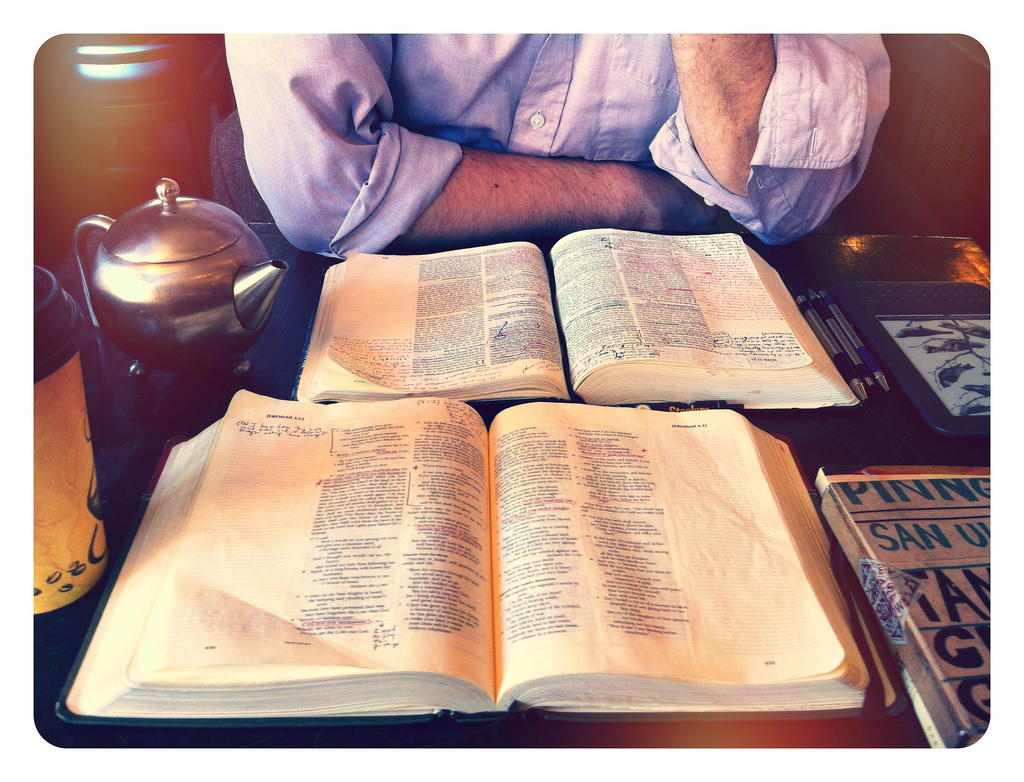
schrott-bibles-paul-coffee

I’ll be honest. It’s been years since I’ve been able to find a way to regularly read the Bible that sticks and works for me. To be frank, readings plans usually don’t work for me because I get bored. Depending on the plan, you’re either stuck in the same book for long stretches of time or you’re jumping around so much that you lose the sense of the whole.
This year, I think I’ve started a regimen that is clicking: the M’Cheyne Bible reading plan. At any given time, I’m going through four completely different part of Scripture and for me, this is keeping me really engaged. As I’ve gone on through the plan these past couple of months, I started highlighting and writing up little notes on random verses here and there. Lots of themAnd I’d like to share them with you.

So today, I’m introducing a new little part of this blog called Marginalia, where I’ll be posting these short little meditations on Scripture as I go through this plan.
Continue reading

Death & Life; Names & Vows | Genesis 3.20-21


The man named his wife Eve, because she was the mother of all living. And the Lord God made garments of skins for the man and for his wife, and clothed them.
Genesis 3.20-21

I don’t know why I’ve never noticed this before. Why does Adam only name Eve after they sin? Further, of all the things to do after receiving the curse from God, he does this covenantal, marital act: he gives her a name.

I know this isn’t in this text, nor was it on the mind of the original writer, but it reminds me of the odd line in Revelation where God promises to give each person a new name that only He and they will know.

It seems that in the whole sweep of redemptive history, the Bride of the first Adam received a new name when he brought death, just as the Bride of the second Adam receives a new name when he brings life.

See other Marginalia here. Read more about the series here.

The Privilege of Church-lessness: a Donald Miller post-script


donaldmiller-bw-2Donald Miller put up another post sort of talking more about his church attendance thoughts, this time talking about how the doctrine of the “priesthood of believers” means he does sacraments on his own and whenever he wants because God has given us all “agency” in this world to do that kind of stuff. He longs that pastors would empower their people to feel free to do these sort of things as well.

I made my thoughts clear last week about how wrong I think he is on this stuff (especially so with the sacraments. He even says he does baptisms for other people even though he himself has never been baptized). I won’t rehash that here. I did want to bring up one thing I noticed in his other posts that was more explicit in this last post. He writes:

To be fair, I’m wired a bit differently. I’m creative and I’m a risk taker. I realize a mistake I often make in my writing is assuming people are wired the way I’m wired. They aren’t. Most people are looking to “do it right” and play by the rules. This saves them from the trouble I often find myself in.

I can’t get past the the feeling here that Miller is saying that “most people” (read: “those that go to church”) at least primarily go to church because they want to “do it right” and “play by the rules”; that not going to church is an act of freedom, while those that still go are bound by something Miller thinks he has freed himself from. It’s not that he necessarily thinks he’s “better” than others, but I fear he makes a dangerous division within the Body of Christ between himself and “most people”.
Continue reading

The Body of Christ, Broken (a guest post for Restoration Living)


family-old-moustache

Yeah, that’s my family (I’m in the front left). This was one Easter Sunday in the 90’s in Dallas, Texas, at a time and place where (I promise) it was absolutely appropriate to dress like that for Easter (except the glasses, of course). I look at this picture a lot, and not just to chuckle. I find it so oddly and powerfully symbolic of what life in the Bible Belt was like.

You see, my family was deeply wounded by “Church folk” throughout my childhood. Just as in the picture, people in the Church would live their Christian lives dressed up and looking good, all while wearing masks, disguising who they really were. When things were hard at home, people at church had no categories to process it. After all, to be a Christian is to be cleansed by Jesus and walk in new life, right? Failures, sins, and brokenness were seen as signs of some disobedience – some place where you weren’t “okay.”

_______________

And so begins a guest post I wrote for a wonderful site that should be on all of your radars, Restoration Living. Read the rest of the post here.

Weekly Must-Reads {2.12.14} | Creation, Masturbation, & Communism


guy-newspaper-reading

Well, it’s been a good long while since I’ve posted a Reading List for you all to enjoy–too long, in fact. These were some of my favorite things I read this week. What were some of yours?

__________

In defense of creationists | The Week
Michael Brendan Dougherty

I referenced this at the end of my post yesterday, but this is a stunningly beautiful piece that wrestles with humanizing those that frustrate us the most in the Christian family. A must-read for sure.

Escaping the Prison of the Self: C.S. Lewis on Masturbation | First Things
Wesley Hill

Don’t overlook this piece too quickly. It is an incredibly powerful piece that speaks to how all of us–married, single, gay, straight–engage our sexuality in this world. It showed me how having celibate unmarried people in the world is necessary for healthy marriages, as well as how masturbation ruins even good friendships.

Continue reading

I think we all need a reminder: Ken Ham is on our team.


ken-ham-banner

Okay, this one is a tough one to write.

Most all of us know by now about the Great Debate that happened a couple of weeks ago between Bill Nye and Ken Ham on whether or not Creationism is a viable model for human origins. If you’ve followed this blog for an real period of time, you know it’s no secret that I do not think it’s a viable model, and I’ve been quite vocal about that in this space.

So I felt the frustration when Ken Ham was treated like the stand-in for every Christian that wants to take the Bible seriously. I felt better when smart Christians responded well. I chuckled at those that poked fun of him and other Creationists, debunked their logic, or discredited the historical stream in which he finds himself. I gave into the private mocking.

I was then really encouraged when I read this report in Christianity Today that shows that Americans are not as divided on this issue as some polls make it seem. I was overjoyed with knowing that more Christians than ever were leaving the Ken Hams of the world in the dust of irrelevance, their budgets and voices shrinking in the distance.

As the discourse went on, I began to thinking to myself: I think we’re winning! But then yesterday, I felt like I woke from a fog and thought: Wait. Who are we fighting?
Continue reading

That elusive Rest of all rests…


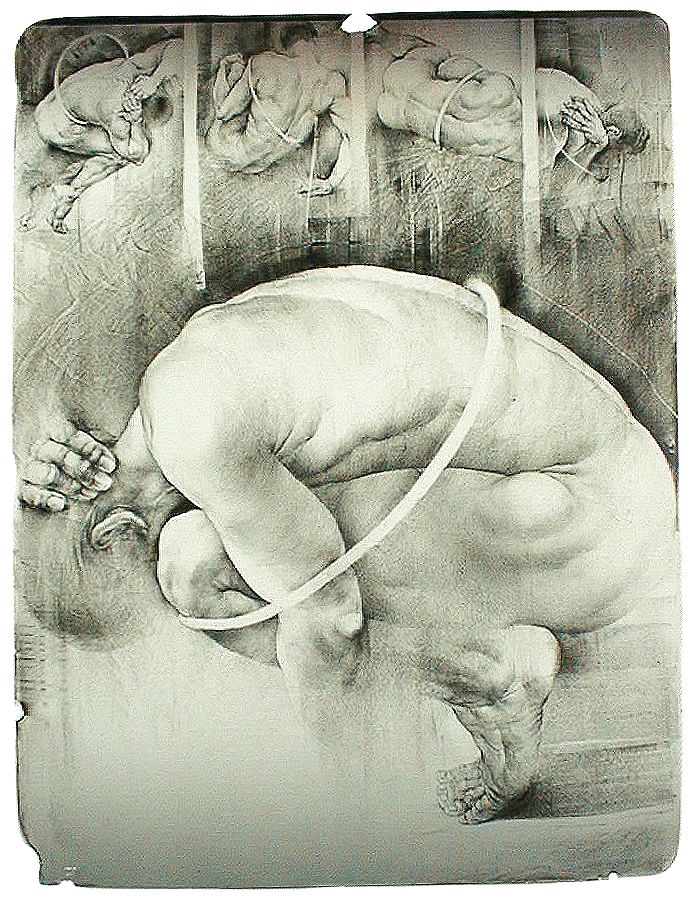
oldrich-kulhanek-untitled2At my job, I have this client (nowadays they’re called “participants”) who’s unlike any other I’ve known. He’s got some sort of complicated cocktail of mental health issues going on. Whatever they are, they’ve come together to create the most agitated, anxious, hyper, manic, rapid-thinking individual I’ve ever seen.

He’s the kind of guy whose own thoughts race a million miles an hour in addition to the other voices in his head doing so as well. He craves attention and simply has to be the center of it at all times; the more people around, the more dramatic and performative he becomes. He acts out like a child in any way to get the attention he craves, all while his inside hums and buzzes with a constant anxiety.

He can easily talk non-stop for hours with random things setting off new associations and new lines of thought and one topic flowing into another topic that seems unrelated, save for a color, a location, or even a word in common with the prior one. The first time I met him, his thoughts became so fast and so loud, he started screaming and clawing at his head just to get them to quiet down.

He evokes little sympathy from those around him, including myself. He seems to thrive on the fact that he can so affect people–even if it’s in a negative, irritating way.

Continue reading

My concern with Obama’s NSA surveillance reforms


obama-flagIn case you haven’t heard, President Obama laid out new reforms on surveillance at the NSA today (more helpful coverage HERE and HERE). These were a direct response to the concerns raised by the leaks of Edward Snowden (can we please we start acknowledging that he has helped us more than hurt us now?).

The reforms are already getting mixed responses among privacy advocates, some praising it as a “major milestone” while other still think it to simply be “reconfigured unconstitutional program”. I am inclined to be mostly happy about these reforms (and this issue has been a big issue for me), but I just have a couple of concerns apart from the reforms themselves I wanted to throw out there. If I’m wrong on any of this, please let me know.
Continue reading

Why my soul is glad to have feminists around me


wwii-woman-we-can-do-it-feminismThis is a post in our on-going series on Women in the Church.

As I wrote last week, I was at my in-person seminary intensive the past two weeks. While there, I met a woman who is about to be ordained a minister in my denomination. We were all sharing our stories and I told her I was raised a Southern Baptist. Having been raised in area where they have little to no foothold, she had only had one experience with a Southern Baptist.

She was working a table at a conference where an older gentleman carrying a large briefcase approached, telling her how excited he was about the next speaker–a “fellow Southern Baptist”. Not being familiar with the speaker’s work, this woman asked the gentleman what the work was on. He put his briefcase on the table, opened it up and pulled out a large tome, saying “this is his book, and it is wonderful.” He almost began to summarize its contents, but stopped short, instead pulling out a much smaller paperback, saying “but that book may be too hard for you to understand. Here, look at this one. It’s much simpler.”

He then realized he had no idea why a woman would be at this conference in the first place. He asked, “and so what do you do?”

She told him that she was at seminary studying for her Masters of Divinity.

This gentleman quietly put the books back in his suitcase, shut it, locked the clasps, looked at her, and solemnly said, “you know you’re going to burn for that, right?” And he walked away.

Continue reading

Welcome to Epiphany. (And a free Mixtape to celebrate!)


epiphany-mixtape-coverIf you’re just looking for the mixtape, click here for the official Epiphany Mixtape page.

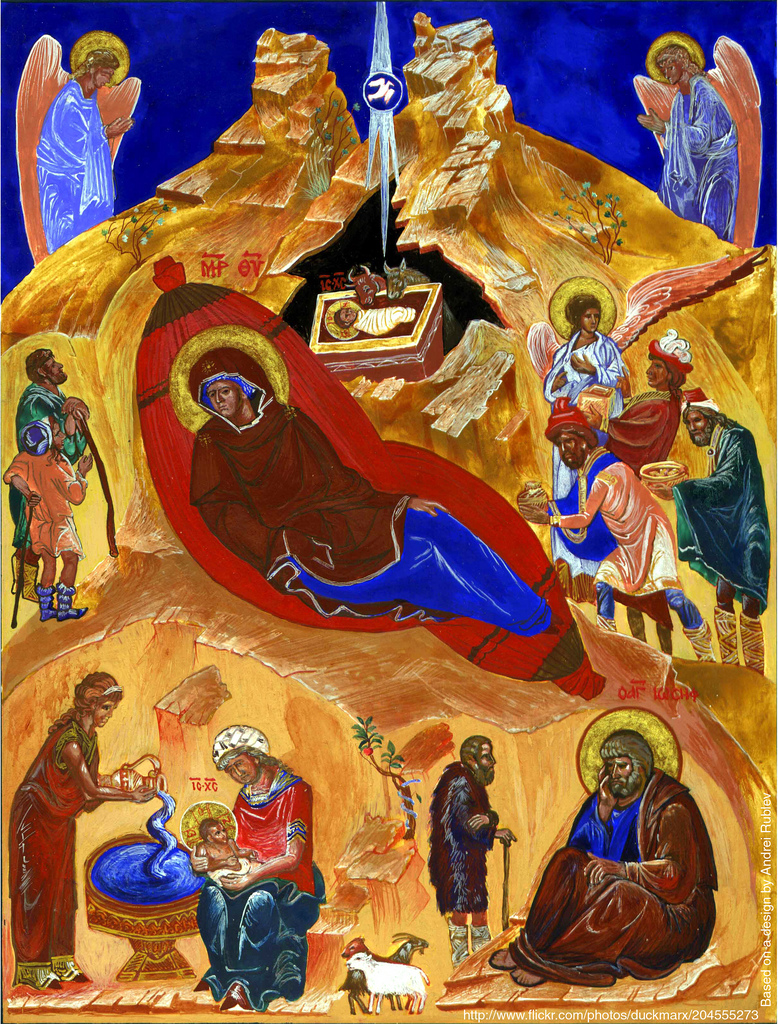
From now until Lent, the Church Calendar is in the season of Epiphany.

Basically, this season seems like it’s sort of a Church Calendar “junk drawer” to meditate and celebrate on all the other parts of Jesus’ life that happened between his Advent/Birth and his Death.

And don’t misread that. In describing it that way, I hope that doesn’t diminish this season for anyone.

Perhaps the most precious doctrine of the Christian faith for me is that of the Imputation of Christ’s Righteousness. That’s a fancy way of saying that Jesus lived out a righteous life, and his very own righteousness is given to me as my own. And so, with a complete and perfect righteousness in hand, I don’t have to bear the weight of shame or condemnation. This is so beautiful to me.

But this Righteousness in which I am dressed was not created out of thin air, nor was it created by Christ at the Cross, or even at his Resurrection. It was built throughout his life of obedience to His Father, as the light of his character and life grew brighter and brighter in the midst of our darkened world. It’s this part of his life that we celebrate and meditate upon in this season.

And this is amazing. As I’ve written before, if Herod had been successful in killing the infant Jesus, there would be an essential aspect of our salvation that’s missing. This is why Epiphany is so important.

And so, to try and help me spend some time meditating on this season, the best way I knew to think deeply about all this was to re-post Epiphany mixtape I first posted last year.

To read more about the specifics of Epiphany, the mixtape, and to listen/download it yourself, you can either read below or just go to the official Epiphany Mixtape page.

[cover image credit: the photo on the mixtape cover is used with the gracious permission of photographer and friend of the blog, David Schrott]

Dispatches from the Snowy Midwest (Seminary Daze)


winternight-bw2For the next week-and-a-half more, I find myself in Holland, Michigan. I’m here for an in-person intensive in my otherwise distance seminary program. It’s two weeks of Hebrew for over 5 hours a day and two other classes in the afternoon and evenings.

I’ve been here since Sunday and it really has been amazing. There was tons of snow here causing travel hiccups for a lot of people, though I came in just before the worst of it. I’m staying with some guys from the program in a house right on Lake Matacawa (see picture above).

I still don’t know how to relate to these sorts of times. Going into it, I expected it to be a time appealing to my introverted self; mainly sitting and staying to myself (and happily so), keeping my nose in books. I wasn’t looking forward to taking this much time off from work, and I wondered why these classes couldn’t continue being online. I didn’t need to know these other people in the program. Why was I being forced to spend time with them in person?

Instead, it’s been hard to get a moment to myself (and–surprisingly–happily so). These guys I’m staying with are all amazing men, and the classes have been learning experiences unlike anything I’ve seen before. I get to have conversations that are so refreshing compared to my previous seminary experiences. Yes, the talks are still all about those things most normal people don’t (and shouldn’t) spend much time in thought over (theories of lapsarianism, the mutability of God, the influence of Western philosophical models on classical theology, etc.).

And yet, these talks have been marked by two big differences from their prior college and seminary iterations. First, few of these talks have stayed there in the ether for their entire duration. Eventually they get to talks about how it affects how we do ministry, serve others, how we communicate these ideas in helpful ways, and how we can peaceably coexist with others that disagree with us on any particular niche issue. It has challenged my pastoral sensibilities and has really connected high theology with the mundane in really beautiful ways.

And that leads to the second thing. In my particular program, there is so much diversity in opinion on even major parts of theology and church life. This school is a denominational school with lots of beliefs about lots of things–and they don’t hide it–they’re anything but wishy-washy on doctrinal issues. And yet, those that are here have such a beautiful sense of what’s essential and not. To see the most theologically conservative members of our group joking around with and living life with those that would be considered some of the most rebellious “liberal” theologians in the Church today truly is a beautiful thing.

So many of our theological conversations have simply been exploring what one another thinks, why they think it, what led them there, and how it affects their lives. It’s not debate or argument. Just sharing and, in a sense, playing in the playground of theology.

And when theology becomes that–not a battle ground with God as our theological General, but a playground with our loving Father watching on, kissing boo-boos, and bandaging scraped knees–theology becomes an exercise in freedom, worship, beauty, and invitation unlike anything the rest of the world has to offer.

Would that all of our brothers and sisters felt the same way.