My Pilgrimage to Israel & Palestine: Day 1


DSC_2033 (2)

A couple of days ago, I kissed Philadelphia goodbye, boarded a plane, and began the nearly 24-hour process of traveling to the Middle East for a two-week long trip to Israel and Palestine. Today was Day 1 (I’m 7 hours ahead, so while I’m about to go to bed, most of my readers are probably getting this in the afternoon).

I’m part of a team of students in my seminary program who are engaging in this Intercultural Immersion trip, where we will be spending time throughout Israel and the Palestinian territories.

Anyway, I’m sitting here at the end of the first day. I’m exhausted physically, as well as emotionally. I had no idea just how disconnected my religious faith has been to the real world. I love historical things and enjoy walking in others’ footsteps and inhabiting their space once more. And yet, for the most important part of me, I have never had any material interaction with the physical, tangible stuff of my faith’s own story.

I realized today that I have learned to live my Christian life in such a way that I have no mental frameworks for how I’m processing this. I took for granted that I could have a thriving, deep, spiritual existence without having seen and walked the lands and places from which the beliefs were born. And yes, we can have such thriving spiritual lives without visiting this land.

But (to overuse a phrase people use all the time when they come back from this region), I feel like the Bible has transitioned from a silent, black-and-white movie, to a full HD Imax one. It’s crazy. I’m still processing it all. It’s surreal, to say the least.
Continue reading

Terror, Rage, Hope & Christmas Lights


Flickr-Advent-Candles-rabasz

This Advent, we’re meditating on the idea of Hope by looking at quotes from Christians and talking about what they might say about our Advent Hope.

“It is precisely because the Christian hopes for the ultimate and definitive, that she also hopes for the temporal and provisional. Precisely because she hopes with joy for the dawn of the great light, that she hopes with provisional joy for the little lights, which may come and go, but which will not come and go in vain.

These little lights act as temporary illuminations that can help the Christian to look and move more properly towards that which they can only point to, but which in their proper time and place can in fact actually represent to us!

Because the Christian hopes for the Last Day, for the eternal year, he hopes for the next day and the new year, from which, whatever they may bring, he can always expect at least new indications of the coming of Jesus Christ.”

–Karl Barth, Church DogmaticsIV.3.2, p.938 (edited for clarity)

Read those words again. Slowly. We need these words, especially this year. As predators of consumerism, terrorism, pseudo-fascism, jingoism, escapism, and liberal idealism lie in wait to consume our souls, we need a light in the darkness. We need something to hold on to.

Continue reading

Advent and… (the series)


advent-nativity-icon

This is the dedicated post page for the Advent series “Advent and…”. In it, we looked at the various ways Advent connects to seemingly unrelated parts of our life and existence.

Welcome to Advent, 2012.
This was the series introduction. I looked at how Advent speaks to our whole selves, including a whole host of “un-Christmas-y” kinds of things.

Advent & Sex: we are holy ground
When you think of Christmas time, you don’t often think about sex. This post talks about the implication of Christ’s arrival for our sex lives.

Advent & Sex-lessness: here’s to singleness & celibacy!
The Advent story is a notably sex-less affair. What this means for us is huge. This was by far the most widely read post of this series, and in the top five most widely read posts in this blog’s history.  Continue reading

How seminary changes your relationship with your church


Caravaggio-Saint-Jerome-header

I’ve got a new post up at Going To Seminary where I talk about how the difficulty of finding one’s voice in the midst of all the heroes you have going into seminary and the new ones you find. We end up doing a lot of mimicking and daydreaming about other people’s spiritual lives and gifts; it’s hard to find our truest selves in the midst of it. Further, I talk at length of the various ways that seminary changes the way that you, as a developing leader, relate to the leaders at your church. It’s also an interesting post to read on this All Soul’s Day. (On a side note, this post has a lot more to do with my experience years ago moving from one state to another for seminary than my current experience at my current church.) Check it out, and let me know what you think! Here’s an excerpt:

For many of us, attending seminary ends up changing our relationship with those people that have shaped and supported us and led us to that moment. For many, they are leaving supportive church families and leaders and doing school elsewhere. I’ve watched many of classmates have to go through a sort of internal “break-up” with their home churches and those pastors with whom they spent so much time. It hurts. They wonder why their pastors “back home” who were so supportive of seminary training won’t return emails. Can’t get together for coffee on school breaks. Won’t talk about possible job opportunities in the future.

Read the full post:
All My Heroes are Dead

Check out the rest of my Going To Seminary posts.

[image credit: “St. Jerome” by Caravaggio]


CashTag

Enjoy the Post? Leave a tip with Square Cash!

Acorns: The only way I’ve been able to save money


Squirrel-Acorn-3

First off, no, this isn’t some “Sponsored Post”. But yes, I am passing off a link that could get me and you $5 for free. (So is this a sponsored blog post then? I don’t know.)

Anyway, this blog is mainly about big things, deep things, human things. Religion, Culture, Politics, Cities, Justice, Beauty, and others. But it’s also about me–a thing neither big nor deep, but still quite human.

And there are few things that expose our humanity more than money. How we relate to the resources under our care shows so much about who we are and the ways we’re wired. For me personally, I’ve had difficulty saving money. Not because I don’t make enough or because I spend too much–I’m just pretty undisciplined and disorganized.

If statistics are any indication (although research differs), for one reason or another, you might have a similar difficulty with saving money.
Continue reading

Seminary for the Whole Person: Practical Theology & Preaching Classes


paul-ultimo-crop
I recently had two more pieces of writing go up at the website Going to Seminary. They both have similar themes about freeing ourselves to engage in seminary with our whole selves. The first about how to make the most of your preaching class. Here’s the intro:

In seminaries, the most hit-or-miss class might be the occasional course on Preaching. I’ve had the unique experience of taking two different preaching courses at two very different seminaries. One course was incredibly dry, unhelpful, and boring. The other was life-giving, challenging, and skill-enhancing. And I’m here to tell you that a good preaching course in seminary can change so much more than how well you do behind a pulpit.

Read the rest: “Don’t Waste Your Preaching Course

The other post is about the most maligned set of courses in most seminaries: Practical Theology. These have the reputation for being the obligatory wishy-washy or touchy-feely classes that all the theologians just want to roll their eyes had. And yet, at my seminaries, I’ve had the opportunity to take Practical Theology courses that ended up being the most important classes I’d take. Here’s a preview:

As I’ve grown older, the sermons that used to feel so “applicable”, “practical”, and resonant now seem to have less and less resemblance to reality or the world around me. They seem to be words offered to imaginary, disembodied people I’ve never met; people that can simply receive the proclamations of God from his ordained authorities and then live lives of passionate obedience and response–those who can simply “hear the Gospel”, “preach it to themselves”, and be changed. That’s a fantasy world. It is not reality.

Read the rest: “Practical Theology: Seminary’s Red-Headed Stepchild

Check out the rest of my Going To Seminary posts.


CashTag

Enjoy the Post? Leave a tip with Square Cash!

Happy 27th Birthday to my little brother Matthew & his attempted beard.


This is a post I put up every once and a while on October 20th, my brother’s birthday. It’s an essay I wrote a years ago during an intense time of doubt and skepticism when I realized just how much a sustaining force he was in my life. I still love him to death. I’m just sorry I can’t be with him and my family this year to celebrate. Oh, and I usually accompany these posts with unflattering pictures. In love. Enjoy! Here’s the piece:

My Brother’s Keeping

NEW POST: Christian (Seminary) Community is Hard & Painful


discipleship-silhouette

I’ve got a new post up at Going To Seminary where I talk about how it’s hard to make and sustain community, even in seminary. I’m writing mainly about my experience at in in-residence seminary program (my experience with distance learning has been quite different, as you can imagine). But, even if you’re not in seminary, the lessons in the piece are entirely applicable to general church life as well. Check it out, and let me know what you think! Here’s the intro:

Seminaries are weird creatures. In the beginning, most everyone is new and has to do the awkward dance of forming relationships while at the same time trying to find a flow for school to survive. It takes a unique person to really be a part of both the academics and communal side of seminary. And let’s face it: no one is holding your hand there; you mostly have to be self-motivated and spiritually self-sustaining, because the usual church structures that motivate, support and counsel just aren’t there at seminary. Even things like prayer groups and chapels are still only as helpful as the attention you put into them.

Read the full post:
Seminary Community is Hard & Hurts

Check out the rest of my Going To Seminary posts.

(On a side note, I’m sorry that the picture above only has men in it. I hate that, but it represents some of the themes of the piece really well.)


CashTag

Enjoy the Post? Leave a tip with Square Cash!

Batman:The Animated Series & Mental Health (Podcast Suggestion)


batman-mask-of-the-phantasm

Here’s a little casual Friday post for y’all.

As a child, my favorite show was Batman: The Animated Series. Likely, if you were born in the 80s, this show was part of your youth. Surprisingly, can you believe it was only on for 3 years?! Only 85 episodes were ever made.

But I loved it, and I watched it over and over again. It was dark and gritty (or as much as it could have been), had compelling stories, and (in hindsight) was full of complex characters.  So complex, in fact, you could actually create an entire podcast psychologically analyzing them!
Continue reading

A Systematic Male Feminist Theology: Table of Contents


IcyAndSot-Freedom

This is the dedicated post page for the Male Feminist Theology Series on this blog.

Male Feminist Theology: a Vision; a Proposal

This series is based on a white paper I wrote. It is more technical than these blog posts are and cites sources without giving introduction or explanation. The blog posts break it up into bite-sized chunks, and are heavily edited to (hopefully) make them more accessible to the casual reader. The full paper is posted below.

Background: Fear & Loathing
The How (and Why) of Christian Male Feminism

This series has been a long time in development and preparation. This was a post that summarizes the whole path leading to thought and process behind it.

God & Her Glory: A Table of Contents

Before we began, I felt I needed to explain why I, at times, would choose to use feminine pronouns for God. This caused such an uproar in my social media sites, it led to several posts in which I went more in-depth about this.

On Theology: Choose Your Own (Feminist) Adventure

This whole series employed a very particular perspective on theology, in which we can freely choose what true things about God to emphasize depending on our context and concern in the moment.

Male Feminist Theology & Sinning Against Women

A reflection on the deep sinfulness towards women I’ve experienced in my own heart, and how the Feminine aspect of the Divine has led to greater life and healing in this.


I. Passion: A Theology of God, Creation, & Humanity
The Suffering & Reconciling Feminist God

This whole Male Feminist Theology begins with laying out a doctrine of God that would motivate us to solidarity and action with women. This opening post lays out a vision in which God’s own nature is Suffering-Unto-Shalom/Goodness/Life

The Dying & Rising Christ

This Suffering-Unto-Life Nature of God extends from the Godhead and is exhibited in each of its Persons. In this piece, we talk about the centrality of Jesus, the Incarnate God, as the center of our theology, and what he can teach us about God.

The Grieving & Comforting Holy Spirit

In this post, we talk about how the Holy Spirit–within Herself–also suffers-unto-life, moving into the brokenness and injustice of the nitty-gritty of the world, to bring healing, life, and wholeness.

THESE BROKEN & GOD-BREATHED SCRIPTURES

Here we articulate a theology of Scripture, and how revelation flows from God the Spirit and not God the Father. We also deconstruct how this acts to liberate women in Christian community.

A Male Feminist Wrestles with the Bible [PART 1] [PART 2]

In these posts, I ask hard questions about how we deal with the patriarchal texts of Scripture. Do we just say the authors were “wrong”, or are we wrong in how we’re reading these texts?

A Groaning & New creation

Coming up next!
Continue reading

Today is my Baptism Birthday. I’m 21!


FOTF81CDuring the summers, when school was out, my mama and I would stay up incredibly late (like, until the sun came up) watching Nic-at-Nite and other TV shows. She would make nachos (using Doritos–don’t knock it til you tried it) and drink a Diet Coke, while I took part in the nightly dance of trying to get some of both for myself.

On one of these extremely late night/mornings, I asked, “Mama, how does someone actually get to heaven?” She answered in the usual Southern Baptist way. I don’t remember all of it, but I do know it ended with describing the act of praying the “Sinner’s Prayer”.

I said, “I want to do that!”

Mama said we could make an appointment to talk to someone at our church so they could make sure I knew what I was doing, and then I could pray that prayer and be baptized.

I ran down the hallways, incredibly excited, and woke up my daddy, only an hour or so from waking up for work. I shook him and said, “Daddy! Daddy! I’m going to get saved!”
Continue reading

NEW POSTS: Apps for Organizing Your Seminary Study


sermon-prep-seminary-books

I have a couple of new posts over at Going To Seminary on helpful apps for reading and studying while you’re going through school.

It won’t take you long upon your arrival at seminary how much things may have changed from previous generations of seminary educations. One of the biggest differences is just how digital everything is. Most seminaries have some sort of online class management system through which you will track grades, assignments, schedules, and get documents and readings necessary for your classwork. Lectures are on PowerPoints that are often shared online. Likely the very first official seminary swag you’ll get is an email address.

Things have changed, for sure. But luckily, we live in a time of unparalleled resources to help you engage all the more deeply in your seminary education; resources that help you focus on what you need to focus on while letting technology do much of the heavy lifting.

Read the rest:

Check out the rest of my Going To Seminary posts.

The Weight of Gratitude: A Sermon of Mine


job-silohetteI’m going on three decades of attending church services. I’ve heard a lot of sermons on gratitude and almost all of them are the same.

They spend much of their time trying to convince us Americans that we actually are far more wealthy than we ever thought. We have more stuff than most any other people in human history, and so we need to stop being so consumeristic and unsatisfied and just learn to be grateful and give thanks for what we have—because we have a lot. And us Christians have even more reason to be thankful, as we have the greatest gift of all: Jesus!

But all this does is lead us towards some brief, unsustainable, inch-deep emotion of happiness which we then call “gratefulness” and then walk out the door thinking we’ve gotten our annual “gratitude shot”—all while being able to ignore the violence raging in the world and in our souls.

So where is gratitude when we face violence and doubt, or when we hit the muck and mire of life, the pits and poverties of existence, the pain and injustice? Does gratitude have nothing to say?

Well that’s what my most recent sermon discusses (I’ve also written about this before). The sermon text is Psalm 40,  Let me know what you think. Here’s the audio:

You can also download it here, or subscribe to our podcast. If reading is more your style, here is my manuscript for your perusal. Continue reading

What is a Sacrament? (Happy Corpus Christi!)


eucharist-bw-wafer

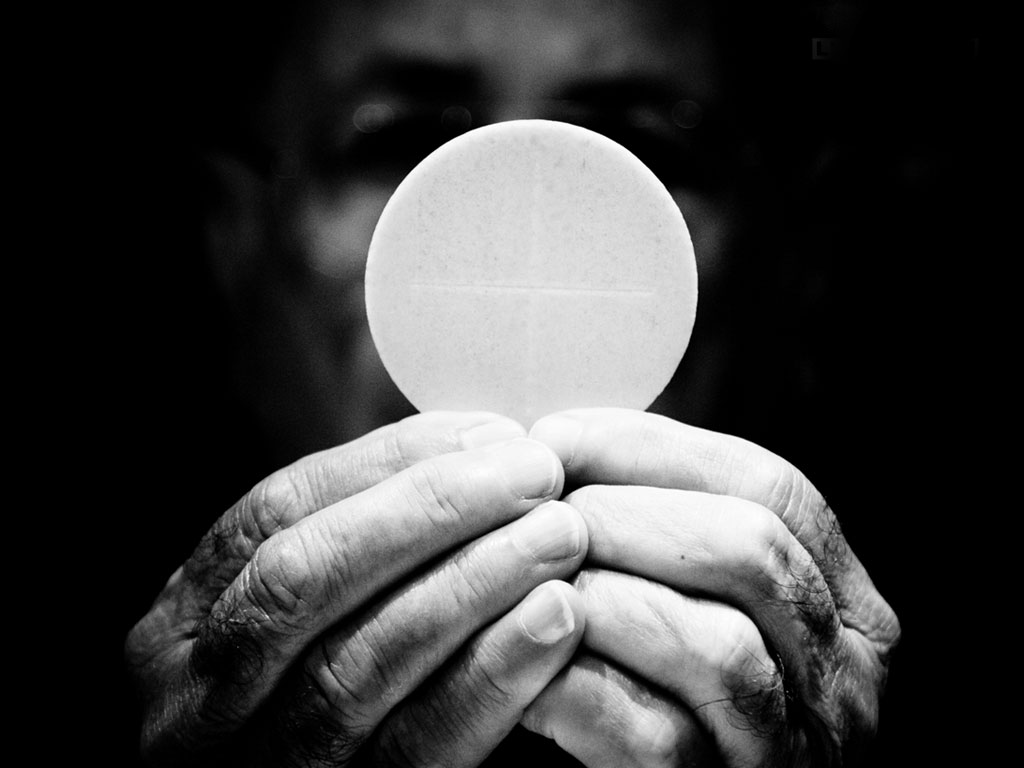
Today is the Church Holy Day called Corpus Christi (Wiki), Latin for “the Body of Christ”, in which the Church takes a few moments to reflect and meditate upon the gift that is the Lord’s Supper (or Eucharist, or Communion). In honor of this, I thought I’d share a recent essay I wrote articulating what I believe is happening in the Sacraments. Let me know what you think!

A sacrament is any material thing that God uses to communicate himself within Creation. Yes, this is quite the broad definition for “sacrament” (little “s”). Every single way that God has ever revealed himself in this world has always been in a mediated sense. God has never been revealed in his full “Godness”. It is always through a material means, and mostly clearly in Jesus Christ.

In this sense, I can accept things like marriage and confirmation as sacraments; but I can also see a good beer, TV show, conversation, or even suffering (like the Cross) as a sacrament. Any material means by which God communicates any part of who he is a sacrament.  It has also been quite freeing for me to see all of life as inherently sacramental.

In this sense, sacramentalism becomes a primary filter through which to understand and describe reality as it is and the nature of the Creator/Creation distinction. This collapses the old unhelpfully-gnostic “transcendence/imminence” dichotomies.
Continue reading

“Selma”: A Post-Christian Treatment of Christianity


Martin_Luther_King,_Jr._and_Lyndon_JohnsonI recently re-watched Selma, the movie about the Civil Rights Marches in Selma, Alabama led by Martin Luther King, Jr. I really, really love this movie. Watching it again, I couldn’t help but notice some powerful dynamics in how faith is represented in the film.

It was directed by Ava Duvernay, who, with this movie, became the first black female director to ever be nominated for an Academy Award. I don’t like artist analysis in approaching a work, as I think a piece of art should stand on its own regardless of its creator. But at times, after the fact, it can illuminate some aspects. And indeed, in looking into Duvernay’s background, I found that she is a very helpful symbol for the spiritual place many in our society find themselves.

She grew up in Compton, in the midst of many of the structural, generational, and long-standing effects of political and economic segregation, disempowerment, and white privilege. She went to an all-girls Catholic high school where, no doubt, she received a very robust religious education.

And yet, now, as she made this film about a man whose legacy is built on acts flowing from his religious convictions, when Rolling Stone asked her, “Are you religious yourself?”, she responded with, “No, not religious. But I love God.”

This, I think, captures well the dynamic of a film like Selma in our day-and-age, when it comes to the relationship between faith and culture. Let me be clear: the film is not in the least hostile to faith. This is not some Christian cultural martyrdom post. The film powerfully depicts the religious tenor and foundation of King’s movement.
Continue reading